How Machine Learning Works
The core idea of Machine Learning (ML) is to enable computers tolearn from data, and infer patterns or regularities from it, without relying on explicitly written rules or code.
In simple terms, the workflow of machine learning is to let machines automatically improve their decision-making and prediction capabilities through historical data.
The workflow of machine learning can be simplified into the following steps:
- Collect data: Prepare data containing features and labels.
- Select a model: Choose an appropriate machine learning algorithm according to the task.
- Train the model: Let the model learn patterns from data and minimize error.
- Evaluate and validate: Evaluate the model's performance using the test set, and optimize it.
- Deploy the model: Apply the trained model to real-world scenarios for prediction.
- Continuous improvement: As new data emerges, the model needs to be regularly updated and optimized.
This process enables computers to automatically learn from experience and make increasingly accurate predictions across various tasks.
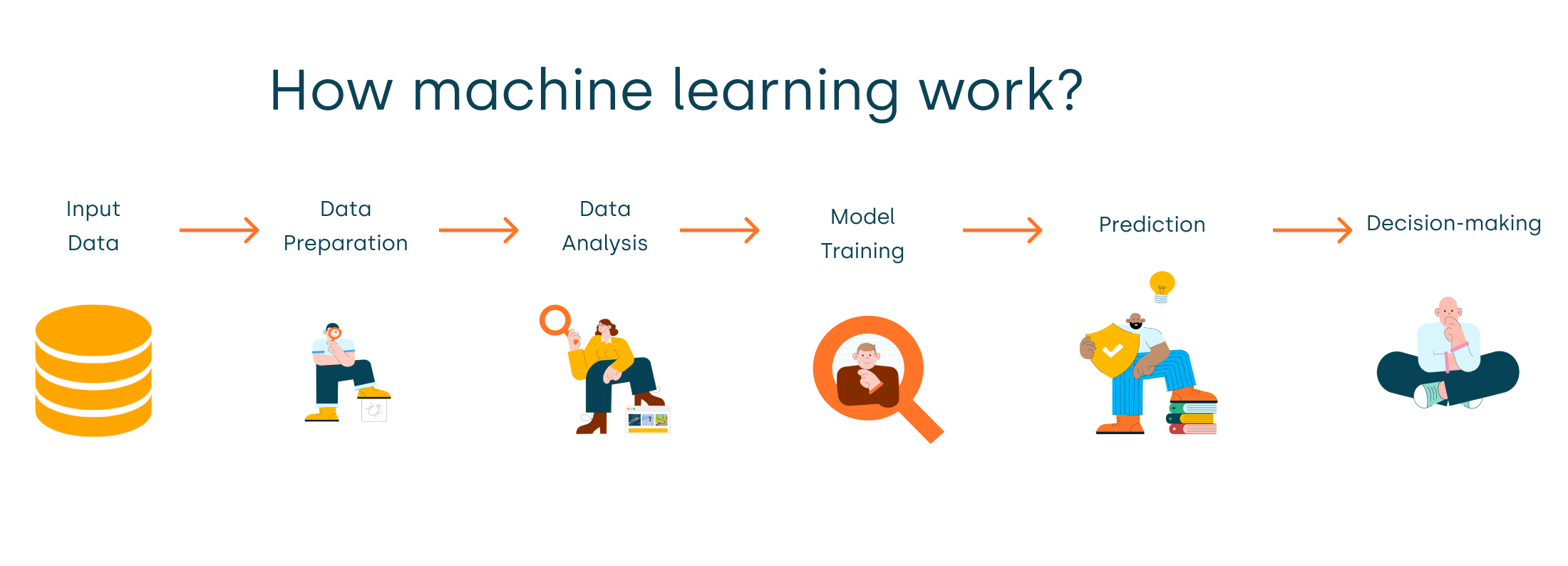
We can understand how machine learning works from the following aspects:
1. Data Input: Data is the Foundation of Learning
The first step in machine learning is data collection. Without data, a machine learning model cannot be trained. Data typically includes "input features" and "labels":
-
Input Features:These are the pieces of information the model uses for prediction or classification. For example, in a house price prediction problem, input features can be the house's area, location, number of bedrooms, etc.
-
Labels:A label is the result we want to predict or classify, usually a number or a category. For example, in a house price prediction problem, the label is the house price.
The goal of a machine learning model is to find the relationship between input features and labels from the data, and make predictions based on these relationships.
2. Model Selection: Choose an Appropriate Learning Algorithm
Machine learning models (also called algorithms) are tools that help computers learn from data and make predictions. Depending on the nature of the data and the task, common machine learning models include:
-
Supervised learning models:Given labeled data, the model makes predictions by learning the relationship between inputs and labels. For example,Linear Regression、Logistic Regression、Support Vector Machine (SVM)andDecision Tree。
-
Unsupervised learning models:Without labeled data, the model learns by exploring the structure or patterns in the data. For example,K-means Clustering、Principal Component Analysis (PCA)。
-
Reinforcement learning models:The model learns optimal behavior through rewards and punishments while interacting with the environment. For example,Q-learning、Deep Reinforcement Learning(Deep Q-Networks, DQN)。
3. Training Process: Let the Model Learn from Data
During the training phase, the model "learns" the relationship between inputs and labels from historical data, typically by minimizing a loss function to optimize the model's parameters. The training process can be summarized in the following steps:
-
Initial state:The model starts with random values. For example, the weights of a neural network are randomly initialized.
-
Compute predictions:For each input, the model makes a prediction. This is done by passing the input data to the model and computing the output.
-
Calculate the error (loss):The error is the difference between the model's predicted output and the actual label. For example, for regression problems, the error can be measured using Mean Squared Error (MSE).
-
Optimize the model:By using optimization algorithms such as backpropagation (in neural networks) or gradient descent, the model's parameters (e.g., neural network weights) are continuously adjusted to minimize the error. This process is calledtraining, until the model can make relatively accurate predictions on the training data.
4. Validation and Evaluation: Test the Model's Performance
After the training process is complete, we need to evaluate the model's performance. To avoid the model overfitting the training data, we split the data intotraining setandtest set, where:
- Training set:The portion of data used to train the model.
- Test set:The portion of data used to evaluate the model's performance, usually not involved in the training process.
Common evaluation metrics include:
- Accuracy:The proportion of correct classifications in a classification problem.
- Mean Squared Error (MSE):The average of the squared differences between predicted values and true values in regression problems.
- Precision and Recall:Used in binary classification problems, especially when classes are imbalanced.
- F1 Score:The harmonic mean of precision and recall, comprehensively considering the classifier's performance.
5. Optimization and Tuning: Improve the Model's Accuracy
If the model's performance on the test set is unsatisfactory, further optimization may be needed. This usually includes:
-
Tuning hyperparameters:For example, learning rate, regularization coefficient, tree depth, etc. These hyperparameters affect the model's learning capability.
-
Model selection and ensemble:Try different models or model ensembles (such as ensemble learning methods like Random Forest, XGBoost, etc.) to improve accuracy.
-
Data augmentation:Expand the training dataset, for example by performing operations like rotation and flipping on images, to help the model improve generalization.
6. Model Deployment and Prediction: Real-World Application
Once the model performs well on training and test data, it can be deployed in real-world applications:
-
Model deployment:Embed the trained model into systems such as applications, websites, servers, etc., for users to use.
-
Real-time prediction:In real-world environments, new data is fed into the model, and the model makes real-time predictions or classifications based on previously learned patterns.
7. Continuous Learning and Model Updating:
Machine learning systems are usually not completed in one go. In real-world applications, as time goes by, new data is constantly generated, so the model needs to be regularly updated and retrained to maintain its predictive ability. This can be achieved throughonline learning、transfer learningand other methods.
Other extensions