Machine Learning Introduction
Machine Learning is a branch of Artificial Intelligence (AI) that enables computer systems to automatically learn and improve their performance using data and algorithms.
Machine learning is an ever-evolving field that is changing the way we interact with technology and providing new tools and methods for solving complex problems.
Machine learning is a technique that allows computers to learn from data and is widely applied across various industries.
Imagine you are teaching a child to recognize different animals. You don't need to explain complex rules like "all cats have two ears, four legs, whiskers..." Instead, you show him many pictures of cats and tell him "this is a cat." Gradually, the child can recognize cats he has never seen before.
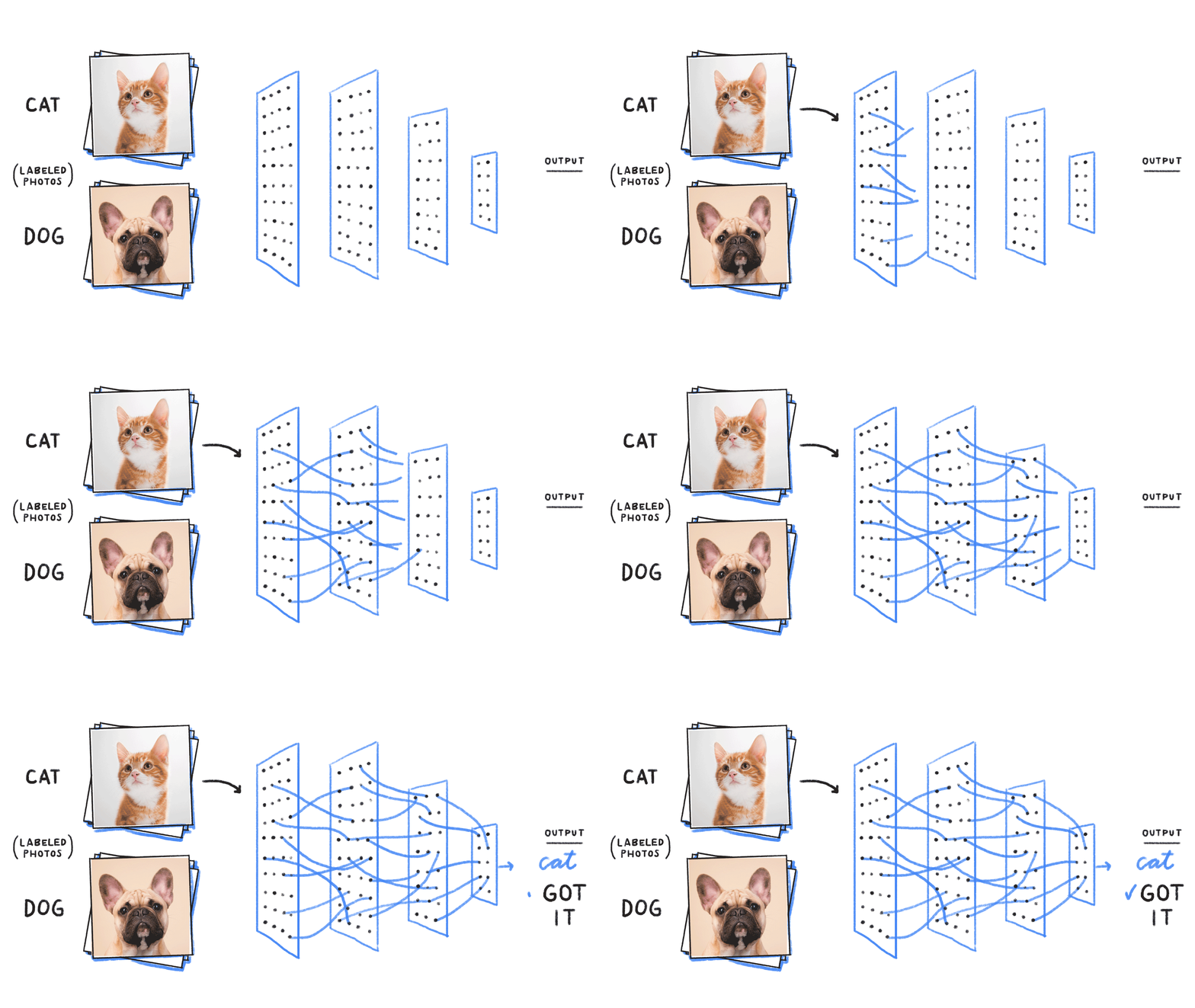
Machine learning is exactly such a method of enabling computers to learn: instead of directly writing complex rules, we let computers automatically discover patterns and regularities from large amounts of data.
How Does Machine Learning Work?
Machine learning makes decisions and predictions by enabling computers to learn patterns and regularities from large amounts of data.
- First, collect and prepare data, then choose an appropriate algorithm to train the model.
- Then, the model continuously optimizes parameters to minimize prediction errors until it can accurately predict new data.
- Finally, the model is deployed into real-world applications, making predictions or decisions in real time, and is updated based on new data.
Machine learning is an iterative process that may require multiple adjustments to model parameters and feature selection to improve model performance.
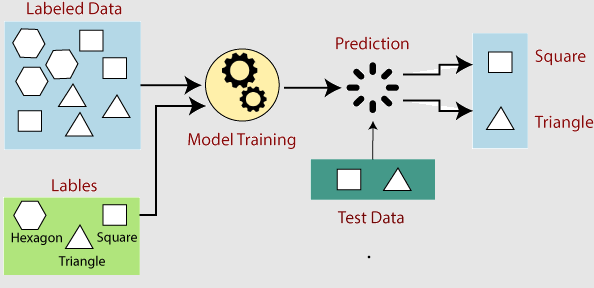
The following diagram illustrates the basic workflow of machine learning:
-
Labeled Data:: The blue area in the figure shows labeled data, which includes different geometric shapes (such as hexagons, squares, triangles).
-
Model Training:: In this stage, the machine learning algorithm analyzes the features of the data and learns how to predict labels based on these features.
-
Test Data:: The dark green area in the figure shows test data, including a square and a triangle.
-
Prediction:: The model uses rules learned from the training data to predict the labels of the test data. In the figure, the model predicts the square and triangle in the test data.
-
Evaluation:: The prediction results are compared with the true labels of the test data to evaluate the model's accuracy.
The machine learning workflow can be roughly divided into the following steps:
1. Data Collection
- Collect data: This is the first step of a machine learning project, involving the collection of relevant data. Data can come from databases, files, the web, or real-time data streams.
- Data types: They can be structured data (such as tabular data) or unstructured data (such as text, images, videos).
2. Data Preprocessing
- Clean data: Handle missing values, outliers, errors, and duplicate data.
- Feature engineering: Select the most relevant features that help the model learn, which may include creating new features or transforming existing ones.
- Data standardization/normalization: Adjust the scale of data to bring it within the same range, which benefits the performance of certain algorithms.
3. Model Selection
- Determine the problem type: Choose an appropriate machine learning model based on the nature of the problem (classification, regression, clustering, etc.).
- Select an algorithm: Based on the problem type and data characteristics, select one or more algorithms for experimentation.
4. Model Training
- Split the dataset: Divide the data into training, validation, and test sets.
- Training: Use the data in the training set to train the model, adjusting model parameters to minimize the loss function.
- Validation: Use the validation set to adjust model parameters and prevent overfitting.
5. Model Evaluation
- Performance metrics: Use the test set to evaluate the model's performance. Common metrics include accuracy, recall, F1 score, etc.
- Cross-validation: A technique for evaluating a model's generalization ability by dividing the data into multiple subsets for training and validation.
6. Model Optimization
- Adjust hyperparameters: Hyperparameters are parameters set before the learning process, such as learning rate, tree depth, etc. They can be tuned using methods like grid search, random search, or Bayesian optimization.
- Feature selection: It may be necessary to re-evaluate and select features to improve model performance.
7. Model Deployment
- Integrate into applications: Integrate the trained model into real-world applications, such as websites, mobile apps, or software.
- Monitoring and maintenance: Continuously monitor the model's performance and update the model based on new data.
8. Feedback Loop
- Continuous learning: Machine learning models can be designed to automatically learn from new data over time to adapt to changes.
Technical Details
- Loss function: A function that measures the difference between model predictions and actual results. The goal of model training is to minimize this function.
- Optimization algorithm: Such as gradient descent, used to find parameter values that minimize the loss function.
- Regularization: A technique that prevents model overfitting by adding penalty terms.
The machine learning workflow is iterative and may require multiple adjustments and optimizations to achieve the best performance. In addition, with the accumulation of data and the development of algorithms, machine learning models can become more accurate and efficient.
Types of Machine Learning
Machine learning is mainly divided into the following three types:
1. Supervised Learning
- Definition:Supervised learning refers to training with labeled data, where the model learns the relationship between input data and labels to make predictions or classifications.
- Applications:Classification (e.g., spam detection), regression (e.g., house price prediction).
- Examples:Linear regression, decision trees, support vector machines (SVM).
2. Unsupervised Learning
- Definition:Unsupervised learning uses unlabeled data, and the model attempts to discover underlying structures or patterns in the data.
- Applications:Clustering (e.g., customer segmentation), dimensionality reduction (e.g., data visualization).
- Examples:K-means clustering, principal component analysis (PCA).
3. Reinforcement Learning
- Definition:Reinforcement learning involves interacting with the environment, where an agent learns the optimal strategy through trial and error to maximize long-term rewards. After each action, the system receives a reward or penalty to guide behavioral improvement.
- Applications:Game AI (e.g., AlphaGo), autonomous driving, robot control.
- Examples:Q-learning, deep Q-network (DQN).
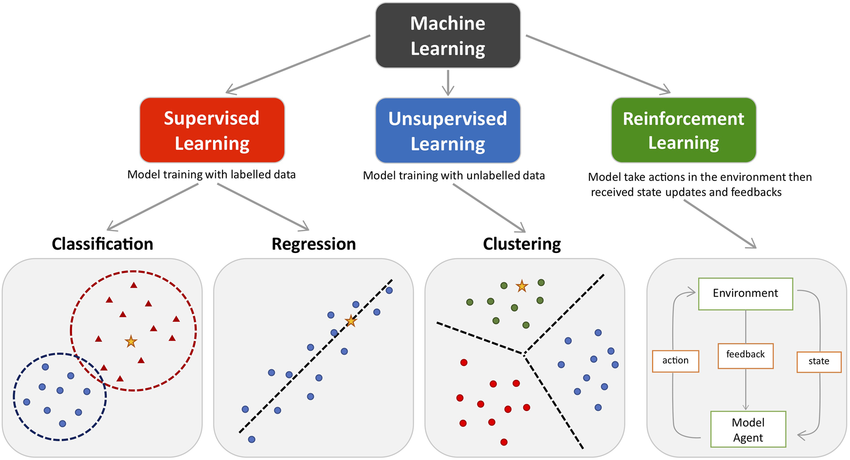
These three types of machine learning each have their own application scenarios and advantages. Supervised learning is suitable for data with clear labels, unsupervised learning is suitable for exploring the underlying structure of data, and reinforcement learning is suitable for scenarios where the optimal strategy needs to be learned through trial and error.
Application Areas of Machine Learning
Recommendation systems:For example, Douyin recommends videos you might be interested in, Taobao recommends products you might purchase, and NetEase Cloud Music recommends music you like.
Natural language processing (NLP):Machine learning applications in speech recognition, machine translation, sentiment analysis, chatbots, and more. For example, Google Translate, Siri, and intelligent customer service.
Computer vision:Machine learning is widely used in image recognition, object detection, facial recognition, autonomous driving, and other fields. For example, self-driving cars use cameras and sensors to identify surrounding obstacles, pedestrians, and other vehicles.
Financial analysis:Machine learning has important applications in finance, such as stock market prediction, credit scoring, and fraud detection. For example, banks use machine learning to detect fraudulent credit card transactions.
Healthcare:Machine learning helps doctors diagnose diseases, discover drug side effects, predict disease progression, and more. For example, IBM's Watson system helps doctors analyze patient medical record data and provides diagnostic and treatment recommendations.
Gaming and entertainment:Machine learning is not only used for intelligent opponents in games, but also applied in game design, dynamic difficulty adjustment, and other areas. For example, AlphaGo used deep learning techniques to defeat the Go world champion.
The Future of Machine Learning
With the explosive growth of data volume and the improvement of computing power, the applications of machine learning will continue to expand, bringing more intelligent and efficient systems. For example:
Reinforcement Learning:It enables computers to solve complex problems through trial and error without explicit guidance. For example, AlphaGo and Dota 2 game AI both use reinforcement learning.
Self-supervised Learning:Current machine learning models usually require a large amount of labeled data for training, while self-supervised learning can learn more effective representations from unlabeled data.
Deep Learning:Deep learning is a branch of machine learning that focuses on the application of neural networks. It has made breakthrough progress in image recognition, natural language processing, and other fields. In the future, deep learning will continue to drive the development of artificial intelligence.
Through machine learning, we can create smarter systems, automate tedious tasks, and improve various aspects of our daily lives. With the development of technology, machine learning will become one of the core driving forces in various industries in the future.
Other Extensions