Skills Tutorial
Skills, translated literally, meansskill, used to add professional skills and knowledge to AI agents.
Just like humans, you can cook, drive, and write PPTs—these are all your skills.
Agents are the same; they also need skills to help you get things done.
Skills are the skills of an agent. The large model is responsible for thinking and speaking, while Skills are responsible for doing.
The core difference between ordinary AI and AI agents: agents are not justthinkers, but alsodoers。
Why Do You Need Agent Skills
Although AI agents possess powerful general capabilities, they often lack the necessary context and professional knowledge when handling tasks in specific domains.
For example, an AI agent may not know what coding standards your company uses, may not understand how to use a specific API, or may not be clear about the specific steps of a business process.
The core idea of Skills is:Encapsulate human professional knowledge into skill packages, allowing AI agents to automatically load and use them when needed.
What Can Agent Skills Bring
| Capability | Description |
|---|---|
| Domain-specific professional knowledge | Encapsulate domain-specific knowledge (such as legal review processes, data analysis pipelines) into reusable instructions and resources |
| Repeatable workflows | Turn multi-step tasks into consistent, auditable standard processes |
| Cross-product reuse | Write a Skill once, and use it in any tool that supports the Agent Skills format |
Common Problems Without Skills
Without Skills, an Agent may repeatedly ask the same clarifying questions, miss team-specific naming conventions, or forget important edge cases.
With Skills, this experience can be written directly into files, and the Agent will follow them every time.
The Relationship Between Agents and Skills
An AI agent is an AI system that can perceive, reason, and act. It doesn't just chat; it can also execute tasks.
Skills are instruction manuals (Markdown files) that tell agents how to complete a certain type of task. The value of Skills lies in making task execution accurate, stable, and reusable.
智能体的大模型 = 大脑(负责理解、决策、说话)
Skills = 手和脚(负责动手干活)
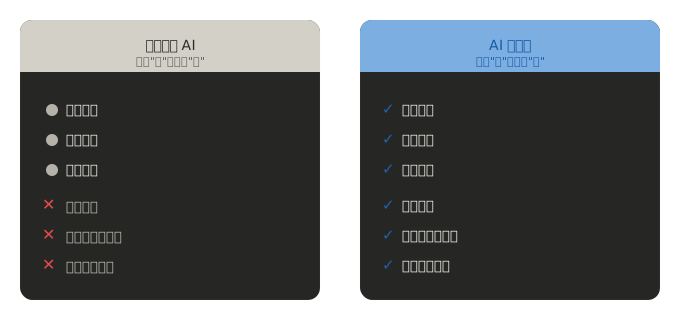
Imagine that when you first join a company, you have two completely different AI assistants:
Assistant A (ordinary conversational AI):
- One question, one answer; passive response.
- If you ask "How do I write a quarterly report?", it will only give you a generic template.
- It can't open spreadsheets, can't independently query data, and certainly can't organize files or handle sending.
- In essence, it's just a talking online encyclopedia—it only gives answers, it doesn't execute.
Assistant B (AI Agent)
- Direct command, fully automated closed-loop execution.
- You only need one sentence: "Organize this quarter's sales data, generate a report, and send it to General Manager Zhang."
- It can then autonomously complete the entire process: retrieve files, read raw data, automatically generate charts, write a complete report, and send the email with one click.
- No manual operation is needed throughout the entire process; just sit back and wait for the result.
Three Core Capabilities of Agents
| Capability | Description | Example |
|---|---|---|
| Perception | Receive input, understand context | Read the files you upload, understand your needs |
| Reasoning | Make a plan, decide what to do | Determine "read the file first, then generate the report, and finally send the email" |
| Action | Call tools, execute steps | Actually open the file, write content, and send it out |
Why Are Skills Needed? What Problems Do They Solve?
Ordinary AI agents (such as Claude or DeepSeek) are very smart, but they are prone to errors when lacking specific context. For example:
- The team has its own coding standards, but the AI needs to be manually reminded every time.
- For complex processes such as handling PDF forms or debugging GitHub Actions, the AI may not know the best practices.
Agent Skills solves these problems:
- Automatic triggering: The AI automatically loads relevant skills based on the task, with no need to manually enter long prompts.
- Reusable & Shareable: Created once, used by the entire team or community, with Git version control support.
- Efficient context utilization: Uses progressive disclosure, loading only the needed parts to avoid context window overflow.
- Cross-platform: The same Skill can be used in tools such as Claude, VS Code Copilot, and Cursor.