Data Leakage
In the practice of machine learning, we often encounter a confusing phenomenon: the model performs excellently on the training set and validation set, with all metrics close to perfect, but once deployed to a real production environment, its performance drops off a cliff and becomes almost unusable. Behind this huge gap, one of the most common and dangerous invisible killers isData Leakage。
Data leakage is a major cause of machine learning project failures. It undermines the fairness of model evaluation, leading us to make blindly optimistic misjudgments about model performance. Understanding, identifying, and preventing data leakage is a core engineering skill that every machine learning engineer and data scientist must master.
This article will guide you to systematically understand data leakage, comprehend its mechanisms, learn diagnostic methods, and master a set of effective prevention strategies.
What is Data Leakage?
Core Definition
Data Leakage, refers to, during the model training process,improperly using information that is unavailable in real prediction scenarios, causing the model to learn "future information" or "global information" it should not know, thereby producing overly optimistic but actually invalid performance during evaluation.
Simply put, it's like the model secretly peeked at the "answers" before the "exam." This allows it to score high on mock exams (validation set), but fail miserably in the real exam where there are no answers (production environment).
A Vivid Metaphor
Imagine you are teaching a student to recognize pictures of animals.
- The correct approach: You show him some pictures of cats and dogs (training set), tell him which are cats and which are dogs. Then, you take out some new pictures he has never seen (test set) and ask him to identify them.
- The data leakage approach: While showing him training images, you accidentally mix in some images from the test set and tell him the answers. As a result, when the student faces truly "new" images, he has actually seen and memorized the answers long ago. He seems to have learned well, but in reality he hasn't learned the general ability to "identify animals based on features"; he has only memorized the answers for specific images.
Common Types and Scenarios of Data Leakage
Data leakage is not always obvious; it often hides in the details of the data processing pipeline. It can mainly be divided into the following two categories:
1. Data Leakage in Features
This is the most common type, where the features used for training contain direct or indirect information about the target variable.
Scenario 1: Use of Future Information
This is a typical trap in time series forecasting.
- Incorrect example: Predicting the price of a stock tomorrow, but using tomorrow's news sentiment index or tomorrow's trading volume as features. In real prediction, you absolutely cannot know this information about tomorrow in advance.
- Correct approach: Any feature must behistorical information known at the time of prediction. For example, you can only use historical prices, news, etc. up to today's close to predict tomorrow.
Scenario 2: Shadow of the Target Variable
Features have a reversed causality or high correlation with the target variable.
- Incorrect example: In a medical diagnosis model, use a feature "whether the patient has taken special drug A" to predict whether the patient has disease X. But in reality, only patients diagnosed with disease X are prescribed special drug A. This feature almost directly reveals the answer.
- Incorrect example: In a model predicting whether a user will churn, the number of times the customer recently contacted support is added as a feature. If contacting support is a remedial measure before user churn, then this feature contains information about imminent churn.
Scenario 3: Improper Data Preprocessing
InBefore splitting the training set and test setglobal data preprocessing operations were performed.
- Incorrect operation: First normalize the entire dataset (subtract the global mean, divide by the global standard deviation), and then split it into training set and test set.
- The problem: The test set data participates in the calculation of the global mean and standard deviation, which means that when training the model, you have already "peeked" at the distribution information of the test set.
- Correct approach:Split first, then preprocess. Calculate the normalization parameters (mean, standard deviation) using the training set data, then use these parameters to transform the training set and test set.
Example
from sklearn.preprocessing import StandardScaler
scaler = StandardScaler()
# Error: Fitting on the entire data before splitting
X_scaled = scaler.fit_transform(X_all)
X_train, X_test, y_train, y_test = train_test_split(X_scaled, y_all, test_size=0.2)
# ----------------------------------------------------------------------
# Correct approach: Split first, then process separately
from sklearn.model_selection import train_test_split
from sklearn.preprocessing import StandardScaler
# 1. First split the data
X_train, X_test, y_train, y_test = train_test_split(X, y, test_size=0.2, random_state=42)
# 2. Fit the preprocessor only on the training set
scaler = StandardScaler()
X_train_scaled = scaler.fit_transform(X_train) # Calculate mean and standard deviation only using training data
# 3. Use the parameters obtained from the training set to transform the test set
X_test_scaled = scaler.transform(X_test) # Note: here it is transform, not fit_transform!
2. Data Leakage in the Evaluation Process
This kind of leakage occurs in the design of the model training and evaluation process, causing the model to indirectly come into contact with test data during evaluation.
Scenario 1: Incorrect Cross-Validation
Using standard random K-fold cross-validation on time series data.
Problem: Randomly shuffling the data can cause "using future data to train a model to predict the past," seriously violating the principle of chronological order.
Correct approach: Usetime series cross-validation, ensuring that the training set always precedes the validation set in time.
from sklearn.model_selection import TimeSeriesSplit
tscv = TimeSeriesSplit(n_splits=5)
for train_index, test_index in tscv.split(X):
    X_train, X_test = X[train_index], X[test_index]
    y_train, y_test = y[train_index], y[test_index]
    # ... 训练和评估
Scenario 2: Feature Selection or Hyperparameter Tuning Based on All Data
This is an extremely common and hidden trap.
Incorrect process:
- Use all data to perform feature selection and pick out the best feature subset.
- Use all data to perform hyperparameter grid search and find the optimal parameters.
- Apply the above "optimal" features and parameters to the model, and then use train_test_split again to evaluate performance.
The problem: The process of feature selection and tuning has already seen all the data (including the future test set), and the selected "optimal" features and parameters are the result of overfitting to the entire dataset, which cannot represent its generalization ability on new data.
Correct approach: Incorporate steps such as feature selection and hyperparameter tuningas part of model training, and encapsulate them inside the cross-validation loop. UsePipelineandGridSearchCVto automate this process well.
Example
from sklearn.pipeline import Pipeline
from sklearn.feature_selection import SelectKBest
from sklearn.model_selection import GridSearchCV
from sklearn.ensemble import RandomForestClassifier
# Create pipeline: feature selection first, then modeling
pipe = Pipeline([
('selector', SelectKBest()), # Feature selector
('classifier', RandomForestClassifier()) # Classifier
])
# Define parameter grid
param_grid = {
'selector__k': [5, 10, 20], # Select a few features
'classifier__n_estimators': [50, 100]
}
# Use GridSearchCV for cross-validation tuning
# The cv parameter ensures that in each fold of cross-validation, feature selection and tuning are only performed on the training fold
grid_search = GridSearchCV(pipe, param_grid, cv=5, scoring='accuracy')
grid_search.fit(X_train, y_train) # Only done on the training set!
print("Best parameters:", grid_search.best_params_)
print("Best cross-validation score:", grid_search.best_score_)
# Finally evaluate on the independent test set
final_score = grid_search.score(X_test, y_test)
print("Independent test set score:", final_score)
How to Diagnose Data Leakage?
- Performance gap warning: The model's performance on the training/validation set (e.g., accuracy, AUC) is far higher than its performance in real business scenarios or on a strictly isolated test set; this is the most obvious red flag.
- Feature importance analysis: Examine the features the model considers most important. If you find a feature with abnormally high importance, and from a business logic perspective it should not have such strong predictive power (e.g., an ID field, or a field containing target information), leakage is very likely.
- Check the correlation between features and the target: Calculate the correlation between all features and the target variable. If a feature has extremely high correlation with the target in the training set, but it doesn't make sense from a business logic standpoint, be highly vigilant.
- Conduct an "availability test": Before deployment, simulate a completely sealed test: train with data from a historical point in time, predict data for a subsequent period, and compare with real results. This is the most effective way to detect time series leakage.
- Code review and process retrospective: Carefully review the entire code flow of data preprocessing, feature engineering, model training, and evaluation to ensure there is no "contaminate first, split later" operation.
Best Practices for Preventing Data Leakage
By following the following principles and processes, you can avoid data leakage to the greatest extent:
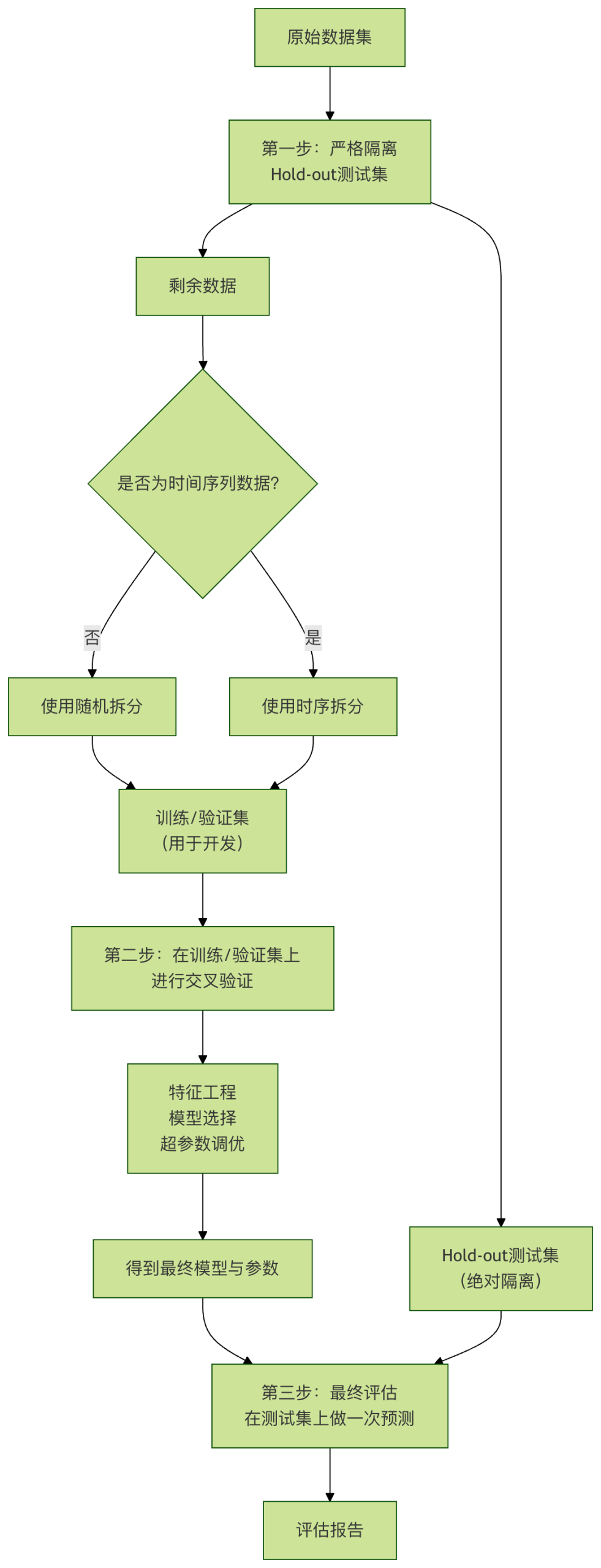
- Establish a strict data isolation mindset: At the beginning of the project, immediately, randomly (or by time), set aside a portion of the data as thefinal test set, and lock it away, never using it throughout the entire model development cycle. It is only used for the final step of model evaluation.
- Follow the iron rule of "split first, then process": Any operation that learns parameters from data (normalization, filling missing values, encoding, etc.) must only be performed on the training set, and then the learned parameters are applied to the validation and test sets.
- Use Pipeline: Scikit-learn's
Pipelinetools can forcibly bundle preprocessing steps and model training steps together, ensuring that preprocessing steps are correctly re-executed during cross-validation. They are a powerful weapon against preprocessing leakage. - Maintain reverence for time series: When handling time data, always assume "the future is unknowable." Use time-series cross-validation, and ensure all features are lagged features.
- Deeply understand business logic: Communicate with domain experts to understand the true meaning and generation time of each feature. Be wary of features that have a reversed causal relationship with the outcome or contain after-the-fact information.
- Maintain a skeptical attitude: If a model performs unrealistically well (e.g., 99.9% accuracy), your first reaction should be "Is this data leakage?" rather than celebrating success.
Summary
Data leakage is a key challenge on the path to machine learning engineering. It is not just a technical bug, but a manifestation of a systemic thinking flaw. To combat data leakage, we need to:
- Cognitively: Stay vigilant at all times, understanding that its essence is the improper use of information.
- In process: Establish and adhere to strict data processing and model evaluation standards.
- In tools: Make good use of
Pipeline, correct cross-validation methods, and other tools to build a firewall.