The Real Cost of Models
Imagine you have just trained an image recognition model that achieves 99% accuracy on the test set, and you confidently deploy it to a factory production line.
However, a few weeks later you receive feedback: the model frequently misjudges, causing the production line to shut down multiple times without reason, resulting in huge economic losses. Where is the problem?
This scenario reveals a truth often overlooked in the field of machine learning:A model's excellent performance in a laboratory or test environment does not equal its success in the real world.
In the journey of a model from development to deployment, there are many limitations and hidden costs.
This article will take you deep into these real costs and help you build a more comprehensive and pragmatic perspective on machine learning.
Beyond Accuracy - Understanding the Total Cost of Models
When we talk about the cost of a model, most people first think of the GPU time and electricity consumed during training. But this is just the tip of the iceberg.
The cost of a complete machine learning project includes at least the following four dimensions:
1. Data Cost: Acquisition and Purification of Fuel
Machine learning models use data as "fuel," and the cost of obtaining high-quality fuel is extremely high.
Data collection cost:
- Monetary cost: Expenses for purchasing annotated datasets and using data collection services (such as the crowdsourcing platform MTurk).
- Time cost: From defining annotation specifications and training annotators to completing the initial annotation, the cycle can last weeks or even months.
- Compliance cost: Ensuring data collection complies with laws and regulations such as GDPR (General Data Protection Regulation) and CCPA (California Consumer Privacy Act) may require legal consultation and process design.
Data preprocessing and annotation cost:
- Cleaning cost: Real-world data is full of noise, missing values, and outliers. Cleaning typically takes 60-80% of the time of the entire project.
- Annotation cost: Taking image bounding box annotation as an example, annotating a single complex image may take several minutes. For a dataset of one hundred thousand images, the annotation labor and management costs are considerable.
Example
def estimate_labeling_cost(num_images, time_per_image, cost_per_hour):
"""
Estimate the total cost of data annotation
Parameters:
num_images (int): Total number of images to annotate
time_per_image (float): Average time to annotate a single image (hours)
cost_per_hour (float): Hourly cost of an annotator (currency unit)
Returns:
total_hours, total_cost: Total hours and total cost
"""
total_hours = num_images * time_per_image
total_cost = total_hours * cost_per_hour
return total_hours, total_cost
# Assume a project has 100,000 images, each takes 0.05 hours (3 minutes) to annotate, and the hourly cost is 20 yuan
hours, cost = estimate_labeling_cost(100000, 0.05, 20)
print(f"Total hours: {hours:.0f} hours")
print(f"Total cost: {cost:.2f} yuan")
# Output: Total hours: 5000 hours
# Output: Total cost: 100000.00 yuan
2. Computational Cost: The Energy Bill for Training and Inference
Computational cost is divided into one-time training cost and ongoing inference cost.
Training cost:
- Use hourly billed GPU instances from cloud services (such as AWS SageMaker, Google Cloud AI Platform).
- The process of model tuning (hyperparameter optimization) may require training dozens to hundreds of model replicas, multiplying the cost.
Inference cost:
- After the model is deployed, every time it processes a user request (i.e., makes a prediction), computational cost is incurred.
- For high-concurrency services (such as personalized recommendation systems), even if the cost per inference is very low, the accumulated cost can be enormous.
Example
def estimate_training_cost(training_hours, instance_hourly_rate, num_trials=1):
"""
Estimate the cost of training a model on a cloud platform
Parameters:
training_hours (float): Number of hours required for a single training run
instance_hourly_rate (float): Hourly rate of the GPU instance (USD)
num_trials (int): Number of hyperparameter searches or experiments
Returns:
total_cost: Estimated total cost
"""
total_cost = training_hours * instance_hourly_rate * num_trials
return total_cost
# Assume training a model takes 10 hours, using a P3 instance at $4 per hour, and performing 20 sets of hyperparameter experiments
cost = estimate_training_cost(10, 4, 20)
print(f"Estimated total training cost: {cost} USD")
# Output: Estimated total training cost: 800 USD
3. Deployment and Maintenance Cost: Keeping the Model Running
Deploying a model to a production environment and keeping it running stably is a long-term investment.
Infrastructure cost:
- Costs for servers, container management (such as Kubernetes), load balancing, and network traffic.
- Tool and labor costs for developing deployment pipelines (CI/CD for ML).
Monitoring and maintenance cost:
- It is necessary to continuously monitor the model's prediction performance, latency, and resource usage.
- The data distribution may change over time (concept drift), requiring periodic retraining or fine-tuning of the model with new data, which incurs ongoing retraining costs.
4. Opportunity Cost and Risk Cost: The Invisible Price
This is the most easily underestimated part.
Opportunity cost:
- A team spending 3 months developing a machine learning solution may mean missing the opportunity to solve the problem in 1 month with a simpler rule-based system.
Risk cost:
- Model bias: If the training data is not representative of all users, the model may be unfair to certain groups, triggering ethical issues and public relations crises.
- Prediction errors: In fields such as healthcare, finance, and autonomous driving, a single wrong prediction may lead to personal injury or significant property damage, bringing legal risks.
The Ceiling of Technology - Intrinsic Limitations of Machine Learning
Even without considering cost, machine learning technology itself has inherent boundaries.
1. Data Dependency and "Garbage In, Garbage Out"
Machine learning models are completely dependent on their training data. If the data is of poor quality, small scale, or biased, the model's performance will be limited.
- Small data problem: For certain niche fields (such as rare disease diagnosis), it may be impossible to obtain enough high-quality data to train a reliable model.
- Data bias: If historical data contains social biases (such as gender discrimination in hiring), the model will learn and amplify these biases.
2. The Interpretability Dilemma: The Price of the Black Box
Many high-performance models (such as deep neural networks) are complex "black boxes," making it difficult for us to understand their internal decision-making logic.
- In fields requiring high reliability and auditability (such as credit approval and judicial assistance), using black-box models may not be allowed.
- When the model makes mistakes, it is difficult to diagnose the root cause, thereby increasing the difficulty of debugging and fixing.
3. The Boundaries of Generalization Ability
A model performing well on training and test sets does not mean it can handle all situations in the real world.
- Out-of-distribution data: The model may be unable to handle inputs that differ too much from the training data distribution. For example, an autonomous driving system trained only on sunny images may completely fail in foggy weather.
- Adversarial examples: Tiny perturbations to the input that are imperceptible to humans can cause the model to make completely wrong predictions, posing a major threat to systems with high safety requirements.
Example
import numpy as np
# Assume a simple "cat vs dog classifier" only saw clear images during training
def trained_classifier_confidence(image):
"""Simulate a model trained on clear images"""
# Simplified here: if the variance of image pixel values is large (indicating more detail, clearer), the confidence is high
clarity = np.var(image)
if clarity > 1000: # Assumed threshold for clear images
return 0.95 # High confidence
else:
return 0.55 # Low confidence, indicating the model is uncertain
# Simulate a clear image (high variance) and a blurry image (low variance)
clear_image = np.random.randn(100, 100) * 255 # High variance, simulating a clear image
blurry_image = np.random.randn(100, 100) * 50 + 128 # Low variance, simulating a blurry image
print(f"Clear image prediction confidence: {trained_classifier_confidence(clear_image):.2f}")
print(f"Blurry image prediction confidence: {trained_classifier_confidence(blurry_image):.2f}")
# Possible output: Clear image prediction confidence: 0.95
# Possible output: Blurry image prediction confidence: 0.55
# Indicates the model lacks confidence in unseen blurry images
Cost-Benefit Analysis - When to Use Machine Learning?
Facing these costs and limitations, we should not blindly apply machine learning. Before starting a project, be sure to conduct a cost-benefit analysis and consider the following alternatives:
Decision Flowchart: Should We Use Machine Learning?
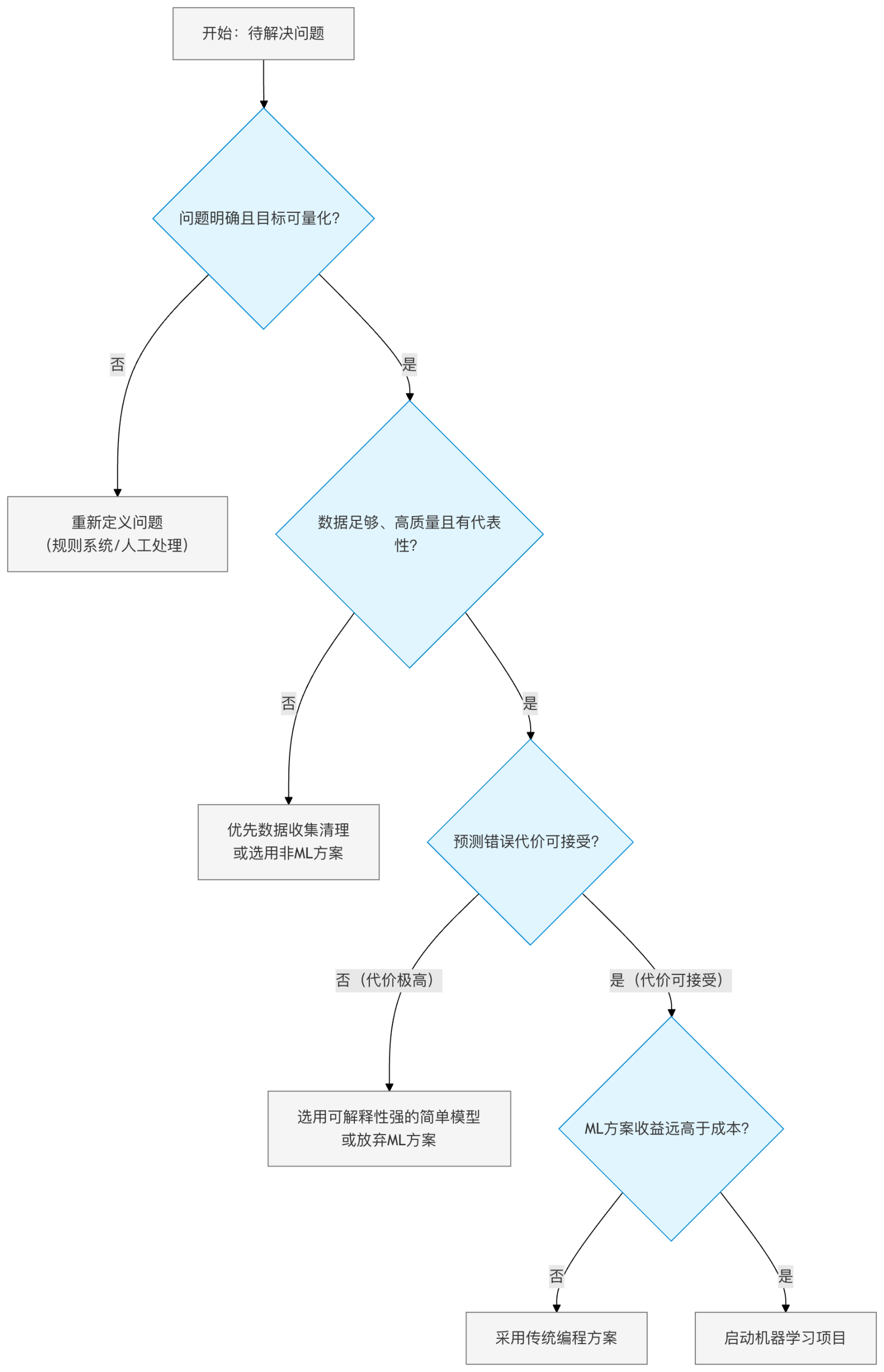
Pragmatic Alternatives
- Rule-based systems: If the business logic is clear, stable, and has few exceptions, writing if-else rules may be faster, cheaper, and more reliable.
- Statistical methods: For many analytical tasks, classical statistical methods such as linear regression and hypothesis testing may already be sufficient and are easier to interpret.
- Human-machine collaboration: In some scenarios, using machine learning as an auxiliary tool (e.g., filtering out high-probability cases for manual review) is more cost-effective and safer than full automation.
Summary and Action Guide
Machine learning is a powerful technology, but it is not a "silver bullet" for all problems. Its successful application is based ona clear understanding of real-world costsandfull respect for technical boundaries.
Action Suggestions for Beginners
- Start small: When starting your first project, choose a scenario with a small scope, easily accessible data, and low cost of errors (e.g., sentiment analysis on movie reviews using a public dataset).
- Estimate costs comprehensively: During the project planning phase, consciously conduct a rough cost estimate from four dimensions: data, computation, deployment, and risk.
- Prioritize simple solutions: Before trying complex deep learning models, first try simple models such as logistic regression and decision trees. They are lower cost, faster, and easier to interpret.
- Continuous monitoring and evaluation: Model deployment is not the end. Establish monitoring metrics and regularly evaluate the model's performance and business value in real-world environments.
Remember, an excellent machine learning practitioner is not only a model architect, but also anengineer who weighs costs, benefits, and risks.。
Other Extensions