Python3 Introduction
Python is a high-level scripting language that combines interpretability, compilation, interactivity, and object-orientation.
Python's design is highly readable. Compared to other languages that often use English keywords and punctuation marks, Python has a more distinctive syntactic structure.
Python is an interpreted language:This means there is no compilation step during development. Similar to PHP and Perl.
Python is an interactive language:This means that you can, at a Python prompt,>>>directly execute code afterward.
Python is an object-oriented language:This means Python supports an object-oriented style or programming technique where code is encapsulated in objects.
Python is a beginner's language:Python is a great language for beginner programmers. It supports a wide range of application development, from simple word processing to WWW browsers and games.

Python Development History
Python was designed by Guido van Rossum in the late 1980s and early 1990s at the National Research Institute for Mathematics and Computer Science in the Netherlands.
Python itself was also developed from many other languages, including ABC, Modula-3, C, C++, Algol-68, SmallTalk, Unix shell, and other scripting languages.
Like Perl, Python source code also follows the GPL (GNU General Public License) agreement.
Python is now maintained by a core development team, and Guido van Rossum still plays a crucial role in guiding its progress.
Python 2.0 was released on October 16, 2000, adding full garbage collection and Unicode support.
Python 3.0 was released on December 3, 2008. This version is not fully compatible with previous Python source code. However, many new features were later ported to the older Python 2.6/2.7 versions.
Python 3.0 is often called Python 3000, or Py3k for short. Compared to earlier versions of Python, this is a major upgrade.
Python 2.7 was determined to be the last Python 2.x version. Besides supporting Python 2.x syntax, it also supports some Python 3.1 syntax.
Python Features
1. Easy to learn:Python has relatively few keywords, a simple structure, and a clearly defined syntax, making it easier to learn.
2. Easy to read:Python code is more clearly defined.
3. Easy to maintain:Python's success lies in the fact that its source code is quite easy to maintain.
4. An extensive standard library:One of Python's greatest advantages is its rich, cross-platform libraries, which are well compatible with UNIX, Windows, and Macintosh.
5. Interactive mode:With interactive mode support, you can input and execute code from a terminal and get results, allowing interactive testing and debugging of code snippets.
6. Portable:Based on its open-source nature, Python has been ported (i.e., made to work) to many platforms.
7. Extensible:If you need a critical piece of code that runs fast, or want to write some algorithms you don't want to open, you can write that part of the program in C or C++ and then call it from your Python program.
8. Databases:Python provides interfaces to all major commercial databases.
9. GUI programming:Python supports GUI, which can be created and ported to many systems.
10. Embeddable:You can embed Python into C/C++ programs to give users of your programs the ability to "script" them.
Python Applications
- YouTube - video social networking site
- Reddit - social sharing website
- Dropbox - file sharing service
- Douban - a database website for cultural products such as books, music, and movies
- Zhihu - a Q&A website
- Guokr - a pan-science/technology themed website
- Bottle - Python micro web framework
- EVE - the online game EVE makes extensive use of Python for development
- Blender - an open-source 3D graphics software that uses Python as a modeling tool and GUI language
- Inkscape - an open-source SVG vector graphics editor.
- ...
Python Version Progress
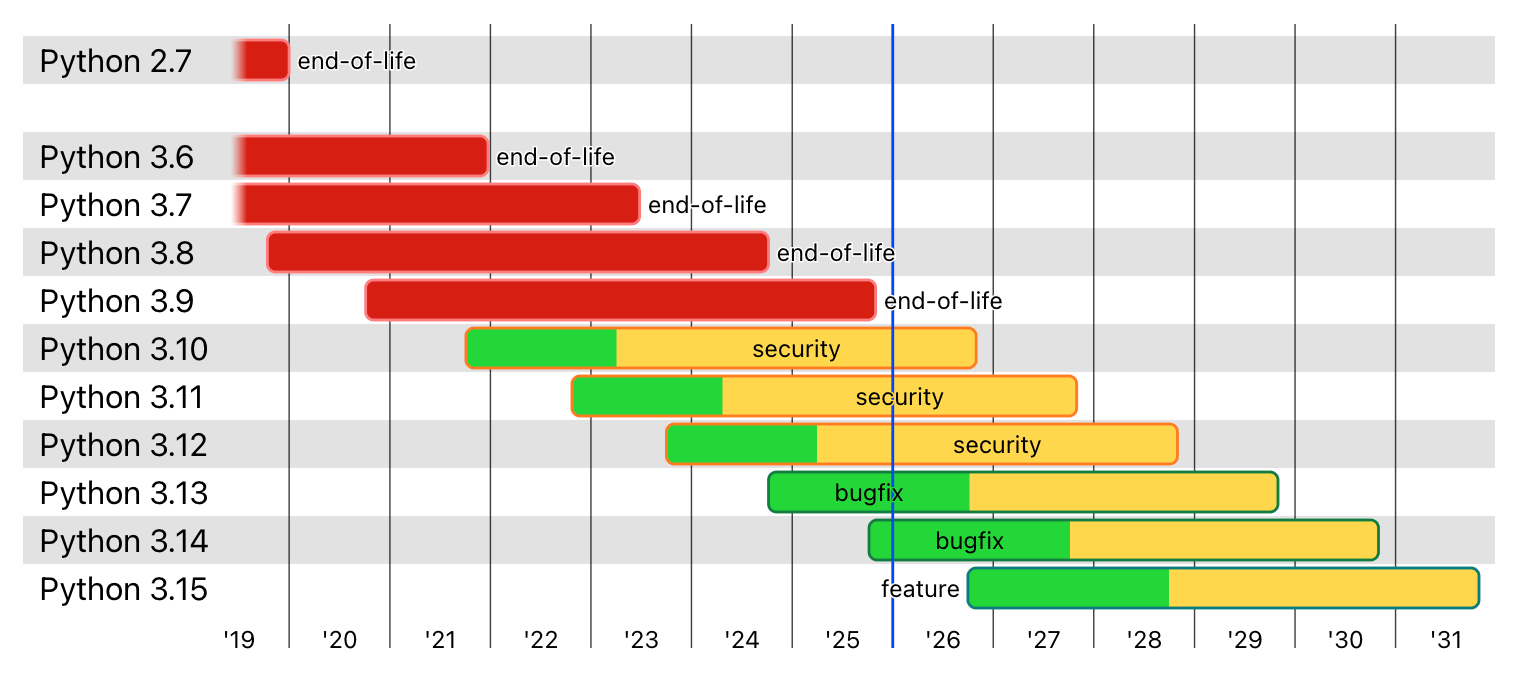
The figure below shows the maintenance and release timeline of Python's historical versions and future versions: