Node.js Working Mechanism
Node.js is a JavaScript runtime environment based on the Chrome V8 engine, which allows developers to write server-side code using JavaScript. Unlike traditional server-side technologies, Node.js adopts anevent-drivenandnon-blocking I/Omodel, which makes it particularly suitable for handling high-concurrency network applications.
Core Features
- Single-threaded: Node.js uses a single thread to handle requests
- Event loop: Handles concurrency through an event-driven mechanism
- Non-blocking I/O: I/O operations do not block the main thread
- Cross-platform: Can run on Windows, Linux, macOS, and other systems
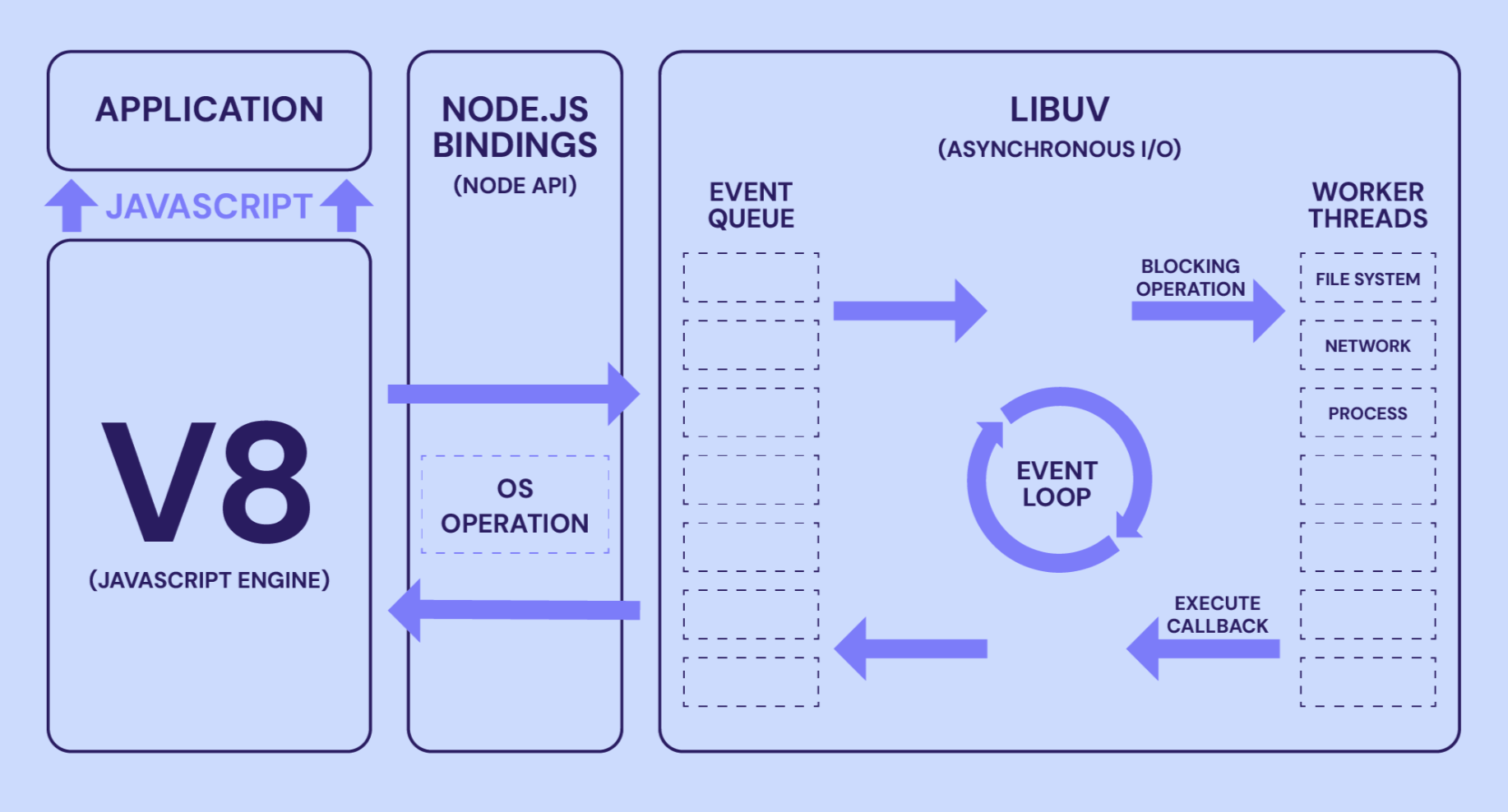
Node.js executes JavaScript code through the V8 engine, interacts with the operating system using Node.js APIs, and handles asynchronous I/O operations through Libuv. The event loop and worker threads ensure Node.js's efficiency and non-blocking characteristics.
-
V8 JavaScript Engine: This is the core of Node.js, responsible for executing JavaScript code. V8 is the JavaScript engine of the Chrome browser, which compiles JavaScript code into machine code to improve execution efficiency.
-
Node.js Bindings (Node API): This layer provides a set of APIs that allow JavaScript code to interact with the operating system. These APIs include file system, network, process, and other operations.
-
Libuv (Asynchronous I/O): Libuv is a cross-platform asynchronous I/O library that runs under Node.js and is used to handle asynchronous operations such as file system, network, and processes. Libuv uses the event loop and worker threads to handle these operations without blocking the main thread.
-
Event Loop: This is one of the core concepts of Node.js. The event loop continuously checks the event queue, processes events, and executes callback functions. It ensures Node.js's non-blocking and event-driven characteristics.
-
Event Queue: The event queue is used to store events waiting to be processed. When an asynchronous operation completes, the related callback function is placed into the event queue, waiting for the event loop to process it.
-
Worker Threads: These are threads used to handle blocking operations, such as file reads/writes and network requests. They allow Node.js to perform these operations without blocking the main thread.
-
Blocking Operation: These are operations that may block threads, such as synchronous file reads/writes. In Node.js, these operations are usually placed in worker threads to avoid blocking the event loop.
-
Execute Callback: Once an asynchronous operation completes, its callback function is executed. This is managed by the event loop.
Node.js Architecture
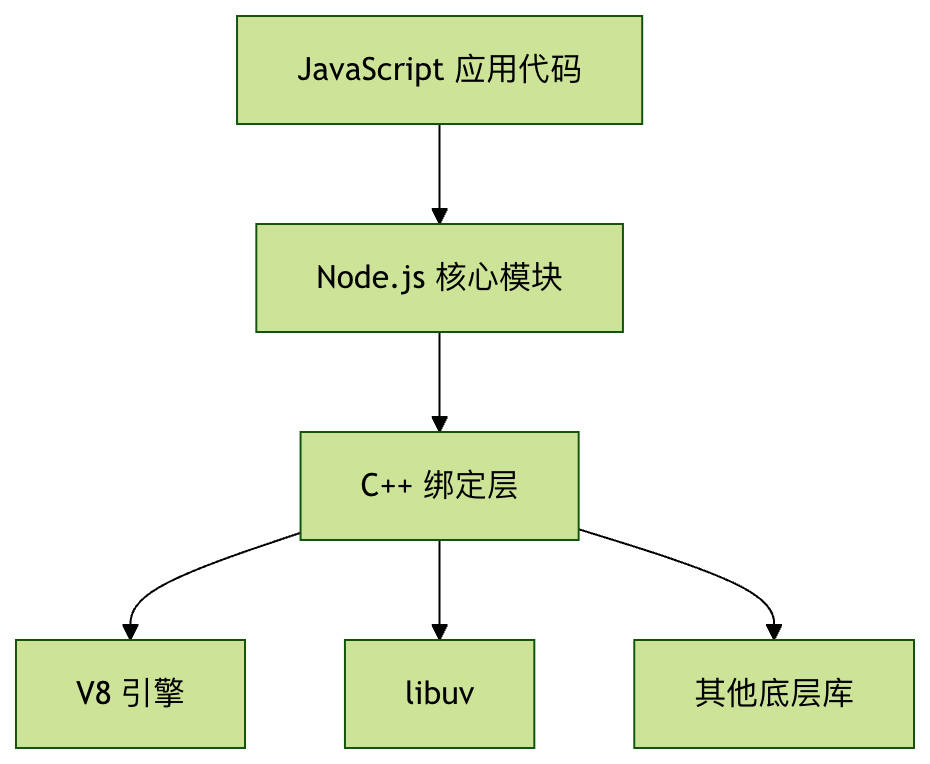
The Node.js architecture can be divided into the following main layers:
1. JavaScript Layer
This is the layer that developers interact with directly, including:
- Core modules (such as fs, http, path, etc.)
- Third-party modules (installed via npm)
- User-defined modules
2. C++ Binding Layer
This layer exposes low-level functionality to the JavaScript layer, including:
- C++ implementations of Node.js core APIs
- Interface wrappers for the V8 engine
3. Underlying Dependencies
- V8 engine: JavaScript engine developed by Google
- libuv: Cross-platform asynchronous I/O library
- c-ares: Asynchronous DNS resolution library
- OpenSSL: Cryptographic functionality support
- zlib: Compression functionality support
Event Loop Mechanism
The core working mechanism of Node.js is theevent loop, which is responsible for scheduling and executing all asynchronous operations.
Phases of the Event Loop
- timers: Executes callbacks for setTimeout and setInterval
- pending callbacks: Executes callbacks for system operations (such as TCP errors)
- idle, prepare: Used internally
- poll: Retrieves new I/O events and executes related callbacks
- check: Executes setImmediate callbacks
- close callbacks: Executes callbacks for close events (such as socket.on('close'))
Example
setTimeout(() => console.log('timeout'), 0);
setImmediate(() => console.log('immediate'));
// The output order may vary depending on the startup time of the event loop
Non-blocking I/O Principles
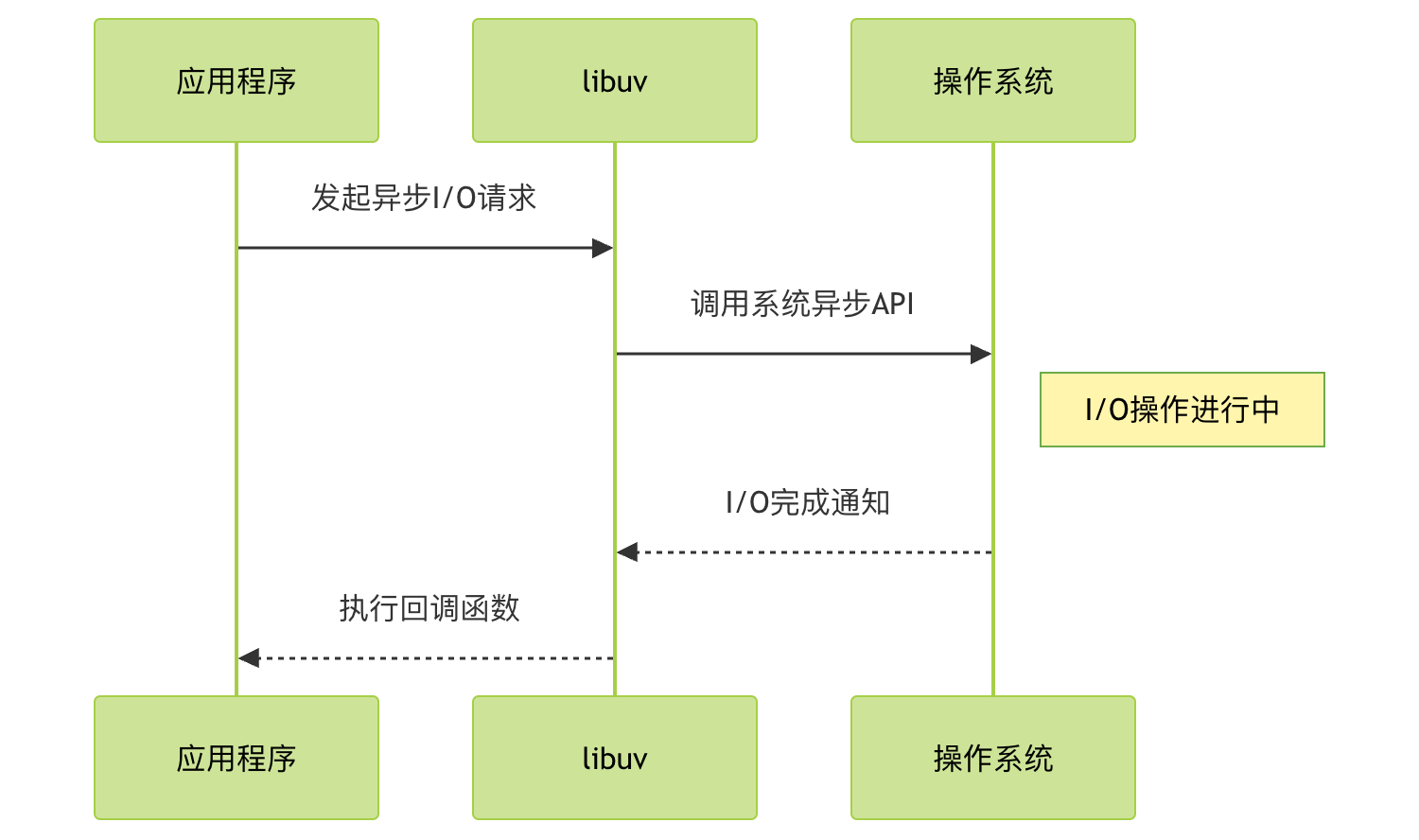
Node.js I/O operations are non-blocking, which is achieved in the following ways:
Workflow
- The application initiates an I/O request (such as reading a file)
- Node.js hands the request to libuv for processing
- libuv uses asynchronous interfaces provided by the system (such as epoll on Linux)
- The main thread continues to execute other tasks
- After the I/O completes, the callback function is placed into the event queue
- The event loop executes the callback at the appropriate phase
Single Thread and Multiple Processes
Although Node.js is single-threaded, it can utilize multi-core CPUs in the following ways:
1. Child Process (child_process)
Example
const child = fork('child.js');
child.on('message', (msg) => {
console.log('Message from child process:', msg);
});
child.send({ hello: 'world' });
2. Cluster Mode (cluster)
Example
const http = require('http');
const numCPUs = require('os').cpus().length;
if (cluster.isMaster) {
// Main process forks worker processes
for (let i = 0; i < numCPUs; i++) {
cluster.fork();
}
} else {
// Worker process creates an HTTP server
http.createServer((req, res) => {
res.writeHead(200);
res.end('Hello World'\n');
}).listen(8000);
}
3. Worker Threads
Example
const worker = new Worker(`
const { parentPort } = require('worker_threads');
parentPort.on('message', (msg) => {
console.log('Message received:', msg);
parentPort.postMessage('Message received');
});
`, { eval: true });
worker.on('message', (msg) => {
console.log('Reply from worker thread:', msg);
});
worker.postMessage('Main thread message');
Performance Optimization Suggestions
1. Avoid blocking the event loop
- Offload CPU-intensive tasks to worker threads or child processes
- Avoid complex computations on the main thread
2. Use stream processing appropriately
Example
fs.readFile('bigfile.txt', (err, data) => {
// Process data
});
// Good practice: using streams
const stream = fs.createReadStream('bigfile.txt');
stream.on('data', (chunk) => {
// Process data chunks
});
3. Connection pool management
- Database connections
- HTTP client connections
4. Memory management
- Monitor memory usage
- Avoid memory leaks
FAQ
Q: Is Node.js really single-threaded?
A: JavaScript execution is single-threaded, but Node.js uses multiple threads at the underlying level (such as libuv's thread pool handling certain I/O operations).
Q: How to handle CPU-intensive tasks?
A: You can use Worker Threads or split tasks into multiple smaller tasks and process them in batches using setImmediate.
Q: Why is Node.js suitable for I/O-intensive applications?
A: Because its non-blocking I/O model can handle other requests while waiting for I/O, without needing to create a new thread for each connection.
Summary
The working mechanism of Node.js is based on the following core concepts:
- Event-driven programming model
- Non-blocking I/O operations
- Single-threaded but supports multi-process/multi-threaded scaling
- Efficient event loop scheduling
Understanding these mechanisms is crucial for writing high-performance Node.js applications. By reasonably leveraging its asynchronous features, you can build network applications capable of handling high concurrency.
Other extensions