AI Agent Introduction
In today's wave of technology, behind the deep integration of artificial intelligence (AI) into life and work,AI Agent (Intelligent Agent)is the supportfrom conversational assistants to autonomous task programscore concept - it is not merely a chat tool, but can, likedigital employeein the same wayaccept tasks, break down steps, and execute actionsautomated entity that can be taken over by AI Agent as long as the task can be decomposed into operational processes.
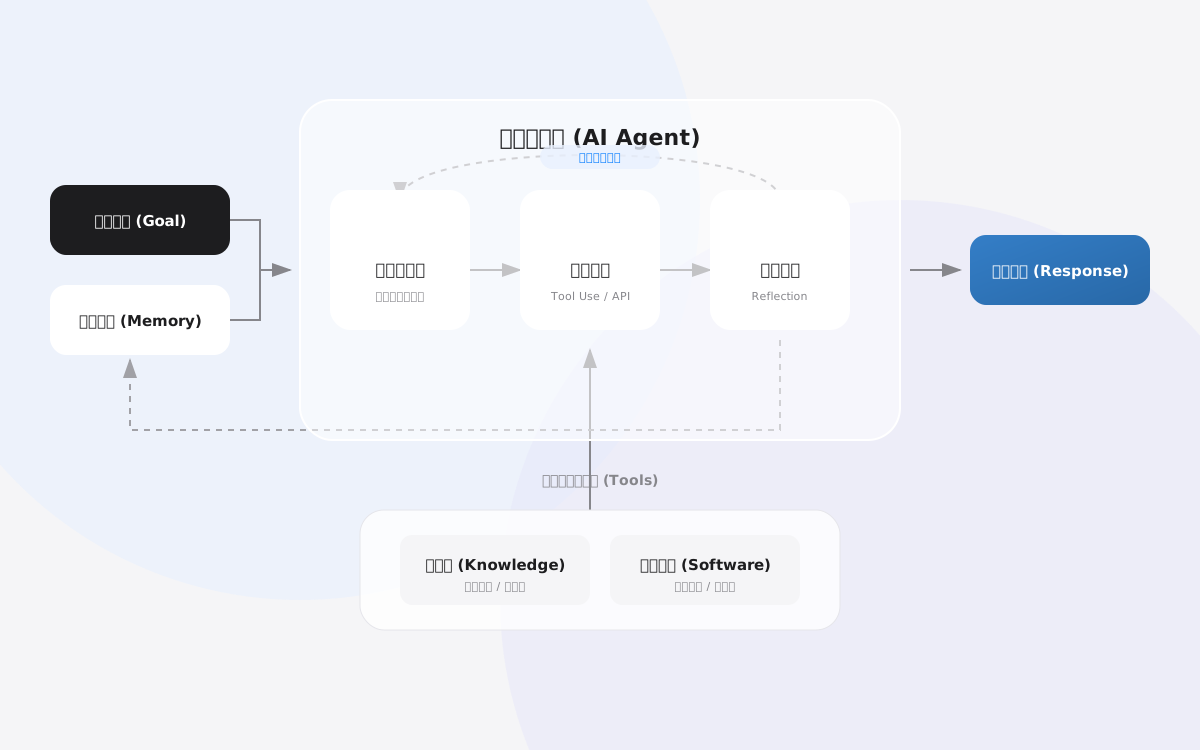
Agent = LLM (brain) + Planning (planning) + Tool use (execution) + Memory (memory).
- LLM (brain):As the core reasoning engine, it is responsible for understanding intent, generating text, and making logical judgments.
- Planning (planning):It can break down complex goals (such as "help me plan a tech salon") into executable steps.
- Memory (memory):Records conversation history (short-term) and stores professional knowledge bases (long-term).
- Tool Use (tool use):It can search Google, read databases, and even run Python code according to needs.
Differences between Agent and Traditional AI Models
| Dimension | Traditional AI Model | AI Agent |
|---|---|---|
| Interaction Mode | Single input/output | Multi-turn dialogue, continuous interaction |
| Decision-making ability | Direct reasoning based on input | Planning, reflection, iterative optimization |
| Tool use | Cannot proactively call external tools | Can call search, calculators, APIs, etc. |
| Memory mechanism | Limited to current context only | Short-term + long-term memory |
| Goal-oriented | Complete a single prediction task | Complete complex goals |
| Error handling | Output marks the end | Can self-correct and retry |
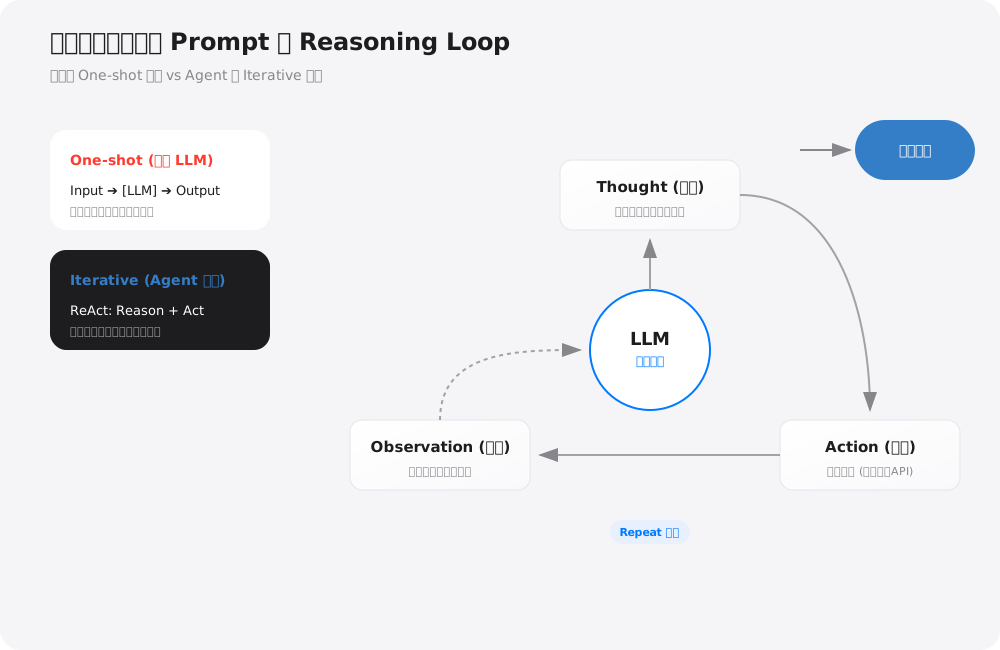
Core Mode: From Prompt to Reasoning Loop
Ordinary LLMs are justOne-shotresponses, while the core of an Agent lies inIterative。
ReAct mode (Reason + Act)is currently the most mainstream Agent reasoning logic:
- Thought:The model describes what it is currently going to do and why.
- Action:The model selects a tool (e.g.:
Google Search)。 - Observation:The model reads the results returned by the tool.
- Repeat:Repeat the above steps until the final answer is reached.
AI Agent Composition: Think and Act Like Humans
A fully functional AI Agent typically mimics the human cognitive and action loop and includes the following key modules:
1. Planning Module: The Brain and Commander of Tasks
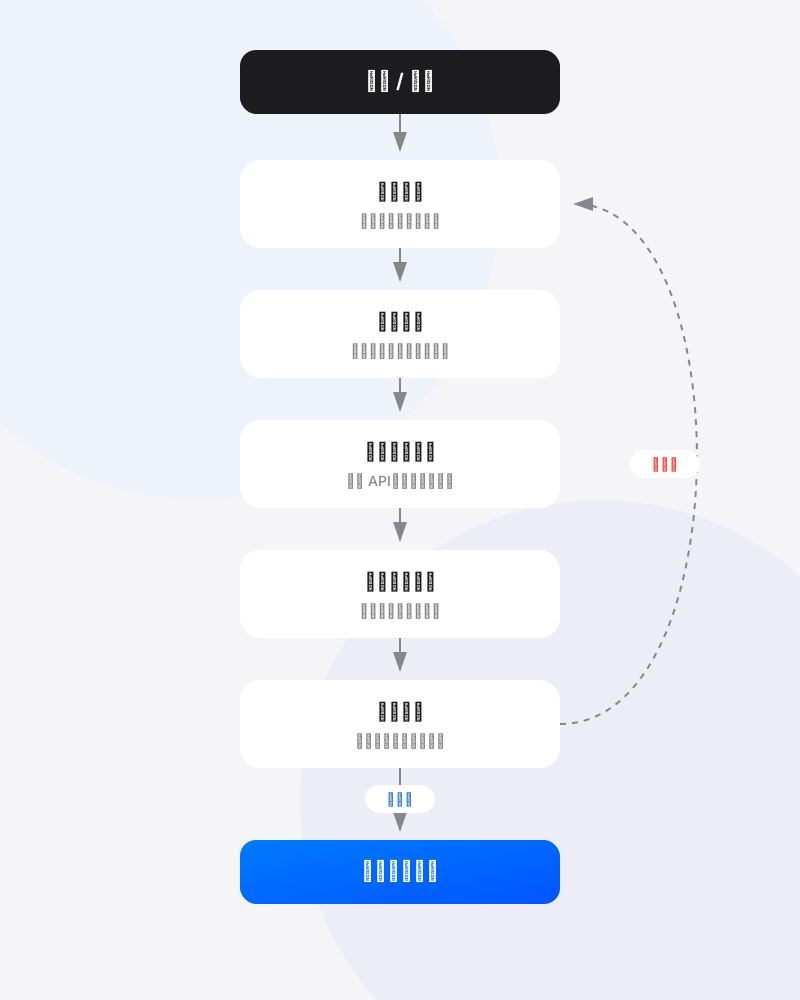
This is the Agent's thinking center. It is responsible for breaking down the user's vague, high-level goals (e.g., analyzing the company's sales data from last quarter) into a series of clear, executable subtask steps.
- Task decomposition: Break big goals down into small steps. For example: 1. Connect to the database; 2. Extract Q3 sales data; 3. Categorize by product and region; 4. Calculate the quarter-over-quarter growth rate; 5. Generate visual charts.
- Reflection and adjustment: The Agent evaluates the results of each step. If it fails (e.g., the database cannot be connected), it reflects on the cause and adjusts the plan (e.g., trying another connection method or asking the user for a password).
2. Memory Module: Notebook of Experience
An Agent needs memory to carry out coherent, context-based conversations and operations.
- Short-term memory: Remembers the context of the current conversation, ensuring responses stay on track.
- Long-term memory: Stores important interaction information and learned knowledge in a database or vector database for future query and use, becoming smarter the more it is used.
3. Tool Calling Module: Flexible Hands
This is the key to an Agent transforming from a thinker to an actor. It can call external tools via an application programming interface (API) to expand its capabilities.
Common tools:
- Search tools: Connect to the internet to get the latest information.
- Calculator/code interpreter: Perform mathematical operations or run code to process data.
- Software operations: Send emails, operate spreadsheets, and control smart home devices via APIs.
- Specialized tools: Call professional software for image generation, speech synthesis, data analysis, and more.
Core Features
A qualified AI Agent typically has the following characteristics:
1. Autonomy
- Can operate independently without step-by-step human guidance
- Decides on its own what to do next
- Example: When you say "Book me a flight to Shanghai tomorrow," the Agent automatically searches flights, compares prices, and selects suitable options
2. Reactivity
- Can perceive environmental changes and respond in a timely manner
- Adjusts behavior based on new information
- Example: If a flight is canceled during booking, it automatically finds alternatives
3. Proactivity
- Not only responds passively, but can also take the initiative to act
- Has goal-oriented behavior
- Example: Detects flight price fluctuations and proactively reminds the user of the best time to buy
4. Social Ability
- Can interact with humans or other Agents
- Understands natural language and conducts multi-turn conversations
- Example: Asks the user for preferences (window/aisle) during the booking process
5. Learning
- Learns from historical interactions
- Remembers user preferences and context
- Example: Remembers that you prefer morning flights and window seats
Development History of AI Agent
Timeline

Phase 1: Conceptual germination period (1950s-2010s)
- 1950s: The Turing test was proposed, and the concept of the Agent first emerged
- 1990s: Research on multi-agent systems gained momentum
- 2000s: Rule-driven chatbots (such as ELIZA)
- Features: Rule-based, limited capabilities
Phase 2: Deep Learning Empowerment Era (2010s-2020)
- 2012: Deep learning achieves breakthrough on ImageNet
- 2017: Transformer architecture emerges
- 2018-2020: BERT and GPT series models released
- Characteristics: Improved comprehension, but still a "passive tool"
Phase 3: Large Model Agent Explosion Era (2021-present)
- 2022.11: ChatGPT released, demonstrating powerful conversational abilities
- 2023.03: GPT-4 + Plugins, first implementation of tool calling
- 2023.03: AutoGPT open-sourced, proof of concept for autonomous Agents
- 2023.05: Frameworks such as LangChain and LlamaIndex mature
- 2024-2025: Enterprise-level Agent applications deployed at scale
- Characteristics: True autonomy, tool use, task planning
Multi-Agent Collaboration Mode
Multiple Agents can work collaboratively, like a team:
Main Types and Application Scenarios of AI Agent
Based on their complexity and autonomy, AI Agents can be divided into different types and applied in various scenarios:
| Type | Characteristics | Example application scenarios |
|---|---|---|
| Single-task Agent | Focuses on completing one specific task with a dedicated function. | Intelligent customer service robots, automated data entry assistants, personal schedule reminder assistants. |
| Multimodal Agent | Can understand and process multiple types of information such as text, images, and speech. | Generate website code from sketches, analyze medical images and generate reports, automatic video content summarization. |
| Autonomous Agent | Possesses high autonomy, can run long-term and proactively manage complex goals. | Autonomous vehicles, automated stock trading systems, intelligent game NPCs (non-player characters). |
| Simulation Agent | Simulate, test, and train in virtual environments. | Training robots to complete grasping tasks, simulating urban traffic flow optimization, and molecular simulation for new drug development. |
Currently popular practical applications:
- AI programming assistant: Such as Devin, capable of independently completing the entire process from requirements analysis and writing code to testing and deployment.
- AI research assistant: Automatically reads large volumes of literature, proposes hypotheses, and designs experimental plans.
- Personal life assistant: Manages your emails and schedule, automatically orders food, and compares prices when shopping.
- Enterprise process automation: Automatically processes expense reports, generates weekly reports, and follows up on customer contracts.
Common Challenges and Limitations
Hallucination issue (Hallucination)
Agents may generate information that appears reasonable but is actually incorrect; retrieval augmentation and verification mechanisms are needed to reduce risks.
Scope creep (Scope Creep)
Excessive autonomy may cause the Agent to perform operations beyond the expected scope; clear permission boundaries need to be set.
Cost control
Multiple iterative calls to LLMs and tools can generate high costs; call strategies and caching mechanisms need to be optimized.
Security and privacy
Agents may access sensitive data; strict access control and audit mechanisms need to be implemented.
Progressive autonomy
Start with simple tasks and gradually increase the Agent's autonomy permissions, step by step.
Human supervision
Set up human review at key decision points to balance efficiency and safety.
Continuous evaluation
Establish a comprehensive evaluation metric system, and regularly test and optimize Agent performance.
Fault tolerance mechanisms
Implement mechanisms such as retry, degradation, and alerting to ensure system stability.
Future Development Trends
Deepening multimodal interaction
Agents will better integrate multimodal perception capabilities such as vision, hearing, and touch, enabling more natural human-computer interaction.
Multi-Agent collaboration systems
Multiple specialized Agents work collaboratively, forming an organizational structure similar to an "AI team" to handle complex tasks.
Edge computing deployment
Lightweight Agents will run on edge devices such as phones and IoT devices, enabling localized intelligent services.
Deep cultivation of vertical domains
Agents in professional fields such as healthcare, law, and finance will possess stronger domain knowledge and reasoning capabilities.