UDP Protocol
UDP (User Datagram Protocol) is a simple, connectionless transport-layer protocol used to transmit data over a network.
andTCPIn contrast, UDP does not provide reliability, ordering, or flow control, but it features low latency and high efficiency, making it suitable for applications with high real-time requirements.
How UDP Works
UDP is a connectionless protocol. The client and server do not need to establish a connection before sending data. Its core function is to quickly transmit data packets.
1. UDP Packet Structure
A UDP packet consists of the following parts:
- Source port: the sender's port number.
- Destination port: the receiver's port number.
- Length: the total length of the packet (including header and data).
- Checksum: used to detect whether the packet is corrupted (optional).
- Data: the actual data being transmitted.

2. UDP Data Transmission
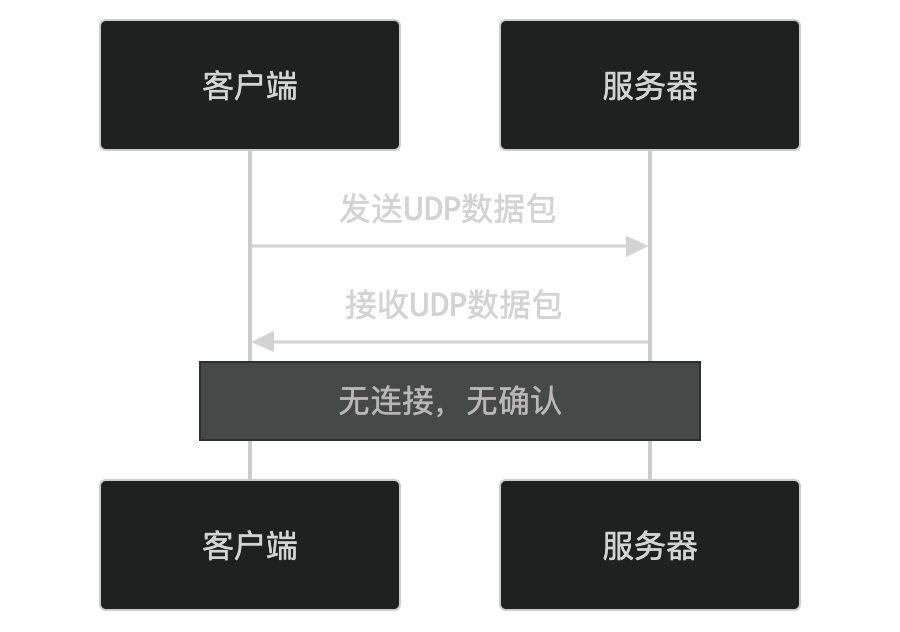
- The client sends UDP packets directly to the server.
- The server receives UDP packets but does not send acknowledgment messages.
Key Features of UDP
-
Connectionless:
- No connection is needed; data is sent directly.
-
Unreliability:
- Does not guarantee packet delivery, ordering, or integrity.
-
Low latency:
- Since no connection establishment or acknowledgment is required, transmission latency is low.
-
High efficiency:
- Small header overhead, suitable for transmitting small packets.
-
Supports broadcast and multicast:
- Can send packets to multiple receivers.
UDP Application Scenarios
UDP is widely used in the following scenarios:
- Real-time applications: such as VoIP (voice calls), video conferencing, and online games.
- Broadcast and multicast: such as network broadcasting and streaming media distribution.
- Simple queries: such as DNS queries and DHCP requests.
- Lightweight protocols: such as SNMP (Simple Network Management Protocol) and TFTP (Trivial File Transfer Protocol).
Advantages and Disadvantages of UDP
Advantages:
- Low latency: suitable for applications with high real-time requirements.
- Efficient: small header overhead, suitable for transmitting small packets.
- Simple: simple to implement and consumes few resources.
Disadvantages:
- Unreliable: does not guarantee packet delivery, ordering, or integrity.
- No flow control: may cause packet loss or network congestion.
- No connection management: cannot detect connection status.
UDP Alternatives
In some scenarios, the following alternatives can be used:
- TCP: provides reliability, ordering, and flow control, suitable for applications with high data integrity requirements.
- SCTP: combines the advantages of TCP and UDP, supporting multiple streams and multi-homing.
In summary, UDP is a simple, connectionless transport-layer protocol that is suitable for applications with high real-time requirements due to its low latency and efficient data transmission. It is widely used in scenarios such as real-time applications, broadcast, and multicast, but attention should be paid to its disadvantages of unreliability and lack of connection management.
Other Extensions