RARP Protocol
RARP (Reverse Address Resolution Protocol) is a protocol used to resolve data link layer addresses (such as MAC addresses) into network layer addresses (such as IP addresses).
RARP is the reverse operation of ARP (Address Resolution Protocol), mainly used by devices such as diskless workstations to obtain their own IP addresses at startup.
How RARP Works
The core function of RARP is to resolve MAC addresses into IP addresses through broadcast requests and unicast responses.
1. RARP Request
When a device starts up and does not know its own IP address, it sends a RARP request broadcast packet asking, "Who owns this MAC address?"
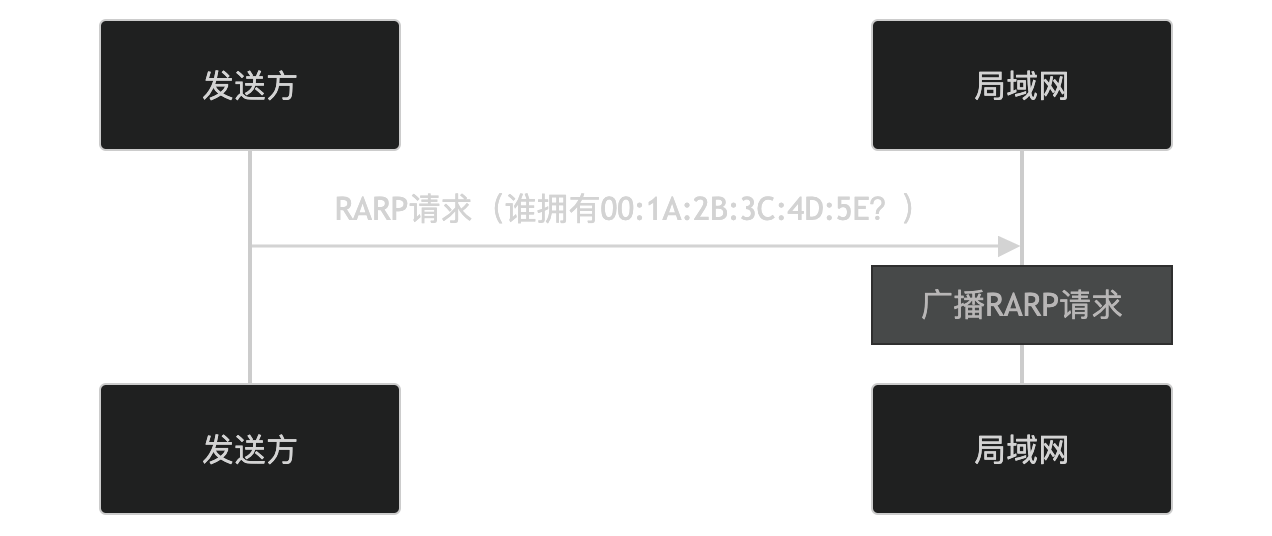
- The sender broadcasts a RARP request packet, asking for the IP address corresponding to its own MAC address.
- All devices on the local network receive this request.
2. RARP Response
If a device (usually a RARP server) finds that its configuration contains the IP address mapping for this MAC address, it sends a RARP response packet to inform the corresponding IP address.
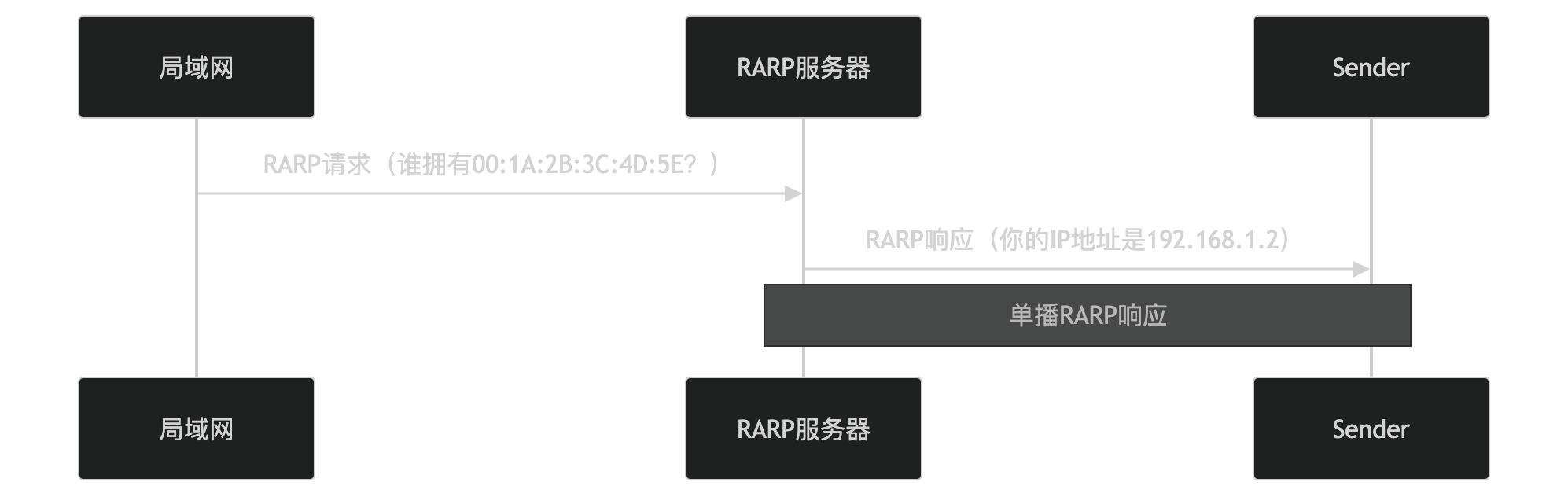
- The RARP server sends a RARP response packet to inform the sender of its IP address.
- The RARP response packet is unicast and is sent only to the requester.
3. IP Address Configuration
After receiving the RARP response, the sender uses the obtained IP address to configure its network interface, enabling it to communicate with other devices.

Key Features of RARP
-
MAC Address to IP Address Mapping:
- Resolves data link layer addresses into network layer addresses.
-
Broadcast Request and Unicast Response:
- Uses broadcast to send RARP requests and unicast to send RARP responses.
-
Diskless Workstation Usage:
- Mainly used by diskless workstations to obtain IP addresses at startup.
-
Used within Local Area Networks:
- RARP is mainly used in local area networks and is not suitable for cross-network communication.
Application Scenarios of RARP
RARP is widely used in the following scenarios:
- Diskless Workstations:
- Diskless workstations obtain IP addresses via RARP at startup.
- Network Configuration:
- In environments lacking DHCP, RARP is used to assign IP addresses to devices.
Limitations of RARP
RARP has the following limitations:
- Single Function:
- Can only provide IP addresses and cannot provide other network configuration information (such as subnet mask, gateway).
- Depends on RARP Server:
- Requires configuring a dedicated RARP server, increasing management complexity.
- Poor Security:
- Vulnerable to spoofing attacks; attackers can forge RARP responses.
Alternatives to RARP
Due to its limitations, RARP has been replaced by more powerful protocols, mainly including:
- BOOTP(Bootstrap Protocol):
- Provides IP addresses and other network configuration information.
- DHCP(Dynamic Host Configuration Protocol):
- Dynamically assigns IP addresses and other network configuration information; it is an extension of BOOTP.
In summary, RARP is a protocol used to resolve MAC addresses into IP addresses, achieving address mapping through broadcast requests and unicast responses. It is mainly used by diskless workstations to obtain IP addresses at startup, but due to its limited functionality and poor security, it has been replaced by BOOTP and DHCP.
Other Extensions