HTTPS Protocol
HTTPS (HyperText Transfer Protocol Secure) is the secure version of HTTP. It protects the security and integrity of data transmission by adding a TLS/SSL encryption layer between HTTP and the transport layer.
HTTPS is widely used to protect the transmission of sensitive information (such as login credentials and payment information).
How HTTPS Works
The core of HTTPS is adding a TLS/SSL encryption layer on top of HTTP, protecting data transmission through encryption and authentication mechanisms.
1. HTTPS Connection Establishment
- ClientHello: The client sends a list of supported encryption algorithms.
- ServerHello: The server selects an encryption algorithm and sends the server certificate.
- Certificate Verification: The client verifies the validity of the server certificate.
- Key Exchange: The client generates a pre-master key, encrypts it with the server's public key, and sends it.
- Session Key: Both parties generate a session key based on the pre-master key to encrypt subsequent communication.
2. HTTP Communication
After the encrypted channel is established, the client and server conduct HTTP communication over HTTPS:
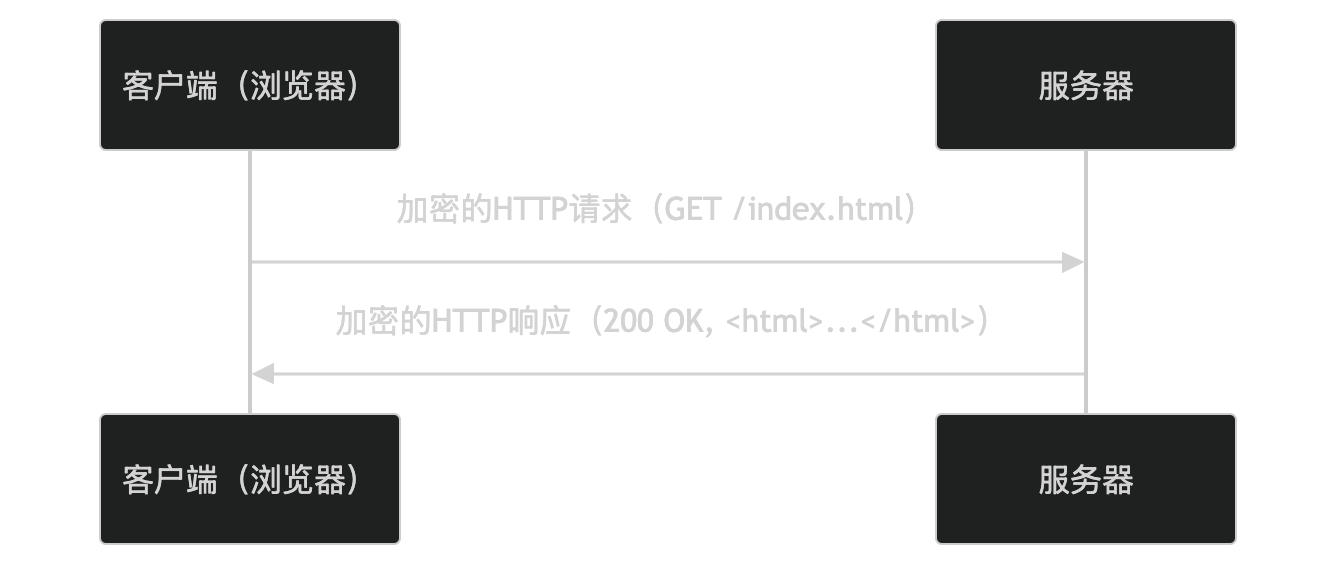
- The client sends encrypted HTTP requests.
- The server returns encrypted HTTP responses.
Key Features of HTTPS
-
Encrypted Communication:
- Uses symmetric encryption (such as AES) to encrypt data.
- Uses asymmetric encryption (such as RSA) to exchange keys.
-
Authentication:
- Verifies the server's identity through the server certificate.
- Optionally verifies the client's identity through a client certificate.
-
Data Integrity:
- Uses hash algorithms (such as SHA) to ensure data has not been tampered with.
-
Compatibility:
- Fully compatible with HTTP, supporting the same request methods and response formats.
Application Scenarios of HTTPS
HTTPS is widely used in the following scenarios:
- Web browsing: Protects user privacy and sensitive information.
- Online payments: Protects the security of payment information.
- API calls: Protects the confidentiality and integrity of data transmission.
- Login authentication: Protects the security of login credentials.
HTTPS Security
HTTPS improves security through the following mechanisms:
- Encrypted transmission: Prevents data from being eavesdropped.
- Authentication: Prevents servers from being impersonated.
- Data integrity: Prevents data from being tampered with.
HTTPS Certificates
The security of HTTPS relies on server certificates. Certificates are issued by trusted Certificate Authorities (CAs) and contain the following information:
- Domain name: The domain name bound to the certificate.
- Public key: Used for encrypted communication.
- Validity period: The validity period of the certificate.
- Signature: The CA's signature on the certificate, used to verify the certificate's authenticity.
HTTPS Deployment
Deploying HTTPS requires the following steps:
- Obtain a certificate: Apply for a server certificate from a CA.
- Configure the server: Install the certificate on the server and enable HTTPS.
- Redirect HTTP to HTTPS: Ensure all traffic is transmitted over HTTPS.
HTTPS Alternatives
In certain scenarios, the following alternatives can be used:
- V**N: Protects data transmission through an encrypted tunnel.
- SSH Tunnel: Encrypts communication through SSH.