NTP Protocol
NTP (Network Time Protocol) is a protocol used to synchronize computer system time.
Through a hierarchical time server architecture, NTP ensures that the time of all devices in the network remains consistent, with accuracy up to milliseconds or even microseconds.
NTP is the most widely used time synchronization protocol on the Internet, widely applied in fields such as computer networks, financial transactions, and scientific experiments.
How NTP Works
NTP uses a client-server model to achieve time synchronization through a hierarchical time server architecture.
1. NTP Hierarchical Architecture
NTP adopts a hierarchical (Stratum) architecture, dividing time servers into different levels:
- Stratum 0: High-precision time source, such as atomic clocks and GPS clocks.
- Stratum 1: Time servers directly connected to Stratum 0.
- Stratum 2: Time servers that synchronize time from Stratum 1.
- Stratum 3: Time servers that synchronize time from Stratum 2.
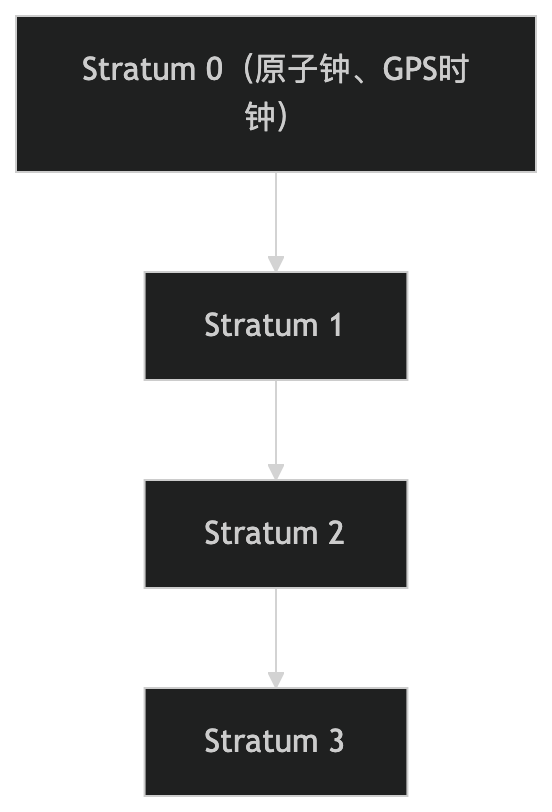
- The lower the level, the higher the time accuracy.
- Clients usually synchronize time from Stratum 2 or Stratum 3 time servers.
2. Time Synchronization Process
The NTP client synchronizes time with the time server through the following steps:
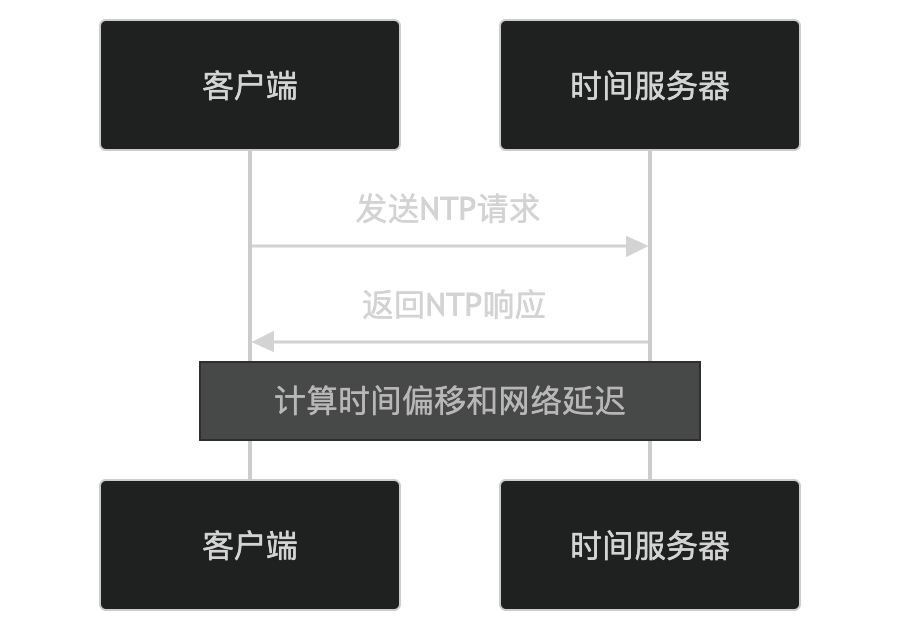
- Send NTP Request:
- The client sends an NTP request packet to the time server, recording the sending time.\( T_1 \)。
- Return NTP Response:
- After receiving the request, the server records the receiving time.\( T_2 \)and the response sending time.\( T_3 \)。
- The server\( T_1 \)、\( T_2 \)、\( T_3 \)sends them to the client together with the response packet.
- Calculate Time Offset:
- The client records the response receiving time.\( T_4 \)。
Calculate the time offset using the following formula: \( \theta \)and network delay.\( \delta \):
\[ \theta = \frac{(T_2 - T_1) + (T_3 - T_4)}{2} \] \[ \delta = (T_4 - T_1) - (T_3 - T_2) \]
- Adjust Local Time:
- Based on the time offset, the client\( \theta \)adjusts the local time.
Key Features of NTP
-
High-Precision Time Synchronization:
- Accuracy can reach milliseconds or even microseconds.
-
Hierarchical Architecture:
- Achieves reliability and scalability of time sources through a hierarchical architecture.
-
Fault Tolerance Mechanism:
- Supports multiple time servers and automatically selects the optimal time source.
-
Security:
- Supports authentication and encryption to prevent time servers from being forged.
-
Compatibility:
- Supports multiple operating systems and devices.
Application Scenarios of NTP
NTP is widely used in the following scenarios:
- Computer Networks:
- Synchronize the time of all devices in the network to ensure consistency of logs and event timestamps.
- Financial Transactions:
- Ensure the time accuracy of transaction records, preventing disputes caused by time inconsistency.
- Scientific Experiments:
- Synchronize device time in distributed experiments to ensure data consistency.
- Industrial Control:
- Synchronize the time of industrial equipment to ensure the accuracy of control systems.
- Internet Services:
- Synchronize server time to ensure normal operation of services.
NTP Security
To improve NTP security, the following measures can be taken:
- Authentication:
- Use keys to verify the identity of time servers to prevent forgery.
- Encrypted Communication:
- Use encryption protocols (such as NTS, Network Time Security) to protect communication data.
- Access Control:
- Restrict access permissions to time servers to prevent unauthorized access.
NTP Alternatives
In some scenarios, the following alternatives can be used:
- SNTP(Simple Network Time Protocol):
- A simplified version of NTP, suitable for scenarios with low time accuracy requirements.
- PTP(Precision Time Protocol):
- Used for scenarios requiring higher time accuracy, such as industrial control.
- GPS Clock:
- Directly use GPS signals to synchronize time, suitable for high-precision requirements.
In summary, NTP is a protocol used to synchronize computer system time, achieving high-precision time synchronization through a hierarchical time server architecture. It is widely used in fields such as computer networks, financial transactions, and scientific experiments, and is a key tool for ensuring time consistency.
Other Extensions