Pandas Introduction
Pandas is an open-source data analysis and data processing library based on the Python programming language.
Pandas provides easy-to-use data structures and data analysis tools, especially suitable for processing structured data such as tabular data (similar to Excel spreadsheets).
Pandas is one of the commonly used tools in data science and analysis. It enables users to easily import data from various data sources and perform efficient operations and analysis on data.
Pandas mainly introduces two new data structures:SeriesandDataFrame。
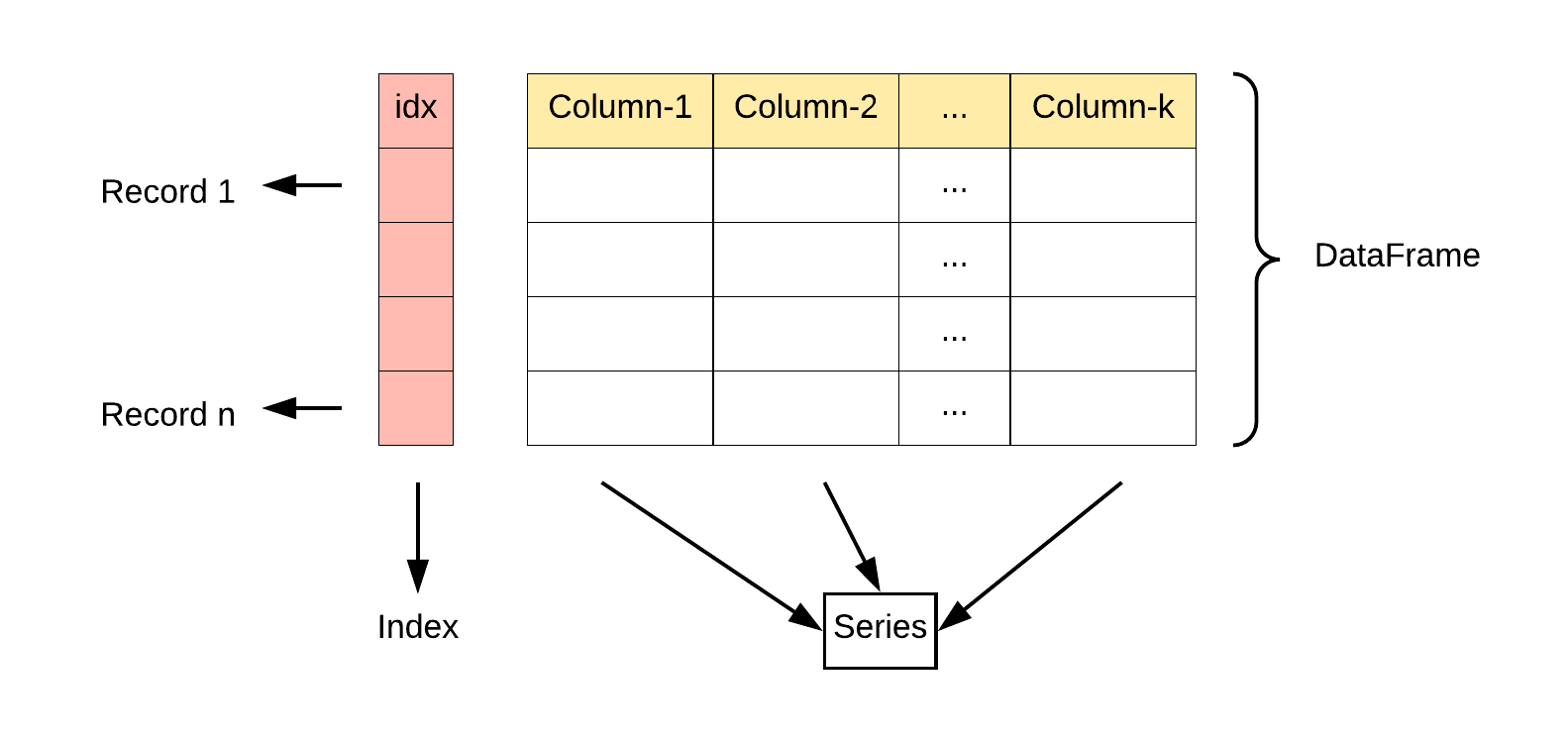
Series: Similar to a one-dimensional array or list, it is composed of a set of data and associated data labels (indices). A Series can be viewed as a column in a DataFrame, or it can exist independently as a one-dimensional data structure.

DataFrame: Similar to a two-dimensional table, it is the most important data structure in Pandas. A DataFrame can be viewed as a table composed of multiple Series arranged by columns. It has both row indices and column indices, making it convenient to perform row/column selection, filtering, merging, and other operations.
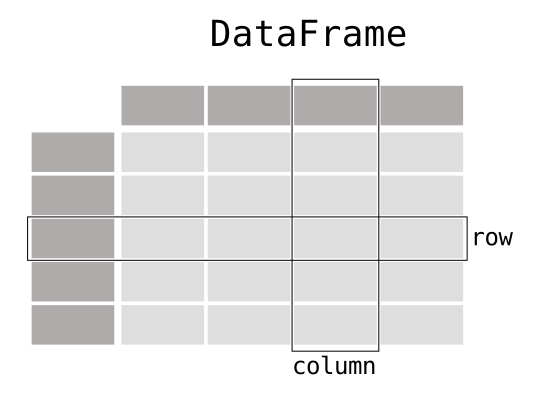
A DataFrame can be regarded as a data structure composed of multiple Series:
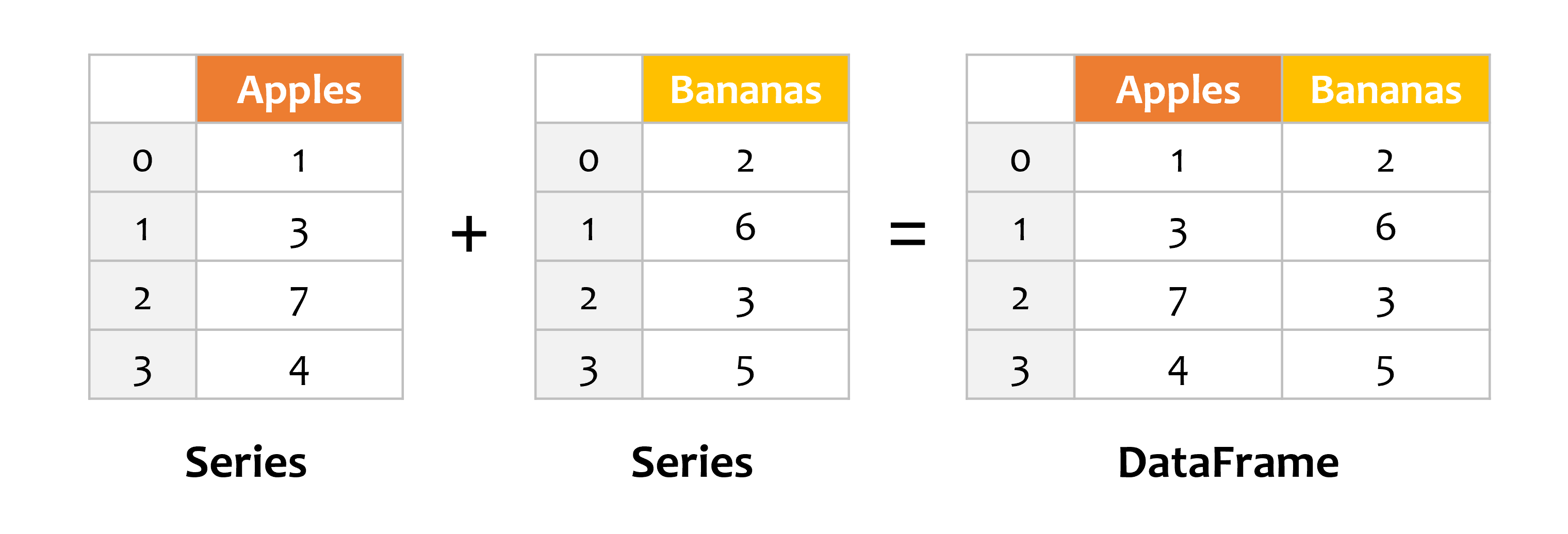
The figure below shows two Series objects being added together to obtain a DataFrame object:
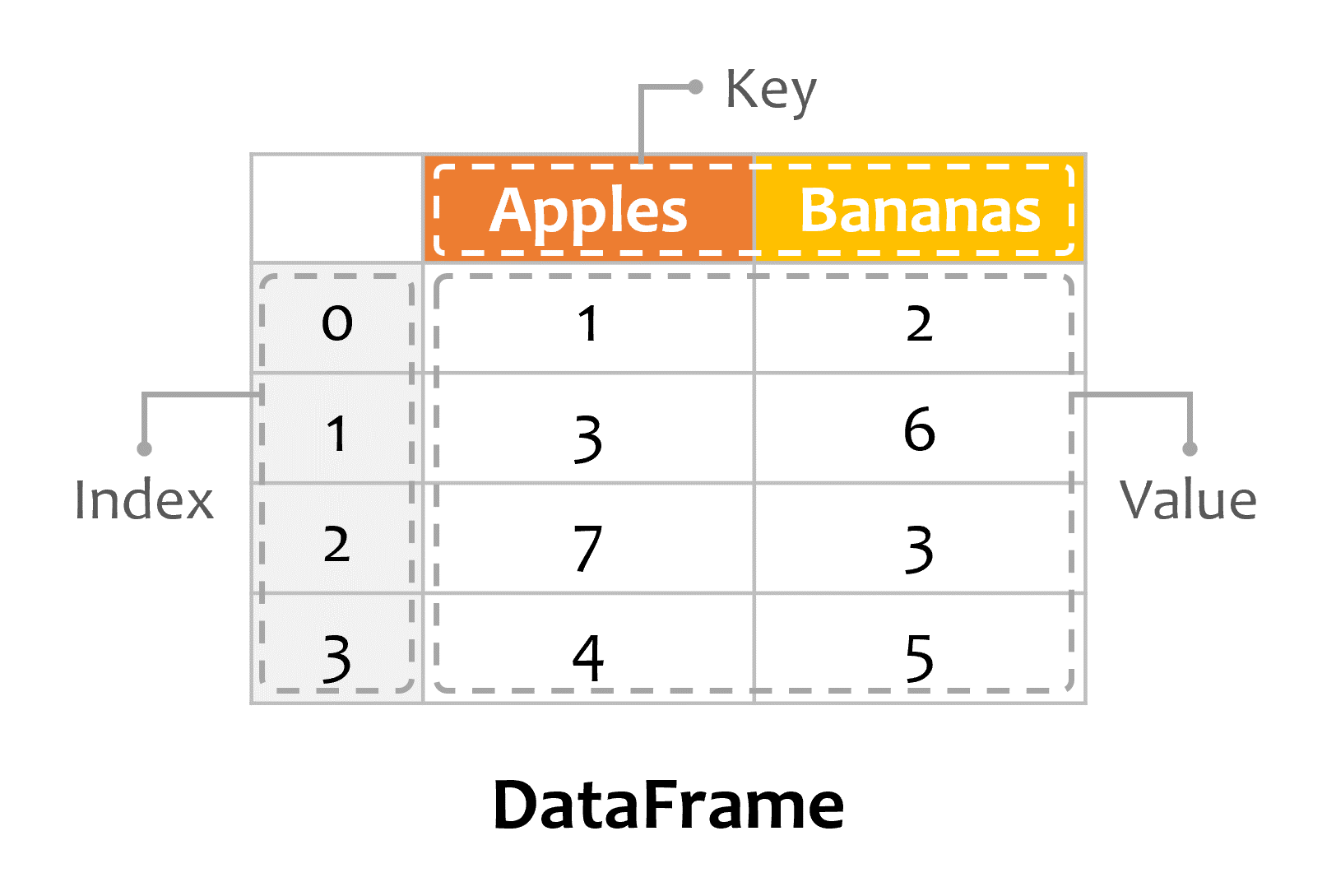
A DataFrame consists of Index, Key, and Value:
Examples
# Create two Series objects
series_apples = pd.Series([1, 3, 7, 4])
series_bananas = pd.Series([2, 6, 3, 5])
# Add the two Series objects to obtain a DataFrame and specify column names
df = pd.DataFrame({ 'Apples': series_apples, 'Bananas': series_bananas })
# Display the DataFrame
print(df)
The output result is:
   Apples  Bananas
0       1        2
1       3        6
2       7        3
3       4        5
Pandas Features
Efficient data structures:
- Series: One-dimensional data structure, similar to a list (List), but with more powerful features and supports indexing.
- DataFrame: Two-dimensional data structure, similar to a table or a data table in a database, where both rows and columns have labels (indices).
Data cleaning and preprocessing:
- Pandas provides rich functions to handle missing values, duplicate data, data type conversion, string operations, etc., helping users easily clean and transform data.
Data manipulation and analysis:
- Supports efficient data selection, filtering, slicing, extracting data by conditions, merging, concatenating multiple datasets, data grouping, summary statistics, and other operations.
- It can perform complex data transformations, such as pivot tables, cross-tabulation, time series analysis, etc.
Data reading and export:
- Supports reading data from data sources in various formats, such as CSV, Excel, JSON, SQL databases, etc.
- It can also export processed data to different formats, such as CSV, Excel, etc.
Data visualization:
- Through integration with Matplotlib and other visualization tools, Pandas can quickly generate common charts such as line charts, bar charts, scatter plots, etc.
Time series analysis:
- Supports powerful time series processing functions, including date parsing, resampling, time zone conversion, etc.
Performance and optimization:
- Pandas optimizes large-scale data processing and provides efficient vectorized operations, avoiding the inefficiency of using Python loops to process data.
- It also supports some memory optimization techniques, such as using
categorytype to handle duplicate data.
Pandas Applications
Pandas is widely used in the fields of data science and data analysis, and its main advantage lies in its ability to process and analyze structured data.
The following are some of the main application areas of Pandas:
Financial sector: Financial institutions use Pandas to process and analyze stock market data, financial data, trading data, etc. The flexibility and efficiency of Pandas enable financial analysts to quickly perform data cleaning, statistical analysis, modeling, and other tasks.
Scientific research: The scientific research field often involves large amounts of experimental data, observational data, etc. Pandas provides powerful tools to process and analyze these data, such as in astronomy, biology, earth science, and other fields.
Enterprise data analysis: Various enterprises and organizations need to analyze business data to support decision-making and strategic planning. Pandas provides functionality for processing and analyzing enterprise data, including sales data, customer data, operational data, etc.
Social media analysis: The massive data generated by social media platforms needs to be analyzed to understand user behavior, trends, and sentiment tendencies. Pandas can help analysts process and analyze social media data, conduct user behavior analysis, sentiment analysis, etc.
Healthcare: The healthcare field needs to process and analyze large amounts of medical data, including patient data, clinical trial data, medical image data, etc. Pandas provides tools to process and analyze these data, supporting medical research and clinical decision-making.
Educational research: The education field can use Pandas to process student performance data, teaching evaluation data, course data, etc., thereby conducting educational research and improving teaching quality.
Marketing: Marketing professionals can use Pandas to analyze market data, customer data, advertising data, etc., to formulate marketing strategies and optimize the effectiveness of marketing activities.
Pandas is a powerful and flexible tool in many fields, providing data scientists, analysts, and engineers with a convenient way to process and analyze data.
Other extensions