Attention Mechanism
The Attention Mechanism is an important technique in deep learning that mimics the way attention is allocated in human visual and cognitive processes. Just as you unconsciously focus on keywords while reading, the attention mechanism enables neural networks to dynamically focus on the most relevant parts of the input data.
Basic Concepts
The core idea of the attention mechanism is:dynamically assigning different weights based on the importance of different parts of the input to the current taskThis weight allocation is not fixed, but dynamically computed based on the context.
Mathematical Expression
The attention mechanism can generally be expressed as:
Attention(Q, K, V) = softmax(QK^T/√d_k)V
where:
- Q (Query): the query item for which the output currently needs to be computed
- K (Key): the key used to match against the query item
- V (Value): the actual value corresponding to the key
- d_k: the dimension of the key, used to scale the dot product result
Why is an Attention Mechanism Needed?
- Solving the long-range dependency problem: traditional RNNs struggle to capture relationships between distant words
- Parallel computing capability: compared to RNN's sequential processing, attention can be computed in parallel
- Interpretability: attention weights can intuitively show what the model focuses on
Self-Attention Mechanism
Self-attention is a special form of the attention mechanism that allows each element in the input sequence to establish connections with all other elements in the sequence.
How It Works
- For each element in the input sequence, compute its similarity score with all elements
- Use the softmax function to convert these scores into weights (between 0 and 1)
- Use these weights to perform a weighted sum of the corresponding values to obtain the output
Example
import torch
import torch.nn.functional as F
def self_attention(query, key, value):
scores = torch.matmul(query, key.transpose(-2, -1)) / (query.size(-1) ** 0.5)
weights = F.softmax(scores, dim=-1)
return torch.matmul(weights, value)
Advantages of Self-Attention
- Global context awareness: every position can directly access information from all positions in the sequence
- Position invariance: does not depend on sequence order, suitable for processing various types of structured data
- Efficient computation: compared to RNN's O(n) complexity, self-attention can be computed in parallel
Multi-Head Attention
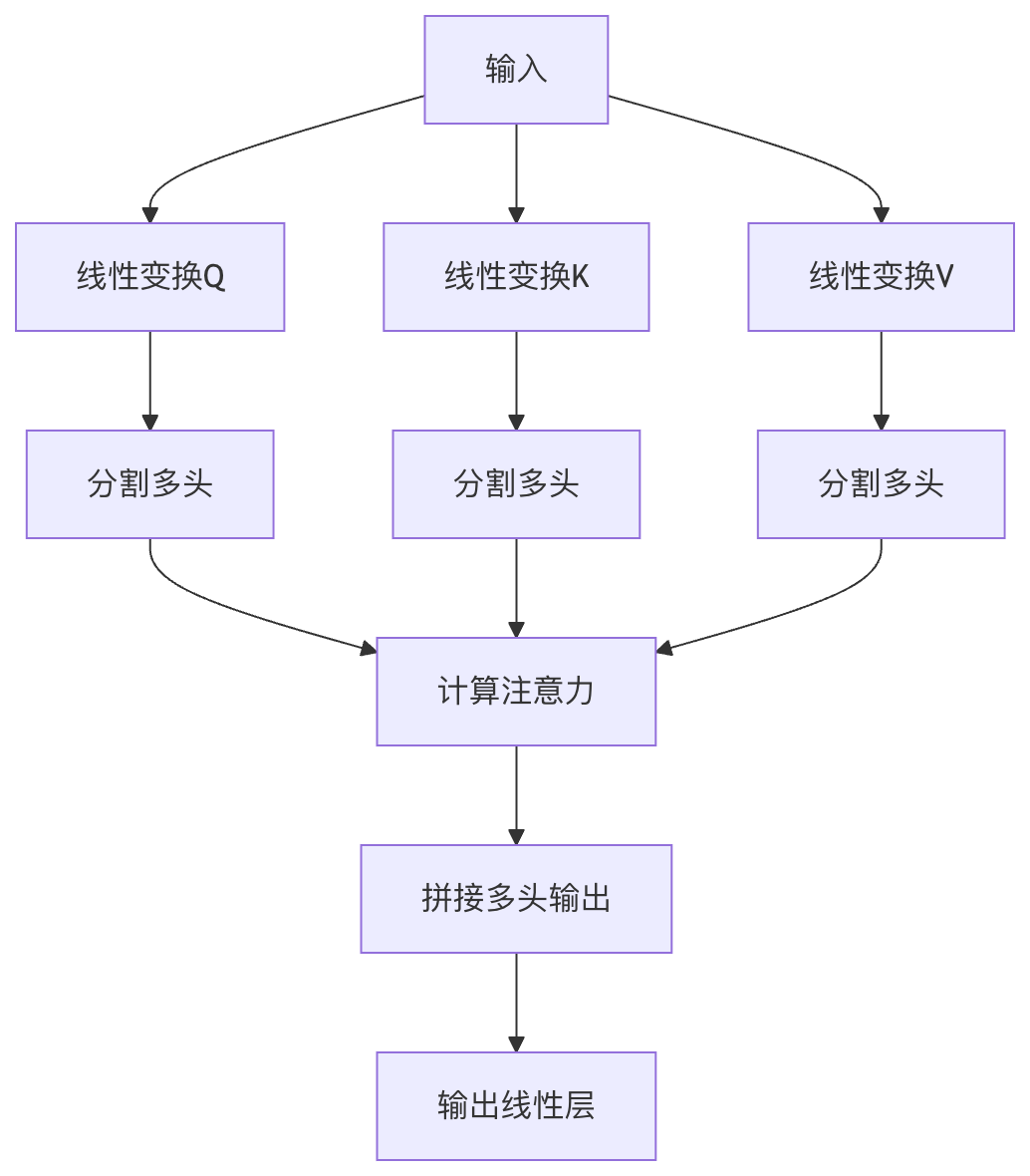
Multi-head attention is an extension of self-attention. It executes the attention mechanism multiple times in parallel and then concatenates the results.
Structure
- Multiple attention heads: typically uses 8 or more parallel attention heads
- Linear transformation layers: each head has its own Q, K, V transformation matrices
- Concatenation and output: concatenate the outputs of all heads and pass them through a linear layer
Advantages of Multi-Head Attention
- Capturing different relationships: each head can learn to focus on relationships from different perspectives
- Enhanced expressive power: stronger feature extraction capability than single-head attention
- Stable training: the combination of multiple heads can reduce the model's dependence on specific patterns
Example
class MultiHeadAttention(nn.Module):
def __init__(self, d_model, num_heads):
super().__init__()
self.d_model = d_model
self.num_heads = num_heads
self.d_k = d_model // num_heads
self.W_q = nn.Linear(d_model, d_model)
self.W_k = nn.Linear(d_model, d_model)
self.W_v = nn.Linear(d_model, d_model)
self.W_o = nn.Linear(d_model, d_model)
def forward(self, query, key, value):
batch_size = query.size(0)
# Linear transformation and split into multiple heads
Q = self.W_q(query).view(batch_size, -1, self.num_heads, self.d_k)
K = self.W_k(key).view(batch_size, -1, self.num_heads, self.d_k)
V = self.W_v(value).view(batch_size, -1, self.num_heads, self.d_k)
# Compute attention
scores = torch.matmul(Q, K.transpose(-2, -1)) / (self.d_k ** 0.5)
weights = F.softmax(scores, dim=-1)
output = torch.matmul(weights, V)
# Concatenate heads and output
output = output.transpose(1, 2).contiguous().view(batch_size, -1, self.d_model)
return self.W_o(output)
Applications of the Attention Mechanism in NLP
The attention mechanism has become a core component of modern NLP systems, especially in the Transformer architecture.
Main Application Scenarios
Machine Translation:
- Classic Seq2Seq with Attention model
- Allows the model to focus on the most relevant parts of the source sentence when generating each target word
Text Summarization:
- Identifying key information in the source text through attention weights
- Generative summarization models use self-attention to capture global relationships in long documents
Question Answering Systems:
- Cross-attention between the question and the document
- Helps the model locate text segments relevant to the question
Language Models:
- GPT series models use masked self-attention
- Allows each word to attend to all preceding words
Case Study: Attention in BERT
BERT (Bidirectional Encoder Representations from Transformers) is a typical representative of models using the attention mechanism:
- Bidirectional self-attention: considers both left and right context simultaneously
- 12/24 Transformer layers: stacked multi-head attention layers
- Pre-training tasks: learns general representations through masked language modeling and next sentence prediction tasks
Example
from transformers import BertModel, BertTokenizer
tokenizer = BertTokenizer.from_pretrained('bert-base-uncased')
model = BertModel.from_pretrained('bert-base-uncased')
inputs = tokenizer("Hello, my dog is cute", return_tensors="pt")
outputs = model(**inputs)
# Get attention weights
attention = outputs.attentions # Contains attention weights for all layers
Variants and Extensions of the Attention Mechanism
1. Scaled Dot-Product Attention
- Introduces a scaling factor (√d_k) to prevent softmax saturation
- High computational efficiency, suitable for large-scale applications
2. Additive Attention
- Uses a single-layer feedforward network to compute the compatibility function
- Suitable for cases where the query and key dimensions differ
3. Local Attention
- Only attends to a subset of the input, reducing computational complexity
- Balances global attention and computational efficiency
4. Sparse Attention
- Only computes attention weights for some positions
- Such as the sliding window attention used by Longformer
Practice Exercises
Exercise 1: Implementing a Basic Attention Mechanism
Example
import torch.nn as nn
import torch.nn.functional as F
class SimpleAttention(nn.Module):
def __init__(self, hidden_size):
super(SimpleAttention, self).__init__()
self.attention = nn.Linear(hidden_size, 1)
def forward(self, encoder_outputs):
# encoder_outputs: [batch_size, seq_len, hidden_size]
attention_scores = self.attention(encoder_outputs).squeeze(2) # [batch_size, seq_len]
attention_weights = F.softmax(attention_scores, dim=1)
context_vector = torch.bmm(attention_weights.unsqueeze(1), encoder_outputs) # [batch_size, 1, hidden_size]
return context_vector.squeeze(1), attention_weights
Exercise 2: Visualizing Attention Weights
Example
import seaborn as sns
def plot_attention(attention_weights, source_tokens, target_tokens):
plt.figure(figsize=(10, 8))
sns.heatmap(attention_weights,
xticklabels=source_tokens,
yticklabels=target_tokens,
cmap="YlGnBu")
plt.xlabel("Source Tokens")
plt.ylabel("Target Tokens")
plt.title("Attention Weights Visualization")
plt.show()
# Example usage
source = ["The", "cat", "sat", "on", "the", "mat"]
target = ["Le", "chat", "s'est", "assis", "sur", "le", "tapis"]
attention = torch.rand(7, 6) # Simulated attention weights
plot_attention(attention, source, target)
Summary and Further Learning
The attention mechanism has become a cornerstone technology of modern deep learning, especially in the NLP field. To study it further:
Read the original papers:
- "Attention Is All You Need" (Vaswani et al., 2017)
- "Neural Machine Translation by Jointly Learning to Align and Translate" (Bahdanau et al., 2015)
Suggested Practice Projects:
- Implement a complete Transformer model
- Use the attention mechanism to improve existing models
- Analyze the impact of different attention variants on performance
Expanded Application Areas:
- Visual attention in computer vision
- Cross-modal attention in multimodal learning
- Graph attention mechanism in graph neural networks
The development of the attention mechanism is still ongoing. Understanding its core principles will help you better master modern deep learning techniques.
Other Extensions