Pre-trained Models
Pre-trained Models are one of the most important technological breakthroughs in the field of Natural Language Processing (NLP) in recent years. Such models are pre-trained on large-scale text data to learn general language representation capabilities, and can then be fine-tuned for specific tasks.
Core Idea
- Two-stage learning: First train on large-scale general data, then fine-tune on small-scale task-specific data
- Transfer learning: Transfer general language knowledge to specific tasks
- Parameter sharing: The same set of model parameters can be used for multiple downstream tasks
Comparison with Traditional Methods
| Feature | Traditional NLP Models | Pre-trained Models |
|---|---|---|
| Data requirements | Requires large amounts of labeled data | Only requires small amounts of labeled data |
| Training method | Train from scratch | Pre-training + fine-tuning |
| Generalization capability | Task-specific | Cross-task general |
| Development efficiency | Low | High |
Development History of Pre-trained Models
1. Word Embedding Era (2013-2017)
- Representative models:Word2Vec、GloVe、FastText
- Characteristics:
- Static word vector representation
- Cannot handle polysemy
- Context-independent
Example
# Word2Vec example
from gensim.models import Word2Vec
sentences = [["natural", "language", "processing"], ["pre-trained", "model", "is very powerful"]]
model = Word2Vec(sentences, vector_size=100, window=5, min_count=1)
print(model.wv["natural"]) # Output word vector
from gensim.models import Word2Vec
sentences = [["natural", "language", "processing"], ["pre-trained", "model", "is very powerful"]]
model = Word2Vec(sentences, vector_size=100, window=5, min_count=1)
print(model.wv["natural"]) # Output word vector
2. Context-Aware Era (2018-2019)
- Representative models:ELMo、ULMFiT
- Breakthrough:
- Dynamic word vector representation
- Can handle polysemy
- Bidirectional language model
3. Transformer Era (2019-present)
- Milestone models:BERT、GPT、T5
- Revolutionary improvements:
- Based on Transformer architecture
- Large-scale pre-training
- Strong transfer learning capability
Mainstream Pre-trained Model Architectures
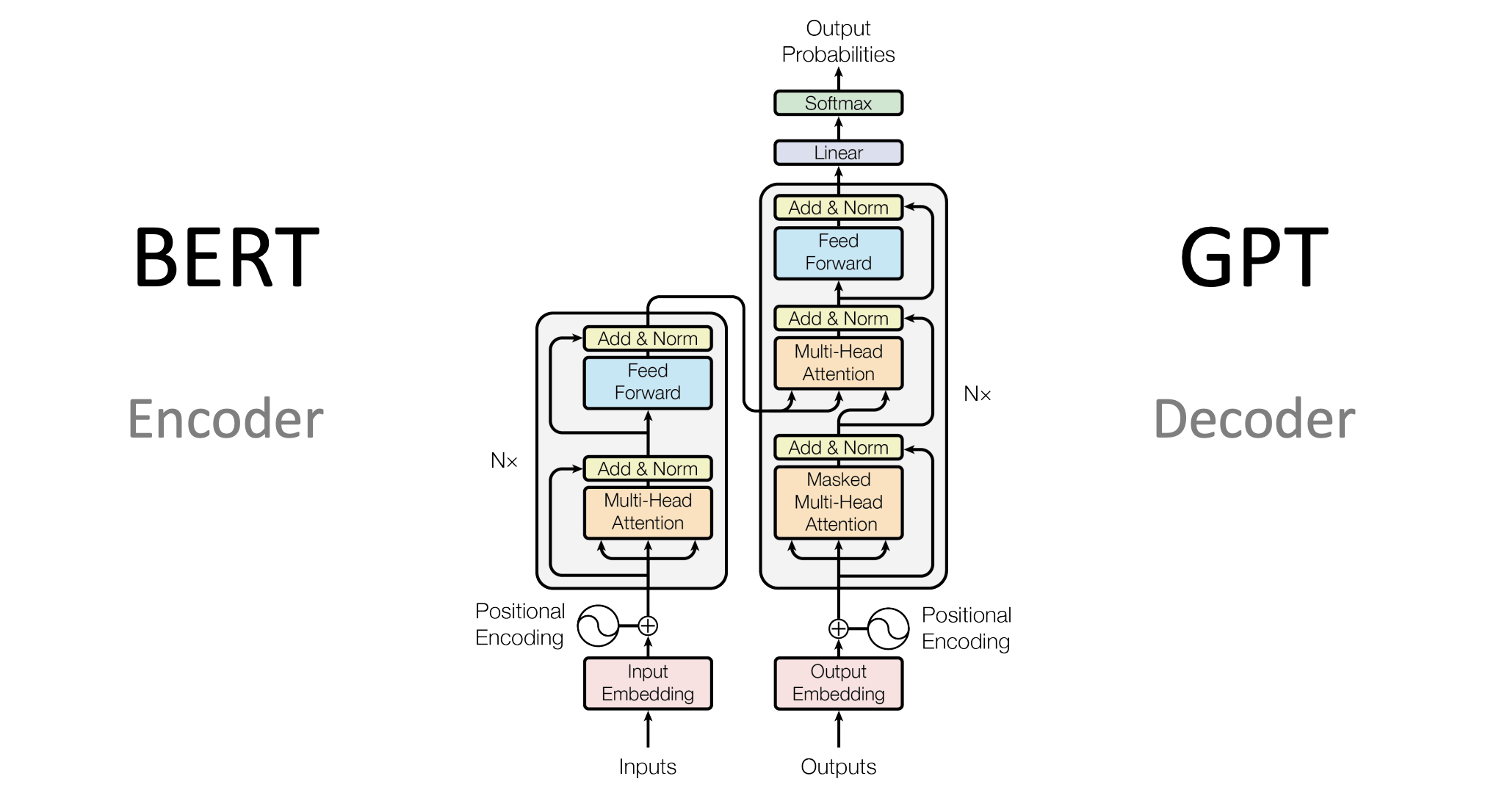
1. Encoder Architecture (BERT Series)

- Characteristics:
- Bidirectional context understanding
- Suitable for classification, QA, and other tasks
- Representative models: BERT, RoBERTa, ALBERT
2. Decoder Architecture (GPT Series)

- Characteristics:
- Unidirectional context (left to right)
- Good at text generation
- Representative models: GPT-3, GPT-4
3. Encoder-Decoder Architecture

- Characteristics:
- Suitable for sequence-to-sequence tasks
- Representative models: T5, BART
Types of Pre-training Tasks
1. Language Model (LM)
- Objective: Predict the next word
- Formula:P(w_t | w_1, ..., w_{t-1})
2. Masked Language Model (MLM)
- Example:
- Original sentence: "Pre-trained model is very powerful"
- After masking: "Pre-trained [MASK] is very powerful"
- Model prediction: "model"
3. Next Sentence Prediction (NSP)
- DetermineWhether two sentences are consecutive
- Positive example:
- Sentence A: "Pre-trained model is very powerful"
- Sentence B: "They can handle multiple NLP tasks"
- Negative example:
- Sentence A: "Pre-trained model is very powerful"
- Sentence B: "The weather is really nice today"
- Positive example:
4. Other Tasks
- Replaced Token Detection (RTD)
- Sentence Order Prediction (SOP)
How to Use Pre-trained Models
1. Using Hugging Face Transformers
Example
from transformers import pipeline
# Sentiment analysis example
classifier = pipeline("sentiment-analysis")
result = classifier("Pre-trained models are really amazing!")
print(result) # [{'label': 'POSITIVE', 'score': 0.9998}]
# Sentiment analysis example
classifier = pipeline("sentiment-analysis")
result = classifier("Pre-trained models are really amazing!")
print(result) # [{'label': 'POSITIVE', 'score': 0.9998}]
2. Model Fine-tuning Process
- Load a pre-trained model
- Prepare a task-specific dataset
- Add a task-specific output layer
- Fine-tune training
Example
from transformers import BertForSequenceClassification, Trainer
model = BertForSequenceClassification.from_pretrained("bert-base-chinese")
# Prepare training data...
trainer = Trainer(model=model, args=training_args, train_dataset=train_dataset)
trainer.train()
model = BertForSequenceClassification.from_pretrained("bert-base-chinese")
# Prepare training data...
trainer = Trainer(model=model, args=training_args, train_dataset=train_dataset)
trainer.train()
3. Key Parameter Descriptions
| Parameter | Description | Typical value |
|---|---|---|
| learning_rate | Learning rate | 2e-5 |
| batch_size | Batch size | 16/32 |
| num_train_epochs | Number of training epochs | 3-5 |
| max_length | Maximum sequence length | 512 |
Application Scenarios of Pre-trained Models
1. Text Classification
- Sentiment analysis
- Spam detection
- Topic classification
2. Question Answering Systems
- Extractive QA
- Open-domain QA
3. Text Generation
- Summarization
- Dialogue systems
- Content creation
4. Other Applications
- Named Entity Recognition (NER)
- Machine translation
- Text similarity computation
Practical Suggestions
Model selection:
- For classification tasks, prioritize BERT-like models
- For generation tasks, choose GPT-like models
- When resources are limited, consider distilled models (e.g., DistilBERT)
Resource management:
- Decrease batch_size when GPU memory is insufficient
- Pay attention to max_length limits when processing long texts
- Consider using model quantization techniques
Performance optimization:
- The learning rate needs fine adjustment
- Early stopping prevents overfitting
- Try different optimizers (AdamW, etc.)
Continuous learning:
- Follow the Hugging Face community
- Track the latest papers on arXiv
- Participate in open-source project practice
Future Development Directions
- Larger scale: Model parameters continue to grow (e.g., GPT-4's trillion parameters)
- Multimodal fusion: Combination of text with images and speech
- Energy efficiency optimization: More efficient training and inference methods
- Domain adaptation: Pre-trained models for specialized domains
- Ethics and safety: Address issues such as bias and toxicity
Pre-trained models are reshaping the technological landscape of the NLP field. Understanding their core principles and mastering application methods will become essential skills for NLP engineers.
Other extensions Linux Command Reference