WebSemantics
The semantics of a word represents its meaning.
The semantics of a thing signifies the thing itself.
Web semantics = the meaning of the Web.
What is Web Semantics?
What is semantics? Simply put, it is about enabling machines to understand content.
- The Beatles were a popular band from Liverpool.
- John Lennon was a member of the Beatles.
- "Hey Jude" is a signature song by the Beatles.
We can easily understand the meaning of the above sentences. But how can these sentences be understood by computers?
Sentences are created by grammatical rules. The grammar of a language defines the rules for creating statements in that language. But how can grammar be turned into semantics?
The Semantic Web enables machines to understand data. Semantic Web technology includes a set of description languages and reasoning logic. It describes ontologies through certain formats.
The Semantic Web is not links between web pages.
The Semantic Web describes the relationships between things (e.g., A is part of B, Y is a member of Z) and the attributes of things (e.g., size, height, age, price, etc.).
 |
The implementation of the Semantic Web is based on XML (eXtensible Markup Language) and the Resource Description Framework (RDF). XML is a tool for defining markup languages. Its content includes XML declarations, DTD (document type declaration) used to define the grammar of the language, detailed specifications describing the markup, and the document itself. The document itself also contains markup and content. RDF is used to express the content of web pages. |
Resource Description Framework
RDF (Resource Description Framework), namely the resource description framework, is a language specification recommended by W3C for describing information resources on the WWW and the relationships between them.
RDF(S) is an important part of the Semantic Web. It uses URIs to identify different objects (including resource nodes, property classes, or property values) and can connect different URIs to clearly express relationships between objects.
Implementation
Although the Semantic Web is a better Web, its implementation is a complex and enormous project. At present, the architecture of the Semantic Web is under construction and mainly requires support from the following two aspects:
(1) Implementation of the data webThat is, through a unified and comprehensive data standard, web information is marked more thoroughly and in more detail, so that the Semantic Web can accurately identify information and distinguish the role and meaning of information. To make Semantic Web searches more precise and thorough, and make it easier to judge whether information is true or false, so as to achieve practical purposes, standards must first be developed. These standards should allow users to add metadata (i.e., detailed explanatory tags) to web content and enable users to specify precisely what they are looking for. Then, a way must be found to ensure that different programs can share content from different websites. Finally, users should be able to add other functions, such as adding application software, etc.
The implementation of the Semantic Web is based on XML (eXtensible Markup Language) and the Resource Description Framework (RDF). XML is a tool for defining markup languages. Its content includes XML declarations, DTD (document type declaration) used to define the grammar of the language, detailed specifications describing the markup, and the document itself. The document itself also contains markup and content. RDF is used to express the content of web pages.
(2) Search engines with semantic analysis capabilitiesIf the data web can be realized in a short time through countless individuals, then the semantization and intellectualization of the Web will have to be achieved through the efforts of the world’s top intelligent groups. Developing an information search engine with semantic analysis capabilities will become the most important step for the Semantic Web. Such an engine can understand human natural language and possess certain reasoning and judgment abilities.
A semantic search engine and a semantically enabled search engine are two different things. The former is merely the use of the Semantic Web as an information retrieval method, whereas a semantically enabled search engine is one that can understand natural language and, through computer reasoning, provide answers that better match the user's needs.
Prospects
The architecture of the Semantic Web is under construction. Currently, international research on this architecture has not yet formed a satisfactory, rigorous logical description and theoretical system. Chinese scholars have only given brief introductions to this architecture based on foreign research, and have not yet produced a systematic exposition.
The implementation of the Semantic Web requires the support of three key technologies: XML, RDF, and Ontology.
XML (eXtensible Markup Language) allows information providers to define their own tags and attribute names as needed, so that the structure of XML documents can be arbitrarily complex.
It has advantages such as a good data storage format, extensibility, high structure, and ease of network transmission. Combined with its unique NS mechanism and the multiple data types and validation mechanisms supported by XML Schema, it has become one of the key technologies of the Semantic Web.
Currently, discussions on the key technologies of the Semantic Web mainly focus on RDF and Ontology.
RDF is a language specification recommended by the W3C for describing resources and the relationships between them. It features simplicity, easy extensibility, openness, easy exchange, and easy integration.
It is worth noting that RDF only defines how resources are described, but does not define what data is used to describe resources. RDF consists of three parts: RDF Data Model, RDF Schema, and RDF Syntax.
Additional:1. The Semantic Web extends the existing Internet by adding content that expresses the meaning of information, enabling computers to work automatically with humans. In other words, resources in the Semantic Web are no longer just connected information; they also include the true meaning of the information, thereby improving the automation and intelligence of computer information processing. Of course, computers do not possess true intelligence. The construction of the Semantic Web requires researchers to effectively represent information and establish unified standards so that computers can process information effectively and automatically.
(Source: He Bin, Zhang Lihou, Principles and Methods of Information Management, Tsinghua University Press, Second Edition, July 2007)
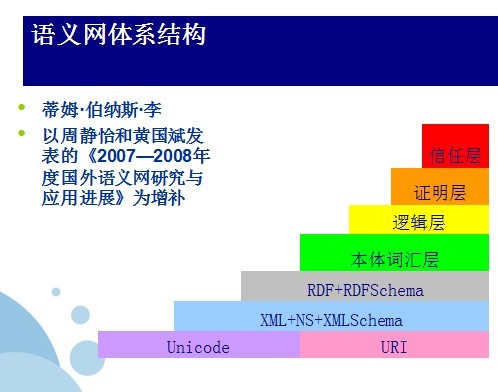
Semantic Web Architecture
- Layer 1: Unicode and URI are the foundation of the entire architecture.
- Layer 2: XML+NS+XMLSchema. It is responsible for syntactically representing the content and structure of data, and separates the presentation form, data structure, and content of web information by using standard format languages.
- Layer 3: RDF + RDF Schema. It provides a semantic model for describing information and types on the Web. RDF (Resource Description Framework), namely the resource description framework, is a language specification recommended by W3C for describing information resources on the WWW and the relationships between them. RDF(S) is an important part of the Semantic Web. It uses URIs to identify different objects (including resource nodes, property classes, or property values) and can connect different URIs to clearly express relationships between objects.
- Layer 4: Ontology vocabulary layer. Ontology is an explicit formal specification of a conceptualization of domain knowledge. In the Semantic Web architecture, the roles of ontology are mainly as follows: (1) Concept description, that is, revealing domain knowledge through concept descriptions; (2) Semantic revelation. Ontology has stronger expressive power than RDF and can reveal richer semantic relationships; (3) Consistency. As an explicit specification of domain knowledge, ontology can ensure semantic consistency, thereby completely solving polysemy, synonymy, and semantic ambiguity; (4) Reasoning support. The certainty of ontology in concept description and its powerful semantic revelation ability effectively guarantee the validity of reasoning at the data level.
- Layer 5: Logic layer. It is responsible for providing axioms and inference principles, laying the foundation for intelligent services. Among them, Description Logic is a formalization of object-based knowledge representation. It absorbs the main ideas of KL-ONE and is a decidable subset of first-order predicate logic. Unlike first-order predicate logic, description logic systems can provide decidable reasoning services. In addition to knowledge representation, description logic is also used in many other fields. It is considered the most important normalized form of object-centric representation languages. The important characteristics of description logic are strong expressive power and decidability, which can guarantee that reasoning algorithms always terminate and return correct results. Among many formal methods for knowledge representation, description logic has received special attention for more than a decade, mainly because it has a clear model-theoretic mechanism; it is well suited for representing application domains through concept taxonomies; and it provides very useful reasoning services.
- Layer 6, the proof layer, and Layer 7, the trust layer, are responsible for providing authentication and trust mechanisms.