機械学習プロジェクトのライフサイクル
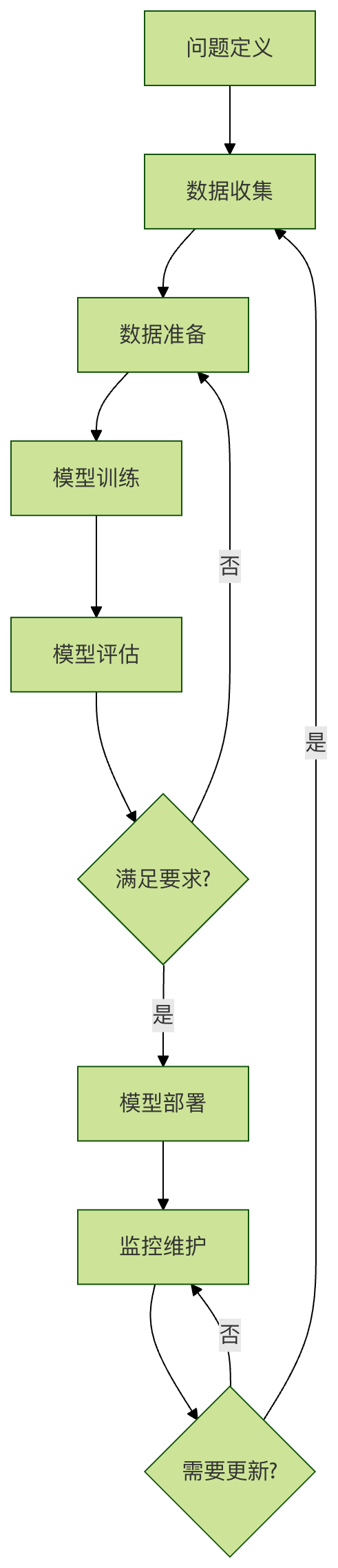
機械学習プロジェクトは家を建てるようなもので、設計図から施工、検収までの完全なプロセスが必要であり、すべての段階が極めて重要で、どれ一つ欠けてもいけません。
機械学習プロセスの6つの中核段階:
- 問題定義:解決すべき問題を明確にする
- データ収集:関連データを取得する
- データ準備:データのクリーニングと前処理
- モデル訓練:アルゴリズムを選択しモデルを訓練する
- モデル評価:モデルの性能を評価する
- モデル展開:モデルを実運用に投入する
第1段階:問題定義
ビジネス問題を明確にする
問題定義は機械学習プロジェクトで最も重要な出発点です、ナビを使う前に目的地を明確にする必要があるのと同じです。
重要な質問
どのような問題を解決するのか?
- 分類問題:メールがスパムかどうかを判定する
- 回帰問題:住宅価格を予測する
- クラスタリング問題:顧客をセグメント化する
- 異常検知:クレジットカード不正を発見する
なぜこの問題が重要なのか?
- ビジネス価値:効率向上、コスト削減、収益増加
- ユーザー価値:体験の改善、パーソナライズされたサービスの提供
成功の基準は何か?
- 定量的指標:精度が90%以上に達すること
- ビジネス指標:コンバージョン率が20%向上
問題定義の例
実例
# 問題定義の例:ECレコメンドシステム
class ProblemDefinition:
def __init__(self):
# ビジネス問題
self.business_problem = "ユーザーの購入コンバージョン率が低く、レコメンドの精度を高める必要がある"
# 技術問題
self.technical_problem = "ユーザーの行動に基づいて、ユーザーが購入する可能性のある商品を予測する"
# 問題タイプ
self.problem_type = "レコメンドシステム(分類+ランキング)"
# 成功基準
self.success_criteria = {
"クリック率の向上": "15%",
"コンバージョン率の向上": "10%",
"レコメンド精度": "80%"
}
# 制約条件
self.constraints = {
"応答時間": "< 100ms",
"データプライバシー": "GDPR要件への準拠",
"計算リソース": "既存のサーバー構成"
}
def define_features_and_labels(self):
"""特徴とラベルを定義"""
features = {
"ユーザー特徴": ["年齢", "性別", "購入履歴", "閲覧行動"],
"商品特徴": ["カテゴリ", "価格", "評価", に庫],
"コンテキスト特徴": ["時間", "デバイス", "地理位置情報"]
}
labels = {
"主要ラベル": "クリックしたかどうか",
"副次ラベル": "購入したかどうか",
"補助ラベル": "滞在時間"
}
return features, labels
def print_definition(self):
"""問題定義を出力"""
print("=" * 50)
print("機械学習問題の定義")
print("=" * 50)
print(f"ビジネス問題:{self.business_problem}")
print(f"技術問題:{self.technical_problem}")
print(f"問題タイプ:{self.problem_type}")
print("\n成功基準:")
for metric, target in self.success_criteria.items():
print(f" {metric}:{target}")
print("\n制約条件:")
for constraint, limit in self.constraints.items():
print(f" {constraint}:{limit}")
features, labels = self.define_features_and_labels()
print("\n特徴定義:")
for category, items in features.items():
print(f" {category}:{', '.join(items)}")
print("\nラベル定義:")
for label_type, label_name in labels.items():
print(f" {label_type}:{label_name}")
# 使用例
problem = ProblemDefinition()
problem.print_definition()
class ProblemDefinition:
def __init__(self):
# ビジネス問題
self.business_problem = "ユーザーの購入コンバージョン率が低く、レコメンドの精度を高める必要がある"
# 技術問題
self.technical_problem = "ユーザーの行動に基づいて、ユーザーが購入する可能性のある商品を予測する"
# 問題タイプ
self.problem_type = "レコメンドシステム(分類+ランキング)"
# 成功基準
self.success_criteria = {
"クリック率の向上": "15%",
"コンバージョン率の向上": "10%",
"レコメンド精度": "80%"
}
# 制約条件
self.constraints = {
"応答時間": "< 100ms",
"データプライバシー": "GDPR要件への準拠",
"計算リソース": "既存のサーバー構成"
}
def define_features_and_labels(self):
"""特徴とラベルを定義"""
features = {
"ユーザー特徴": ["年齢", "性別", "購入履歴", "閲覧行動"],
"商品特徴": ["カテゴリ", "価格", "評価", に庫],
"コンテキスト特徴": ["時間", "デバイス", "地理位置情報"]
}
labels = {
"主要ラベル": "クリックしたかどうか",
"副次ラベル": "購入したかどうか",
"補助ラベル": "滞在時間"
}
return features, labels
def print_definition(self):
"""問題定義を出力"""
print("=" * 50)
print("機械学習問題の定義")
print("=" * 50)
print(f"ビジネス問題:{self.business_problem}")
print(f"技術問題:{self.technical_problem}")
print(f"問題タイプ:{self.problem_type}")
print("\n成功基準:")
for metric, target in self.success_criteria.items():
print(f" {metric}:{target}")
print("\n制約条件:")
for constraint, limit in self.constraints.items():
print(f" {constraint}:{limit}")
features, labels = self.define_features_and_labels()
print("\n特徴定義:")
for category, items in features.items():
print(f" {category}:{', '.join(items)}")
print("\nラベル定義:")
for label_type, label_name in labels.items():
print(f" {label_type}:{label_name}")
# 使用例
problem = ProblemDefinition()
problem.print_definition()
出力内容:
==================================================
机器学习问题定义
==================================================
业务问题:用户购买转化率低,需要提高推荐精准度
技术问题:基于用户行为预测用户可能购买的商品
问题类型:推荐系统(分类+排序)

成功标准:
  点击率提升:15%
  转化率提升:10%
  推荐准确率:80%

约束条件:
  响应时间:< 100ms
  数据隐私:符合 GDPR 要求
  计算资源:现有服务器配置

特征定义:
  用户特征:年龄, 性别, 购买历史, 浏览行为
  商品特征:类别, 价格, 评分, 库存
  上下文特征:时间, 设备, 地理位置

标签定义:
  主要标签:是否点击
  次要标签:是否购买
  辅助标签:停留时间
第2段階:データ収集
データソース
データは機械学習の燃料です、適切なデータがなければ、どんなに優れたアルゴリズムも機能しません。
一般的なデータソース
- 内部データ:会社の業務データ、ユーザー行動データ
- 外部データ:公開データセット、第三者データサービス
- Webクローラー:Webページデータ、ソーシャルメディアデータ
- センサーデータ:IoTデバイス、監視システム
データ収集の例
実例
# データ収集の例:複数のデータソースをシミュレーション
import pandas as pd
import numpy as np
from datetime import datetime, timedelta
class DataCollector:
def __init__(self):
self.collected_data = {}
def collect_user_data(self, n_users=1000):
"""ユーザーデータを収集"""
np.random.seed(42)
user_data = {
'user_id': range(1, n_users + 1),
'age': np.random.randint(18, 65, n_users),
'gender': np.random.choice(['男性', '女性'], n_users),
'city': np.random.choice(['北京', '上海', '広州', '深セン'], n_users),
'registration_date': [
datetime.now() - timedelta(days=np.random.randint(1, 365))
for _ in range(n_users)
]
}
self.collected_data['users'] = pd.DataFrame(user_data)
print(f"{len(user_data['user_id'])} 件のユーザーデータを収集しました")
return self.collected_data['users']
def collect_behavior_data(self, n_behaviors=5000):
"""ユーザー行動データを収集"""
np.random.seed(42)
user_ids = np.random.choice(range(1, 1001), n_behaviors)
product_ids = np.random.choice(range(1, 501), n_behaviors)
behavior_data = {
'behavior_id': range(1, n_behaviors + 1),
'user_id': user_ids,
'product_id': product_ids,
'behavior_type': np.random.choice(
['閲覧', 'クリック', 'カートに追加', '購入'], n_behaviors,
p=[0.4, 0.3, 0.2, 0.1]
),
'timestamp': [
datetime.now() - timedelta(minutes=np.random.randint(1, 10080))
for _ in range(n_behaviors)
],
'duration': np.random.exponential(30, n_behaviors) # 滞在時間(秒)
}
self.collected_data['behaviors'] = pd.DataFrame(behavior_data)
print(f"{len(behavior_data['behavior_id'])} 件の行動データを収集しました")
return self.collected_data['behaviors']
def collect_product_data(self, n_products=500):
"""商品データを収集"""
np.random.seed(42)
categories = ['電子製品', '衣類', '食品', '家庭用品', '書籍']
product_data = {
'product_id': range(1, n_products + 1),
'category': np.random.choice(categories, n_products),
'price': np.random.uniform(10, 1000, n_products),
'rating': np.random.uniform(3.0, 5.0, n_products),
'stock': np.random.randint(0, 1000, n_products)
}
self.collected_data['products'] = pd.DataFrame(product_data)
print(f"{len(product_data['product_id'])} 件の商品データを収集しました")
return self.collected_data['products']
def get_data_summary(self):
"""データ概要を取得"""
print("\nデータ収集概要:")
for name, df in self.collected_data.items():
print(f"\n{name} データセット:")
print(f" 形状:{df.shape}")
print(f" 列名:{list(df.columns)}")
print(f" 欠損値:{df.isnull().sum().sum()}")
print(f" サンプルデータ:")
print(df.head(2))
# 使用例
collector = DataCollector()
collector.collect_user_data()
collector.collect_behavior_data()
collector.collect_product_data()
collector.get_data_summary()
import pandas as pd
import numpy as np
from datetime import datetime, timedelta
class DataCollector:
def __init__(self):
self.collected_data = {}
def collect_user_data(self, n_users=1000):
"""ユーザーデータを収集"""
np.random.seed(42)
user_data = {
'user_id': range(1, n_users + 1),
'age': np.random.randint(18, 65, n_users),
'gender': np.random.choice(['男性', '女性'], n_users),
'city': np.random.choice(['北京', '上海', '広州', '深セン'], n_users),
'registration_date': [
datetime.now() - timedelta(days=np.random.randint(1, 365))
for _ in range(n_users)
]
}
self.collected_data['users'] = pd.DataFrame(user_data)
print(f"{len(user_data['user_id'])} 件のユーザーデータを収集しました")
return self.collected_data['users']
def collect_behavior_data(self, n_behaviors=5000):
"""ユーザー行動データを収集"""
np.random.seed(42)
user_ids = np.random.choice(range(1, 1001), n_behaviors)
product_ids = np.random.choice(range(1, 501), n_behaviors)
behavior_data = {
'behavior_id': range(1, n_behaviors + 1),
'user_id': user_ids,
'product_id': product_ids,
'behavior_type': np.random.choice(
['閲覧', 'クリック', 'カートに追加', '購入'], n_behaviors,
p=[0.4, 0.3, 0.2, 0.1]
),
'timestamp': [
datetime.now() - timedelta(minutes=np.random.randint(1, 10080))
for _ in range(n_behaviors)
],
'duration': np.random.exponential(30, n_behaviors) # 滞在時間(秒)
}
self.collected_data['behaviors'] = pd.DataFrame(behavior_data)
print(f"{len(behavior_data['behavior_id'])} 件の行動データを収集しました")
return self.collected_data['behaviors']
def collect_product_data(self, n_products=500):
"""商品データを収集"""
np.random.seed(42)
categories = ['電子製品', '衣類', '食品', '家庭用品', '書籍']
product_data = {
'product_id': range(1, n_products + 1),
'category': np.random.choice(categories, n_products),
'price': np.random.uniform(10, 1000, n_products),
'rating': np.random.uniform(3.0, 5.0, n_products),
'stock': np.random.randint(0, 1000, n_products)
}
self.collected_data['products'] = pd.DataFrame(product_data)
print(f"{len(product_data['product_id'])} 件の商品データを収集しました")
return self.collected_data['products']
def get_data_summary(self):
"""データ概要を取得"""
print("\nデータ収集概要:")
for name, df in self.collected_data.items():
print(f"\n{name} データセット:")
print(f" 形状:{df.shape}")
print(f" 列名:{list(df.columns)}")
print(f" 欠損値:{df.isnull().sum().sum()}")
print(f" サンプルデータ:")
print(df.head(2))
# 使用例
collector = DataCollector()
collector.collect_user_data()
collector.collect_behavior_data()
collector.collect_product_data()
collector.get_data_summary()
第3段階:データ準備
データ準備の重要性
データ準備は機械学習プロジェクトの60〜80%の時間を占めます、料理前の下準備と同じくらい重要です。
データ準備の主なタスク
- データクリーニング:欠損値、異常値、重複値の処理
- 特徴エンジニアリング:新しい特徴の作成、重要な特徴の選択
- データ変換:標準化、正規化、エンコーディング
- データ分割:トレーニングセット、検証セット、テストセット
データ準備の例
実例
# データ準備の例
import pandas as pd
import numpy as np
from sklearn.preprocessing import StandardScaler, LabelEncoder
from sklearn.model_selection import train_test_split
class DataPreparer:
def __init__(self, data):
self.data = data.copy()
self.processed_data = None
def clean_data(self):
"""データクリーニング"""
print("データクリーニングを開始...")
# 1. 欠損値の処理
print(f"処理前の欠損値の数:{self.data.isnull().sum().sum()}")
# 数値列は平均値で補完
numeric_columns = self.data.select_dtypes(include=[np.number]).columns
for col in numeric_columns:
if self.data[col].isnull().sum() > 0:
self.data[col].fillna(self.data[col].mean(), inplace=True)
# カテゴリ列は最頻値で補完
categorical_columns = self.data.select_dtypes(include=['object']).columns
for col in categorical_columns:
if self.data[col].isnull().sum() > 0:
mode_val = self.data[col].mode()[0]
self.data[col].fillna(mode_val, inplace=True)
print(f"処理後の欠損値の数:{self.data.isnull().sum().sum()}")
# 2. 重複値の処理
duplicates_before = self.data.duplicated().sum()
self.data.drop_duplicates(inplace=True)
duplicates_after = self.data.duplicated().sum()
print(f"重複値の削除:{duplicates_before - duplicates_after} 件")
# 3. 異常値の処理(簡単な方法:IQRを使用)
for col in numeric_columns:
Q1 = self.data[col].quantile(0.25)
Q3 = self.data[col].quantile(0.75)
IQR = Q3 - Q1
lower_bound = Q1 - 1.5 * IQR
upper_bound = Q3 + 1.5 * IQR
outliers = ((self.data[col] < lower_bound) |
(self.data[col] > upper_bound)).sum()
if outliers > 0:
# 境界値で異常値を置換
self.data[col] = self.data[col].clip(lower_bound, upper_bound)
print(f"{col} 列の {outliers} 個の異常値を処理")
return self.data
def feature_engineering(self):
"""特徴エンジニアリング"""
print("\n特徴エンジニアリングを開始...")
# 1. 新しい特徴の作成(例)
if 'price' in self.data.columns and 'rating' in self.data.columns:
# コストパフォーマンス特徴を作成
self.data['price_per_rating'] = self.data['price'] / self.data['rating']
print("新しい特徴を作成:price_per_rating")
# 2. 特徴選択(簡単な例:低分散特徴の削除)
numeric_columns = self.data.select_dtypes(include=[np.number]).columns
low_variance_features = []
for col in numeric_columns:
if self.data[col].var() < 0.01: # 分散閾値
low_variance_features.append(col)
if low_variance_features:
self.data.drop(columns=low_variance_features, inplace=True)
print(f"低分散特徴の削除:{low_variance_features}")
return self.data
def transform_data(self):
"""データ変換"""
print("\nデータ変換を開始...")
# 1. カテゴリ変数のエンコード
categorical_columns = self.data.select_dtypes(include=['object']).columns
label_encoders = {}
for col in categorical_columns:
le = LabelEncoder()
self.data[col] = le.fit_transform(self.data[col])
label_encoders[col] = le
print(f"カテゴリ変数のエンコード:{col}")
# 2. 数値変数の標準化
numeric_columns = self.data.select_dtypes(include=[np.number]).columns
scaler = StandardScaler()
if len(numeric_columns) > 0:
self.data[numeric_columns] = scaler.fit_transform(self.data[numeric_columns])
print(f"数値変数の標準化:{list(numeric_columns)}")
return self.data, label_encoders, scaler
def split_data(self, target_column, test_size=0.2, val_size=0.2):
"""データ分割"""
print(f"\nデータ分割を開始(テストセット比率:{test_size}、検証セット比率:{val_size})...")
X = self.data.drop(columns=[target_column])
y = self.data[target_column]
# まずテストセットを分離する
X_temp, X_test, y_temp, y_test = train_test_split(
X, y, test_size=test_size, random_state=42
)
# 次に残りのデータから検証セットを分離する
val_size_adjusted = val_size / (1 - test_size)
X_train, X_val, y_train, y_val = train_test_split(
X_temp, y_temp, test_size=val_size_adjusted, random_state=42
)
print(f"トレーニングセットのサイズ:{X_train.shape)
print(f"検証セットのサイズ:{X_val.shape)
print(f"テストセットのサイズ:{X_test.shape)
return {
'X_train': X_train, 'y_train': y_train,
'X_val': X_val, 'y_val': y_val,
'X_test': X_test, 'y_test': y_test
}
def prepare_pipeline(self, target_column):
"""完全なデータ準備パイプライン"""
print("=" * 50)
print("データ準備パイプライン")
print("=" * 50)
# 1. データクリーニング
self.clean_data()
# 2. 特徴量エンジニアリング
self.feature_engineering()
# 3. データ変換
processed_data, encoders, scaler = self.transform_data()
# 4. データ分割
splits = self.split_data(target_column)
self.processed_data = processed_data
return splits, encoders, scaler
# サンプルデータを作成してデータ準備をデモする
np.random.seed(42)
sample_data = pd.DataFrame({
'age': np.random.randint(18, 65, 1000),
'income': np.random.normal(50000, 15000, 1000),
'gender': np.random.choice(['男', '女'], 1000),
'city': np.random.choice(['北京', '上海', '広州'], 1000),
'target': np.random.choice([0, 1], 1000)
})
# 欠損値と外れ値をいくつか追加
sample_data.loc[np.random.choice(1000, 50), 'income'] = np.nan
sample_data.loc[np.random.choice(1000, 20), 'age'] = np.random.randint(100, 150)
preparer = DataPreparer(sample_data)
splits, encoders, scaler = preparer.prepare_pipeline('target')
import pandas as pd
import numpy as np
from sklearn.preprocessing import StandardScaler, LabelEncoder
from sklearn.model_selection import train_test_split
class DataPreparer:
def __init__(self, data):
self.data = data.copy()
self.processed_data = None
def clean_data(self):
"""データクリーニング"""
print("データクリーニングを開始...")
# 1. 欠損値の処理
print(f"処理前の欠損値の数:{self.data.isnull().sum().sum()}")
# 数値列は平均値で補完
numeric_columns = self.data.select_dtypes(include=[np.number]).columns
for col in numeric_columns:
if self.data[col].isnull().sum() > 0:
self.data[col].fillna(self.data[col].mean(), inplace=True)
# カテゴリ列は最頻値で補完
categorical_columns = self.data.select_dtypes(include=['object']).columns
for col in categorical_columns:
if self.data[col].isnull().sum() > 0:
mode_val = self.data[col].mode()[0]
self.data[col].fillna(mode_val, inplace=True)
print(f"処理後の欠損値の数:{self.data.isnull().sum().sum()}")
# 2. 重複値の処理
duplicates_before = self.data.duplicated().sum()
self.data.drop_duplicates(inplace=True)
duplicates_after = self.data.duplicated().sum()
print(f"重複値の削除:{duplicates_before - duplicates_after} 件")
# 3. 異常値の処理(簡単な方法:IQRを使用)
for col in numeric_columns:
Q1 = self.data[col].quantile(0.25)
Q3 = self.data[col].quantile(0.75)
IQR = Q3 - Q1
lower_bound = Q1 - 1.5 * IQR
upper_bound = Q3 + 1.5 * IQR
outliers = ((self.data[col] < lower_bound) |
(self.data[col] > upper_bound)).sum()
if outliers > 0:
# 境界値で異常値を置換
self.data[col] = self.data[col].clip(lower_bound, upper_bound)
print(f"{col} 列の {outliers} 個の異常値を処理")
return self.data
def feature_engineering(self):
"""特徴エンジニアリング"""
print("\n特徴エンジニアリングを開始...")
# 1. 新しい特徴の作成(例)
if 'price' in self.data.columns and 'rating' in self.data.columns:
# コストパフォーマンス特徴を作成
self.data['price_per_rating'] = self.data['price'] / self.data['rating']
print("新しい特徴を作成:price_per_rating")
# 2. 特徴選択(簡単な例:低分散特徴の削除)
numeric_columns = self.data.select_dtypes(include=[np.number]).columns
low_variance_features = []
for col in numeric_columns:
if self.data[col].var() < 0.01: # 分散閾値
low_variance_features.append(col)
if low_variance_features:
self.data.drop(columns=low_variance_features, inplace=True)
print(f"低分散特徴の削除:{low_variance_features}")
return self.data
def transform_data(self):
"""データ変換"""
print("\nデータ変換を開始...")
# 1. カテゴリ変数のエンコード
categorical_columns = self.data.select_dtypes(include=['object']).columns
label_encoders = {}
for col in categorical_columns:
le = LabelEncoder()
self.data[col] = le.fit_transform(self.data[col])
label_encoders[col] = le
print(f"カテゴリ変数のエンコード:{col}")
# 2. 数値変数の標準化
numeric_columns = self.data.select_dtypes(include=[np.number]).columns
scaler = StandardScaler()
if len(numeric_columns) > 0:
self.data[numeric_columns] = scaler.fit_transform(self.data[numeric_columns])
print(f"数値変数の標準化:{list(numeric_columns)}")
return self.data, label_encoders, scaler
def split_data(self, target_column, test_size=0.2, val_size=0.2):
"""データ分割"""
print(f"\nデータ分割を開始(テストセット比率:{test_size}、検証セット比率:{val_size})...")
X = self.data.drop(columns=[target_column])
y = self.data[target_column]
# まずテストセットを分離する
X_temp, X_test, y_temp, y_test = train_test_split(
X, y, test_size=test_size, random_state=42
)
# 次に残りのデータから検証セットを分離する
val_size_adjusted = val_size / (1 - test_size)
X_train, X_val, y_train, y_val = train_test_split(
X_temp, y_temp, test_size=val_size_adjusted, random_state=42
)
print(f"トレーニングセットのサイズ:{X_train.shape)
print(f"検証セットのサイズ:{X_val.shape)
print(f"テストセットのサイズ:{X_test.shape)
return {
'X_train': X_train, 'y_train': y_train,
'X_val': X_val, 'y_val': y_val,
'X_test': X_test, 'y_test': y_test
}
def prepare_pipeline(self, target_column):
"""完全なデータ準備パイプライン"""
print("=" * 50)
print("データ準備パイプライン")
print("=" * 50)
# 1. データクリーニング
self.clean_data()
# 2. 特徴量エンジニアリング
self.feature_engineering()
# 3. データ変換
processed_data, encoders, scaler = self.transform_data()
# 4. データ分割
splits = self.split_data(target_column)
self.processed_data = processed_data
return splits, encoders, scaler
# サンプルデータを作成してデータ準備をデモする
np.random.seed(42)
sample_data = pd.DataFrame({
'age': np.random.randint(18, 65, 1000),
'income': np.random.normal(50000, 15000, 1000),
'gender': np.random.choice(['男', '女'], 1000),
'city': np.random.choice(['北京', '上海', '広州'], 1000),
'target': np.random.choice([0, 1], 1000)
})
# 欠損値と外れ値をいくつか追加
sample_data.loc[np.random.choice(1000, 50), 'income'] = np.nan
sample_data.loc[np.random.choice(1000, 20), 'age'] = np.random.randint(100, 150)
preparer = DataPreparer(sample_data)
splits, encoders, scaler = preparer.prepare_pipeline('target')
第4段階:モデル訓練
モデル選択戦略
適切なモデルを選択することは成功の鍵です、まるで仕事に適した道具を選ぶのと同じです。
モデル選択の考慮事項
- 問題タイプ:分類、回帰、クラスタリングなど
- データの特徴:データ量、特徴量の数、データタイプ
- パフォーマンス要件:精度、速度、解釈可能性
- リソース制約:計算リソース、時間制限
モデル訓練の例
実例
# モデルトレーニングの例
from sklearn.linear_model import LogisticRegression, LinearRegression
from sklearn.ensemble import RandomForestClassifier, RandomForestRegressor
from sklearn.svm import SVC, SVR
from sklearn.metrics import accuracy_score, mean_squared_error, classification_report
class ModelTrainer:
def __init__(self):
self.models = {}
self.trained_models = {}
def register_model(self, name, model, problem_type):
"""モデルの登録"""
self.models[name] = {
'model': model,
'problem_type': problem_type
}
print(f"モデルの登録:{name}({problem_type})")
def train_single_model(self, name, X_train, y_train):
"""単一モデルのトレーニング"""
if name not in self.models:
raise ValueError(f"モデル {name} は未登録です")
model_info = self.models[name]
model = model_info['model']
print(f"\nモデルのトレーニング:{name}")
model.fit(X_train, y_train)
self.trained_models[name] = model
print(f"モデル {name} のトレーニングが完了しました")
return model
def train_all_models(self, X_train, y_train):
"""登録済みの全モデルをトレーニング"""
print("\n全モデルのトレーニングを開始...")
for name in self.models.keys():
try:
self.train_single_model(name, X_train, y_train)
except Exception as e:
print(f"モデル {name} のトレーニング中にエラーが発生しました:{e}")
return self.trained_models
def evaluate_models(self, X_test, y_test):
"""トレーニング済みの全モデルを評価"""
print("\nモデル評価結果:")
print("-" * 50)
results = {}
for name, model in self.trained_models.items():
problem_type = self.models[name]['problem_type']
# 予測
y_pred = model.predict(X_test)
# 問題タイプに応じて評価指標を選択
if problem_type == 'classification':
accuracy = accuracy_score(y_test, y_pred)
results[name] = {'accuracy': accuracy}
print(f"{name}: 正解率 = {accuracy:.4f}")
# 詳細レポート
print(classification_report(y_test, y_pred))
elif problem_type == 'regression':
mse = mean_squared_error(y_test, y_pred)
rmse = np.sqrt(mse)
results[name] = {'mse': mse, 'rmse': rmse}
print(f"{name}: MSE = {mse:.4f}, RMSE = {rmse:.4f}")
print("-" * 50)
return results
def get_best_model(self, results, metric='accuracy'):
"""最良モデルの取得"""
if not results:
return None
best_model_name = max(results.keys(), key=lambda x: results[x].get(metric, 0))
best_score = results[best_model_name][metric]
print(f"\n最良モデル:{best_model_name}({metric} = {best_score:.4f})")
return best_model_name, self.trained_models[best_model_name]
# 使用例
trainer = ModelTrainer()
# 異なるタイプのモデルを登録
trainer.register_model('ロジスティック回帰', LogisticRegression(random_state=42), 'classification')
trainer.register_model('ランダムフォレスト', RandomForestClassifier(n_estimators=100, random_state=42), 'classification')
trainer.register_model('サポートベクターマシン', SVC(random_state=42), 'classification')
# トレーニングデータを作成
X_train = splits['X_train']
y_train = splits['y_train']
X_test = splits['X_test']
y_test = splits['y_test']
# 全モデルをトレーニング
trained_models = trainer.train_all_models(X_train, y_train)
# モデルを評価
results = trainer.evaluate_models(X_test, y_test)
# 最良モデルを取得
best_name, best_model = trainer.get_best_model(results)
from sklearn.linear_model import LogisticRegression, LinearRegression
from sklearn.ensemble import RandomForestClassifier, RandomForestRegressor
from sklearn.svm import SVC, SVR
from sklearn.metrics import accuracy_score, mean_squared_error, classification_report
class ModelTrainer:
def __init__(self):
self.models = {}
self.trained_models = {}
def register_model(self, name, model, problem_type):
"""モデルの登録"""
self.models[name] = {
'model': model,
'problem_type': problem_type
}
print(f"モデルの登録:{name}({problem_type})")
def train_single_model(self, name, X_train, y_train):
"""単一モデルのトレーニング"""
if name not in self.models:
raise ValueError(f"モデル {name} は未登録です")
model_info = self.models[name]
model = model_info['model']
print(f"\nモデルのトレーニング:{name}")
model.fit(X_train, y_train)
self.trained_models[name] = model
print(f"モデル {name} のトレーニングが完了しました")
return model
def train_all_models(self, X_train, y_train):
"""登録済みの全モデルをトレーニング"""
print("\n全モデルのトレーニングを開始...")
for name in self.models.keys():
try:
self.train_single_model(name, X_train, y_train)
except Exception as e:
print(f"モデル {name} のトレーニング中にエラーが発生しました:{e}")
return self.trained_models
def evaluate_models(self, X_test, y_test):
"""トレーニング済みの全モデルを評価"""
print("\nモデル評価結果:")
print("-" * 50)
results = {}
for name, model in self.trained_models.items():
problem_type = self.models[name]['problem_type']
# 予測
y_pred = model.predict(X_test)
# 問題タイプに応じて評価指標を選択
if problem_type == 'classification':
accuracy = accuracy_score(y_test, y_pred)
results[name] = {'accuracy': accuracy}
print(f"{name}: 正解率 = {accuracy:.4f}")
# 詳細レポート
print(classification_report(y_test, y_pred))
elif problem_type == 'regression':
mse = mean_squared_error(y_test, y_pred)
rmse = np.sqrt(mse)
results[name] = {'mse': mse, 'rmse': rmse}
print(f"{name}: MSE = {mse:.4f}, RMSE = {rmse:.4f}")
print("-" * 50)
return results
def get_best_model(self, results, metric='accuracy'):
"""最良モデルの取得"""
if not results:
return None
best_model_name = max(results.keys(), key=lambda x: results[x].get(metric, 0))
best_score = results[best_model_name][metric]
print(f"\n最良モデル:{best_model_name}({metric} = {best_score:.4f})")
return best_model_name, self.trained_models[best_model_name]
# 使用例
trainer = ModelTrainer()
# 異なるタイプのモデルを登録
trainer.register_model('ロジスティック回帰', LogisticRegression(random_state=42), 'classification')
trainer.register_model('ランダムフォレスト', RandomForestClassifier(n_estimators=100, random_state=42), 'classification')
trainer.register_model('サポートベクターマシン', SVC(random_state=42), 'classification')
# トレーニングデータを作成
X_train = splits['X_train']
y_train = splits['y_train']
X_test = splits['X_test']
y_test = splits['y_test']
# 全モデルをトレーニング
trained_models = trainer.train_all_models(X_train, y_train)
# モデルを評価
results = trainer.evaluate_models(X_test, y_test)
# 最良モデルを取得
best_name, best_model = trainer.get_best_model(results)
第5段階:モデル評価
評価指標の選択
適切な評価指標を選ぶことは、適切な物差しを選ぶようなものです、異なる指標は異なるシナリオに適しています。
一般的な評価指標
分類問題:
- 正解率(Accuracy):正しく予測した割合
- 適合率(Precision):陽性と予測されたサンプルのうち実際に陽性である割合
- 再現率(Recall):実際に陽性のサンプルのうち正しく陽性と予測された割合
- F1スコア:適合率と再現率の調和平均
回帰問題:
- 平均二乗誤差(MSE):予測値と実際の値の差の二乗の平均
- 平均二乗誤差の平方根(RMSE):MSE の平方根
- 平均絶対誤差(MAE):予測値と実際の値の差の絶対値の平均
- R²スコア:モデルが説明する分散の割合
モデル評価の例
実例
# モデル評価の例
import matplotlib.pyplot as plt
from sklearn.metrics import (
accuracy_score, precision_score, recall_score, f1_score,
confusion_matrix, roc_curve, auc
)
class ModelEvaluator:
def __init__(self):
self.evaluation_results = {}
def evaluate_classification(self, y_true, y_pred, y_prob=None, model_name="Model"):
"""分類モデルの評価"""
results = {}
# 基本指標
results['accuracy'] = accuracy_score(y_true, y_pred)
results['precision'] = precision_score(y_true, y_pred, average='weighted')
results['recall'] = recall_score(y_true, y_pred, average='weighted')
results['f1'] = f1_score(y_true, y_pred, average='weighted')
print(f"\n{model_name} 分類評価結果:")
print(f"正解率:{results['accuracy']:.4f}")
print(f"適合率:{results['precision']:.4f}")
print(f"再現率:{results['recall']:.4f}")
print(f"F1スコア:{results['f1']:.4f}")
# 混同行列
cm = confusion_matrix(y_true, y_pred)
print(f"\n混同行列:")
print(cm)
# ROC曲線(確率予測がある場合)
if y_prob is not None and len(np.unique(y_true)) == 2:
fpr, tpr, thresholds = roc_curve(y_true, y_prob[:, 1])
roc_auc = auc(fpr, tpr)
results['roc_auc'] = roc_auc
# ROC曲線をプロット
plt.figure(figsize=(8, 6))
plt.plot(fpr, tpr, color='darkorange', lw=2,
label=f'ROC曲線 (AUC = {roc_auc:.2f})')
plt.plot([0, 1], [0, 1], color='navy', lw=2, linestyle='--')
plt.xlim([0.0, 1.0])
plt.ylim([0.0, 1.05])
plt.xlabel('偽陽性率')
plt.ylabel('真陽性率')
plt.title(f'{model_name} ROC曲線')
plt.legend(loc="lower right")
plt.grid(True)
plt.show()
self.evaluation_results[model_name] = results
return results
def evaluate_regression(self, y_true, y_pred, model_name="Model"):
"""回帰モデルの評価"""
results = {}
# 基本指標
mse = np.mean((y_true - y_pred) ** 2)
rmse = np.sqrt(mse)
mae = np.mean(np.abs(y_true - y_pred))
# R²スコア
ss_res = np.sum((y_true - y_pred) ** 2)
ss_tot = np.sum((y_true - np.mean(y_true)) ** 2)
r2 = 1 - (ss_res / ss_tot)
results['mse'] = mse
results['rmse'] = rmse
results['mae'] = mae
results['r2'] = r2
print(f"\n{model_name} 回帰評価結果:")
print(f"平均二乗誤差 (MSE):{mse:.4f}")
print(f"平均二乗誤差の平方根 (RMSE):{rmse:.4f}")
print(f"平均絶対誤差 (MAE):{mae:.4f}")
print(f"R²スコア:{r2:.4f}")
# 予測値と実際の値をプロット
plt.figure(figsize=(8, 6))
plt.scatter(y_true, y_pred, alpha=0.6)
plt.plot([y_true.min(), y_true.max()], [y_true.min(), y_true.max()],
'r--', lw=2)
plt.xlabel('実際の値')
plt.ylabel('予測値')
plt.title(f'{model_name} 予測 vs 実際の値')
plt.grid(True)
plt.show()
self.evaluation_results[model_name] = results
return results
def compare_models(self):
"""評価済みの全モデルを比較"""
if not self.evaluation_results:
print("比較できるモデル評価結果がありません")
return
print("\nモデル比較:")
print("-" * 50)
# 比較テーブルを作成
comparison_data = []
for model_name, results in self.evaluation_results.items():
row = [model_name]
for metric, value in results.items():
row.append(f"{value:.4f}")
comparison_data.append(row)
# テーブルを表示
headers = ["モデル名"] + list(self.evaluation_results.values())[0].keys()
print("\t".join(headers))
for row in comparison_data:
print("\t".join(row))
# 使用例
evaluator = ModelEvaluator()
# 分類モデルを評価
y_pred_class = best_model.predict(X_test)
y_prob_class = best_model.predict_proba(X_test)
evaluator.evaluate_classification(y_test, y_pred_class, y_prob_class, "最良の分類モデル")
# 全モデルを比較
evaluator.compare_models()
import matplotlib.pyplot as plt
from sklearn.metrics import (
accuracy_score, precision_score, recall_score, f1_score,
confusion_matrix, roc_curve, auc
)
class ModelEvaluator:
def __init__(self):
self.evaluation_results = {}
def evaluate_classification(self, y_true, y_pred, y_prob=None, model_name="Model"):
"""分類モデルの評価"""
results = {}
# 基本指標
results['accuracy'] = accuracy_score(y_true, y_pred)
results['precision'] = precision_score(y_true, y_pred, average='weighted')
results['recall'] = recall_score(y_true, y_pred, average='weighted')
results['f1'] = f1_score(y_true, y_pred, average='weighted')
print(f"\n{model_name} 分類評価結果:")
print(f"正解率:{results['accuracy']:.4f}")
print(f"適合率:{results['precision']:.4f}")
print(f"再現率:{results['recall']:.4f}")
print(f"F1スコア:{results['f1']:.4f}")
# 混同行列
cm = confusion_matrix(y_true, y_pred)
print(f"\n混同行列:")
print(cm)
# ROC曲線(確率予測がある場合)
if y_prob is not None and len(np.unique(y_true)) == 2:
fpr, tpr, thresholds = roc_curve(y_true, y_prob[:, 1])
roc_auc = auc(fpr, tpr)
results['roc_auc'] = roc_auc
# ROC曲線をプロット
plt.figure(figsize=(8, 6))
plt.plot(fpr, tpr, color='darkorange', lw=2,
label=f'ROC曲線 (AUC = {roc_auc:.2f})')
plt.plot([0, 1], [0, 1], color='navy', lw=2, linestyle='--')
plt.xlim([0.0, 1.0])
plt.ylim([0.0, 1.05])
plt.xlabel('偽陽性率')
plt.ylabel('真陽性率')
plt.title(f'{model_name} ROC曲線')
plt.legend(loc="lower right")
plt.grid(True)
plt.show()
self.evaluation_results[model_name] = results
return results
def evaluate_regression(self, y_true, y_pred, model_name="Model"):
"""回帰モデルの評価"""
results = {}
# 基本指標
mse = np.mean((y_true - y_pred) ** 2)
rmse = np.sqrt(mse)
mae = np.mean(np.abs(y_true - y_pred))
# R²スコア
ss_res = np.sum((y_true - y_pred) ** 2)
ss_tot = np.sum((y_true - np.mean(y_true)) ** 2)
r2 = 1 - (ss_res / ss_tot)
results['mse'] = mse
results['rmse'] = rmse
results['mae'] = mae
results['r2'] = r2
print(f"\n{model_name} 回帰評価結果:")
print(f"平均二乗誤差 (MSE):{mse:.4f}")
print(f"平均二乗誤差の平方根 (RMSE):{rmse:.4f}")
print(f"平均絶対誤差 (MAE):{mae:.4f}")
print(f"R²スコア:{r2:.4f}")
# 予測値と実際の値をプロット
plt.figure(figsize=(8, 6))
plt.scatter(y_true, y_pred, alpha=0.6)
plt.plot([y_true.min(), y_true.max()], [y_true.min(), y_true.max()],
'r--', lw=2)
plt.xlabel('実際の値')
plt.ylabel('予測値')
plt.title(f'{model_name} 予測 vs 実際の値')
plt.grid(True)
plt.show()
self.evaluation_results[model_name] = results
return results
def compare_models(self):
"""評価済みの全モデルを比較"""
if not self.evaluation_results:
print("比較できるモデル評価結果がありません")
return
print("\nモデル比較:")
print("-" * 50)
# 比較テーブルを作成
comparison_data = []
for model_name, results in self.evaluation_results.items():
row = [model_name]
for metric, value in results.items():
row.append(f"{value:.4f}")
comparison_data.append(row)
# テーブルを表示
headers = ["モデル名"] + list(self.evaluation_results.values())[0].keys()
print("\t".join(headers))
for row in comparison_data:
print("\t".join(row))
# 使用例
evaluator = ModelEvaluator()
# 分類モデルを評価
y_pred_class = best_model.predict(X_test)
y_prob_class = best_model.predict_proba(X_test)
evaluator.evaluate_classification(y_test, y_pred_class, y_prob_class, "最良の分類モデル")
# 全モデルを比較
evaluator.compare_models()
第6段階:モデル展開
展開戦略
モデルデプロイは、モデルを実際の運用に投入するプロセスです、まるで開発した製品を市場に出すようなものです。
デプロイ方法
- バッチ予測:定期的に大量のデータを処理
- リアルタイム予測:オンラインサービス、即時応答
- 組み込みデプロイ:モデルを既存システムに統合
- エッジデプロイ:デバイス側でモデルを実行
モデル展開の例
実例
# モデルデプロイの例
import pickle
import json
from datetime import datetime
class ModelDeployer:
def __init__(self):
self.deployed_models = {}
self.deployment_logs = []
def save_model(self, model, model_name, filepath=None):
"""モデルの保存"""
if filepath is None:
filepath = f"{model_name}.pkl"
with open(filepath, 'wb') as f:
pickle.dump(model, f)
print(f"モデル {model_name} は {filepath} に保存されました")
# デプロイログを記録
log_entry = {
'timestamp': datetime.now().isoformat(),
'action': 'save_model',
'model_name': model_name,
'filepath': filepath
}
self.deployment_logs.append(log_entry)
return filepath
def load_model(self, model_name, filepath):
"""モデルの読み込み"""
with open(filepath, 'rb') as f:
model = pickle.load(f)
self.deployed_models[model_name] = model
print(f"モデル {model_name} は {filepath} から読み込まれました")
# デプロイログを記録
log_entry = {
'timestamp': datetime.now().isoformat(),
'action': 'load_model',
'model_name': model_name,
'filepath': filepath
}
self.deployment_logs.append(log_entry)
return model
def create_prediction_service(self, model_name, encoders=None, scaler=None):
"""予測サービスの作成"""
if model_name not in self.deployed_models:
raise ValueError(f"モデル {model_name} はデプロイされていません")
model = self.deployed_models[model_name]
def predict_service(input_data):
"""予測サービス関数"""
try:
# データ前処理
if encoders:
for col, encoder in encoders.items():
if col in input_data.columns:
input_data[col] = encoder.transform(input_data[col])
if scaler:
numeric_cols = input_data.select_dtypes(include=['number']).columns
input_data[numeric_cols] = scaler.transform(input_data[numeric_cols])
# 予測
prediction = model.predict(input_data)
# 分類モデルの場合は確率も返す
if hasattr(model, 'predict_proba'):
probability = model.predict_proba(input_data)
return {
'prediction': prediction.tolist(),
'probability': probability.tolist(),
'status': 'success',
'timestamp': datetime.now().isoformat()
}
else:
return {
'prediction': prediction.tolist(),
'status': 'success',
'timestamp': datetime.now().isoformat()
}
except Exception as e:
return {
'error': str(e),
'status': 'error',
'timestamp': datetime.now().isoformat()
}
# サービス作成ログを記録
log_entry = {
'timestamp': datetime.now().isoformat(),
'action': 'create_service',
'model_name': model_name
}
self.deployment_logs.append(log_entry)
return predict_service
def monitor_model(self, model_name, input_data, true_labels=None):
"""モデル性能の監視"""
if model_name not in self.deployed_models:
raise ValueError(f"モデル {model_name} はデプロイされていません")
predict_service = self.create_prediction_service(model_name)
# 予測結果を取得
result = predict_service(input_data)
# 監視情報
monitoring_info = {
'timestamp': datetime.now().isoformat(),
'model_name': model_name,
'input_shape': input_data.shape,
'prediction_count': len(result.get('prediction', [])),
'status': result.get('status', 'unknown')
}
# 実ラベルがある場合は性能指標を計算
if true_labels is not None and 'prediction' in result:
predictions = result['prediction']
if len(predictions) == len(true_labels):
accuracy = accuracy_score(true_labels, predictions)
monitoring_info['accuracy'] = accuracy
print("モデル監視情報:")
for key, value in monitoring_info.items():
print(f" {key}: {value}")
return monitoring_info
def get_deployment_logs(self):
"""デプロイログの取得"""
return self.deployment_logs
# 使用例
deployer = ModelDeployer()
# 最良モデルを保存
model_path = deployer.save_model(best_model, "best_classification_model")
# モデルを読み込み
deployer.load_model("best_classification_model", model_path)
# 予測サービスを作成
prediction_service = deployer.create_prediction_service(
"best_classification_model", encoders, scaler
)
# 予測サービスを使用
test_input = X_test.head(5)
prediction_result = prediction_service(test_input)
print("\n予測結果:")
print(json.dumps(prediction_result, indent=2, ensure_ascii=False))
# モデルを監視
deployer.monitor_model("best_classification_model", test_input, y_test.head(5).values)
import pickle
import json
from datetime import datetime
class ModelDeployer:
def __init__(self):
self.deployed_models = {}
self.deployment_logs = []
def save_model(self, model, model_name, filepath=None):
"""モデルの保存"""
if filepath is None:
filepath = f"{model_name}.pkl"
with open(filepath, 'wb') as f:
pickle.dump(model, f)
print(f"モデル {model_name} は {filepath} に保存されました")
# デプロイログを記録
log_entry = {
'timestamp': datetime.now().isoformat(),
'action': 'save_model',
'model_name': model_name,
'filepath': filepath
}
self.deployment_logs.append(log_entry)
return filepath
def load_model(self, model_name, filepath):
"""モデルの読み込み"""
with open(filepath, 'rb') as f:
model = pickle.load(f)
self.deployed_models[model_name] = model
print(f"モデル {model_name} は {filepath} から読み込まれました")
# デプロイログを記録
log_entry = {
'timestamp': datetime.now().isoformat(),
'action': 'load_model',
'model_name': model_name,
'filepath': filepath
}
self.deployment_logs.append(log_entry)
return model
def create_prediction_service(self, model_name, encoders=None, scaler=None):
"""予測サービスの作成"""
if model_name not in self.deployed_models:
raise ValueError(f"モデル {model_name} はデプロイされていません")
model = self.deployed_models[model_name]
def predict_service(input_data):
"""予測サービス関数"""
try:
# データ前処理
if encoders:
for col, encoder in encoders.items():
if col in input_data.columns:
input_data[col] = encoder.transform(input_data[col])
if scaler:
numeric_cols = input_data.select_dtypes(include=['number']).columns
input_data[numeric_cols] = scaler.transform(input_data[numeric_cols])
# 予測
prediction = model.predict(input_data)
# 分類モデルの場合は確率も返す
if hasattr(model, 'predict_proba'):
probability = model.predict_proba(input_data)
return {
'prediction': prediction.tolist(),
'probability': probability.tolist(),
'status': 'success',
'timestamp': datetime.now().isoformat()
}
else:
return {
'prediction': prediction.tolist(),
'status': 'success',
'timestamp': datetime.now().isoformat()
}
except Exception as e:
return {
'error': str(e),
'status': 'error',
'timestamp': datetime.now().isoformat()
}
# サービス作成ログを記録
log_entry = {
'timestamp': datetime.now().isoformat(),
'action': 'create_service',
'model_name': model_name
}
self.deployment_logs.append(log_entry)
return predict_service
def monitor_model(self, model_name, input_data, true_labels=None):
"""モデル性能の監視"""
if model_name not in self.deployed_models:
raise ValueError(f"モデル {model_name} はデプロイされていません")
predict_service = self.create_prediction_service(model_name)
# 予測結果を取得
result = predict_service(input_data)
# 監視情報
monitoring_info = {
'timestamp': datetime.now().isoformat(),
'model_name': model_name,
'input_shape': input_data.shape,
'prediction_count': len(result.get('prediction', [])),
'status': result.get('status', 'unknown')
}
# 実ラベルがある場合は性能指標を計算
if true_labels is not None and 'prediction' in result:
predictions = result['prediction']
if len(predictions) == len(true_labels):
accuracy = accuracy_score(true_labels, predictions)
monitoring_info['accuracy'] = accuracy
print("モデル監視情報:")
for key, value in monitoring_info.items():
print(f" {key}: {value}")
return monitoring_info
def get_deployment_logs(self):
"""デプロイログの取得"""
return self.deployment_logs
# 使用例
deployer = ModelDeployer()
# 最良モデルを保存
model_path = deployer.save_model(best_model, "best_classification_model")
# モデルを読み込み
deployer.load_model("best_classification_model", model_path)
# 予測サービスを作成
prediction_service = deployer.create_prediction_service(
"best_classification_model", encoders, scaler
)
# 予測サービスを使用
test_input = X_test.head(5)
prediction_result = prediction_service(test_input)
print("\n予測結果:")
print(json.dumps(prediction_result, indent=2, ensure_ascii=False))
# モデルを監視
deployer.monitor_model("best_classification_model", test_input, y_test.head(5).values)
完全なフローの例
実例
# 完全な機械学習プロセスの例
class MLProjectPipeline:
def __init__(self):
self.data_collector = DataCollector()
self.data_preparer = None
self.model_trainer = ModelTrainer()
self.model_evaluator = ModelEvaluator()
self.model_deployer = ModelDeployer()
def run_complete_pipeline(self, target_column):
"""完全な機械学習パイプラインを実行する"""
print("=" * 60)
print("機械学習プロジェクトの完全なフロー")
print("=" * 60)
# 1. データ収集
print("\n"第1步:データ収集")
print("-" * 30)
user_data = self.data_collector.collect_user_data(1000)
behavior_data = self.data_collector.collect_behavior_data(5000)
# データを結合(簡略化した例)
merged_data = pd.merge(user_data, behavior_data, on='user_id', how='inner')
# 目的変数を作成(例: 購入するかどうか)
merged_data['purchased'] = (merged_data['behavior_type'] == '購入').astype(int)
# 2. データ準備
print("\n"第2步:データ準備")
print("-" * 30)
# 特徴量の列を選択
feature_columns = ['age', 'gender', 'city', 'duration']
if all(col in merged_data.columns for col in feature_columns):
data_for_ml = merged_data[feature_columns + ['purchased']].copy()
# カテゴリ変数を処理
data_for_ml['gender'] = data_for_ml['gender'].map({'男性': 0, '女性': 1})
data_for_ml['city'] = data_for_ml['city'].map({'北京': 0, '上海': 1, '広州': 2})
# データ準備
self.data_preparer = DataPreparer(data_for_ml)
splits, encoders, scaler = self.data_preparer.prepare_pipeline('purchased')
# 3. モデル訓練
print("\n"第3步:モデル訓練")
print("-" * 30)
# モデルを登録
self.model_trainer.register_model(
'ロジスティック回帰', LogisticRegression(random_state=42), 'classification'
)
self.model_trainer.register_model(
'ランダムフォレスト', RandomForestClassifier(n_estimators=100, random_state=42), 'classification'
)
# モデルを訓練
trained_models = self.model_trainer.train_all_models(
splits['X_train'], splits['y_train']
)
# 4. モデル評価
print("\n"第4步:モデル評価")
print("-" * 30)
results = self.model_trainer.evaluate_models(
splits['X_test'], splits['y_test']
)
best_name, best_model = self.model_trainer.get_best_model(results)
# 5. モデルデプロイ
print("\n"第5步:モデルデプロイ")
print("-" * 30)
# モデルを保存
model_path = self.model_deployer.save_model(best_model, "production_model")
# 予測サービスの作成
prediction_service = self.model_deployer.create_prediction_service(
"production_model"
)
# 予測サービスのテスト
test_input = splits['X_test'].head(3)
prediction_result = prediction_service(test_input)
print("\n"予測サービスのテスト結果:")
print(json.dumps(prediction_result, indent=2, ensure_ascii=False))
print("\n" + "=" * 60)
print(機械学習プロジェクトのフローが完了しました!)
print("=" * 60)
return {
'data': data_for_ml,
'splits': splits,
'best_model': best_model,
'best_model_name': best_name,
'evaluation_results': results,
'prediction_service': prediction_service
}
else:
print("データ列が不完全なため、プロセスを続行できません")
return None
# 完全なフローを実行
pipeline = MLProjectPipeline()
project_results = pipeline.run_complete_pipeline('purchased')
class MLProjectPipeline:
def __init__(self):
self.data_collector = DataCollector()
self.data_preparer = None
self.model_trainer = ModelTrainer()
self.model_evaluator = ModelEvaluator()
self.model_deployer = ModelDeployer()
def run_complete_pipeline(self, target_column):
"""完全な機械学習パイプラインを実行する"""
print("=" * 60)
print("機械学習プロジェクトの完全なフロー")
print("=" * 60)
# 1. データ収集
print("\n"第1步:データ収集")
print("-" * 30)
user_data = self.data_collector.collect_user_data(1000)
behavior_data = self.data_collector.collect_behavior_data(5000)
# データを結合(簡略化した例)
merged_data = pd.merge(user_data, behavior_data, on='user_id', how='inner')
# 目的変数を作成(例: 購入するかどうか)
merged_data['purchased'] = (merged_data['behavior_type'] == '購入').astype(int)
# 2. データ準備
print("\n"第2步:データ準備")
print("-" * 30)
# 特徴量の列を選択
feature_columns = ['age', 'gender', 'city', 'duration']
if all(col in merged_data.columns for col in feature_columns):
data_for_ml = merged_data[feature_columns + ['purchased']].copy()
# カテゴリ変数を処理
data_for_ml['gender'] = data_for_ml['gender'].map({'男性': 0, '女性': 1})
data_for_ml['city'] = data_for_ml['city'].map({'北京': 0, '上海': 1, '広州': 2})
# データ準備
self.data_preparer = DataPreparer(data_for_ml)
splits, encoders, scaler = self.data_preparer.prepare_pipeline('purchased')
# 3. モデル訓練
print("\n"第3步:モデル訓練")
print("-" * 30)
# モデルを登録
self.model_trainer.register_model(
'ロジスティック回帰', LogisticRegression(random_state=42), 'classification'
)
self.model_trainer.register_model(
'ランダムフォレスト', RandomForestClassifier(n_estimators=100, random_state=42), 'classification'
)
# モデルを訓練
trained_models = self.model_trainer.train_all_models(
splits['X_train'], splits['y_train']
)
# 4. モデル評価
print("\n"第4步:モデル評価")
print("-" * 30)
results = self.model_trainer.evaluate_models(
splits['X_test'], splits['y_test']
)
best_name, best_model = self.model_trainer.get_best_model(results)
# 5. モデルデプロイ
print("\n"第5步:モデルデプロイ")
print("-" * 30)
# モデルを保存
model_path = self.model_deployer.save_model(best_model, "production_model")
# 予測サービスの作成
prediction_service = self.model_deployer.create_prediction_service(
"production_model"
)
# 予測サービスのテスト
test_input = splits['X_test'].head(3)
prediction_result = prediction_service(test_input)
print("\n"予測サービスのテスト結果:")
print(json.dumps(prediction_result, indent=2, ensure_ascii=False))
print("\n" + "=" * 60)
print(機械学習プロジェクトのフローが完了しました!)
print("=" * 60)
return {
'data': data_for_ml,
'splits': splits,
'best_model': best_model,
'best_model_name': best_name,
'evaluation_results': results,
'prediction_service': prediction_service
}
else:
print("データ列が不完全なため、プロセスを続行できません")
return None
# 完全なフローを実行
pipeline = MLProjectPipeline()
project_results = pipeline.run_complete_pipeline('purchased')