Sklearn Introduction
Sklearn, whose full name isSklearn, is an open-source machine learning library based on Python.
Sklearn is a powerful and easy-to-use machine learning library, providing a complete set of tools from data preprocessing to model evaluation.
Sklearn is built on top of NumPy and SciPy, so it can efficiently handle numerical computation and array operations.
Sklearn is suitable for various machine learning tasks, such as classification, regression, clustering, dimensionality reduction, etc.
With its concise and consistent API, Sklearn has become one of the essential tools for machine learning enthusiasts and experts.
How Sklearn Works
In Sklearn, the machine learning process follows a certain pattern: data loading, data preprocessing, model training, model evaluation, and model tuning.

The specific workflow is as follows:
- Data Loading: Load the dataset using Sklearn or other libraries, for example through
datasets.load_iris()load the classic Iris dataset, or usetrain_test_split()split the data. - Data Preprocessing: Depending on the type of data, operations such as standardization, denoising, and missing value imputation may be required.
- Select Algorithm and Train Model: Select an appropriate algorithm (such as logistic regression, support vector machine, etc.), and use
.fit()method to train the model. - Model Evaluation: Use cross-validation or a single training/test set to evaluate performance metrics such as accuracy, recall, and F1 score.
- Model Optimization: Use grid search (
GridSearchCV) or random search (RandomizedSearchCV) to perform hyperparameter optimization on the model, improving model performance.
Features of Sklearn
- Ease of Use: Sklearn's API design is concise and consistent, making the learning curve relatively gentle. Through simple
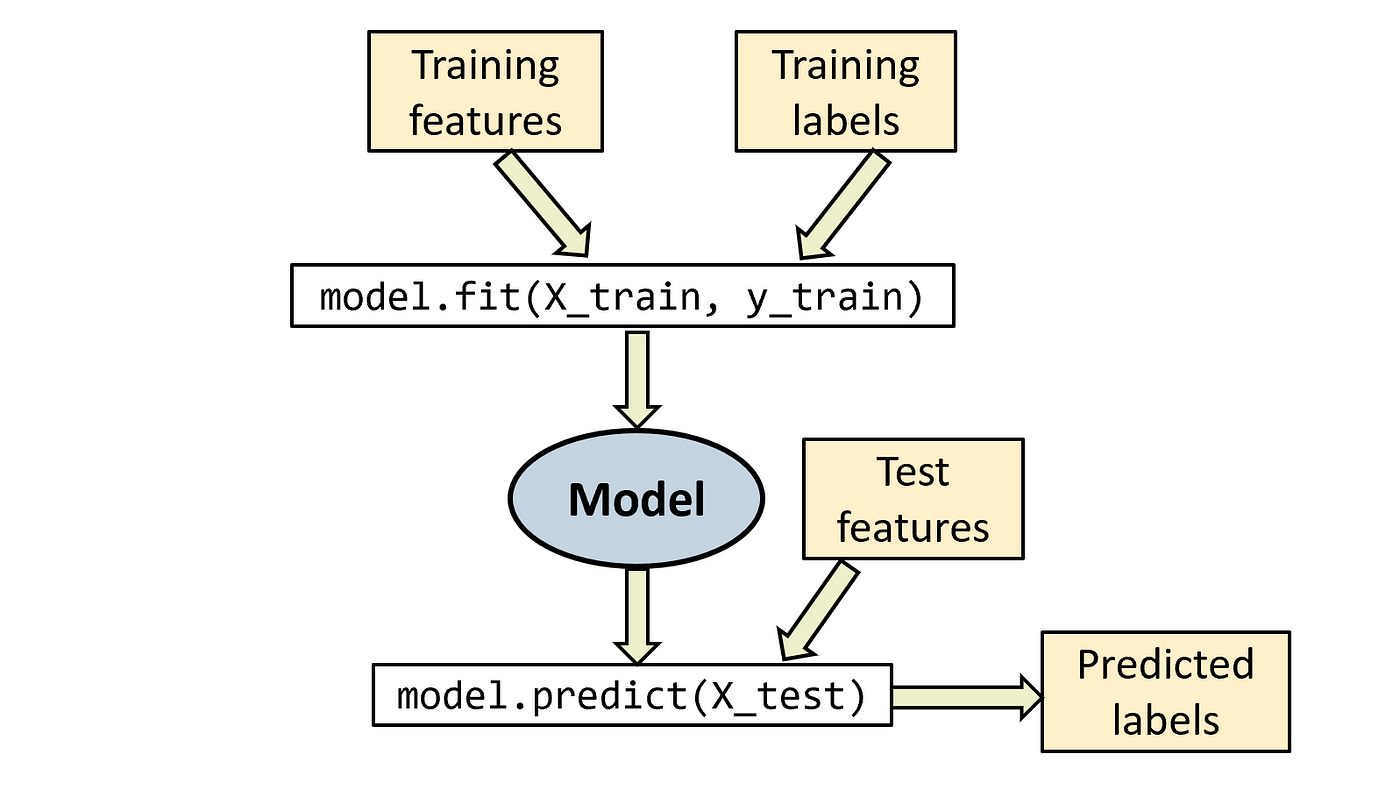
fit、predict、scoremethods such as ..., you can quickly implement machine learning tasks. - Efficiency: Although Sklearn is written in pure Python, most of its underlying implementations rely on Cython and NumPy, which makes it very fast when executing machine learning algorithms.
- Rich Functionality: Sklearn provides a large number of classic machine learning algorithms, including:
- Classification algorithms: such as logistic regression, support vector machine (SVM), K-nearest neighbors (KNN), random forest, etc.
- Regression algorithms: such as linear regression, ridge regression, Lasso regression, etc.
- Clustering algorithms: such as K-means, hierarchical clustering, DBSCAN, etc.
- Dimensionality reduction algorithms: such as principal component analysis (PCA), t-SNE, etc.
- Model Selection and Evaluation: cross-validation, grid search, model evaluation metrics, etc.
- Good Compatibility: Sklearn is well compatible with Python data processing libraries such as NumPy, SciPy, and Pandas, and supports multiple data formats (such as NumPy arrays and Pandas DataFrames) for input and output.
Machine Learning Tasks Supported by Sklearn
Sklearn provides a rich set of tools and supports the following types of machine learning tasks:
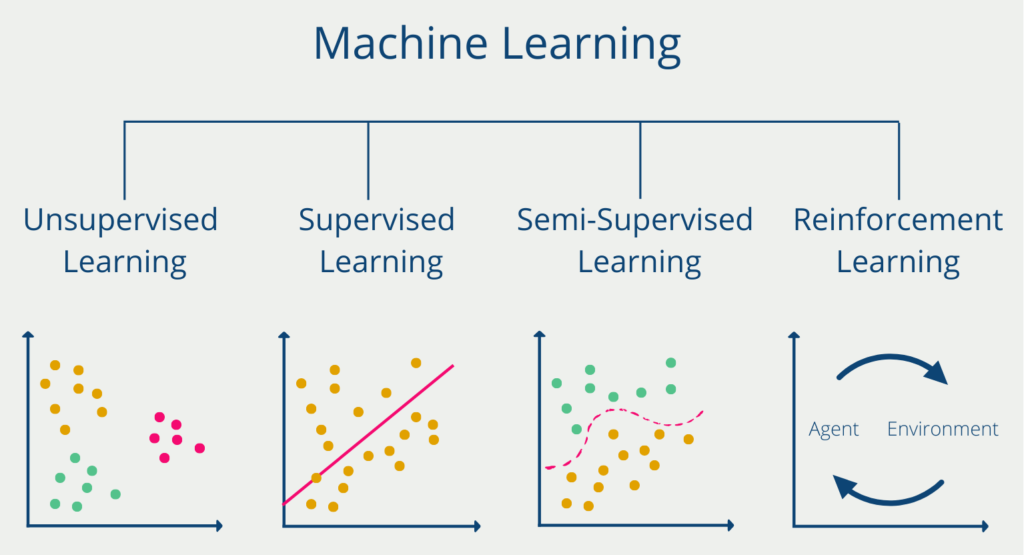
- Supervised Learning:
- Classification problems: Predict the category of data (e.g., email spam classification, image classification, disease prediction, etc.).
- Regression problems: Predict continuous values (e.g., house price prediction, stock price prediction, etc.).
- Unsupervised Learning:
- Clustering problems: Group data into different clusters (e.g., customer segmentation, document clustering, etc.).
- Dimensionality reduction problems: Project high-dimensional data into a low-dimensional space to facilitate visualization or reduce computational complexity (e.g., PCA, t-SNE).
- Semi-supervised Learning: Some data are labeled, some are unlabeled, and the model attempts to extract information from these data.
- Reinforcement Learning: Although Sklearn mainly focuses on supervised and unsupervised learning, it also has some related tools that can be used to handle reinforcement learning problems.
Common Modules and Classes in Sklearn
- Classification
sklearn.linear_model.LogisticRegression: Logistic regressionsklearn.svm.SVC: Support vector machine classificationsklearn.neighbors.KNeighborsClassifier: K-nearest neighbors classificationsklearn.ensemble.RandomForestClassifier: Random forest classification
- Regression
sklearn.linear_model.LinearRegression: Linear regressionsklearn.linear_model.Ridge: Ridge regressionsklearn.ensemble.RandomForestRegressor: Random forest regression
- Clustering
sklearn.cluster.KMeans: K-means clusteringsklearn.cluster.DBSCAN: Density-based spatial clustering
- Dimensionality Reduction
sklearn.decomposition.PCA: Principal component analysis (PCA)sklearn.decomposition.NMF: Non-negative matrix factorization
- Model Selection
sklearn.model_selection.train_test_split: Split the dataset into training and test setssklearn.model_selection.GridSearchCV: Grid search for finding the best hyperparameters
- Data Preprocessing
sklearn.preprocessing.StandardScaler: Standardizationsklearn.preprocessing.MinMaxScaler: Min-max standardizationsklearn.preprocessing.OneHotEncoder: One-hot encoding
Common Terms Explained
- Fit: Refers to applying the model to training data and adjusting the model's parameters through training.
model.fit(X_train, y_train) - Predict: Predict unknown data based on the trained model.
model.predict(X_test) - Evaluation (Score): Evaluate the performance of the model, usually returning a scoring metric such as accuracy.
model.score(X_test, y_test) - Cross-validation: Split the dataset into multiple subsets, and evaluate the model's stability and generalization ability through multiple rounds of training and validation.
Relationship between Sklearn and Other Libraries
- Relationship with NumPy and SciPy: Sklearn is built on top of NumPy and SciPy, so it can efficiently handle numerical computation and array operations.
- Relationship with Pandas: Pandas provides powerful data processing capabilities, while Sklearn supports extracting data directly from Pandas DataFrames for model training and prediction.
- Relationship with TensorFlow and PyTorch: Sklearn mainly focuses on traditional machine learning methods, while TensorFlow and PyTorch focus more on deep learning models. Nevertheless, Sklearn can be used in combination with these libraries to handle some preliminary feature engineering tasks, or to serve as baseline models for comparison with deep learning.