Skills Introduction
Skills is an open format for adding specialized skills and knowledge to AI agents.
With Skills, you can encapsulate domain-specific expertise, workflows, and best practices into reusable skill packs that AI agents can automatically invoke when needed.
Before learning Skills, let's first clarify a more fundamental question: what is an AI agent?
You've probably used tools like ChatGPT, Doubao, and Tongyi Qianwen, right? You type a question and it gives you a text answer. This is what we commonly calllarge model chatbots。
Tools like ChatGPT, Doubao, and Tongyi Qianwen are very smart, but they have a fatal problem:They can talk, but they can't act.
If you ask it: "What's the weather in Beijing today?", it can only guess an answer based on what it learned during training, rather than actually checking the weather.
An agent = an AI assistant that can understand your words, think on its own, and take action.
A chatbot is a mouth substitute; an agent is a true hand substitute.
So what is an agent?
Agent = large model + ability to take action.
Let's use the same example:
| Chatbot | Agent | |
|---|---|---|
| You ask: What's the weather in Beijing today? | Beijing is probably sunny today, around 25 degrees (guessed) | It actually calls the weather API and tells you: "Beijing is cloudy today, 23°C, humidity 45%" (real) |
| You ask: Help me check last month's sales | Sorry, I can't access your database | It actually queries the database and pulls the data out for you |
| You say: Help me book a high-speed train ticket to Shanghai for tomorrow | You can go to the 12306 website to book tickets | It actually opens 12306 for you, searches tickets, selects seats, and places the order |
The difference is one sentence: a chatbot just talks, while an agent actually does it.
How does an agent do it?
An agent roughly consists of the following parts:
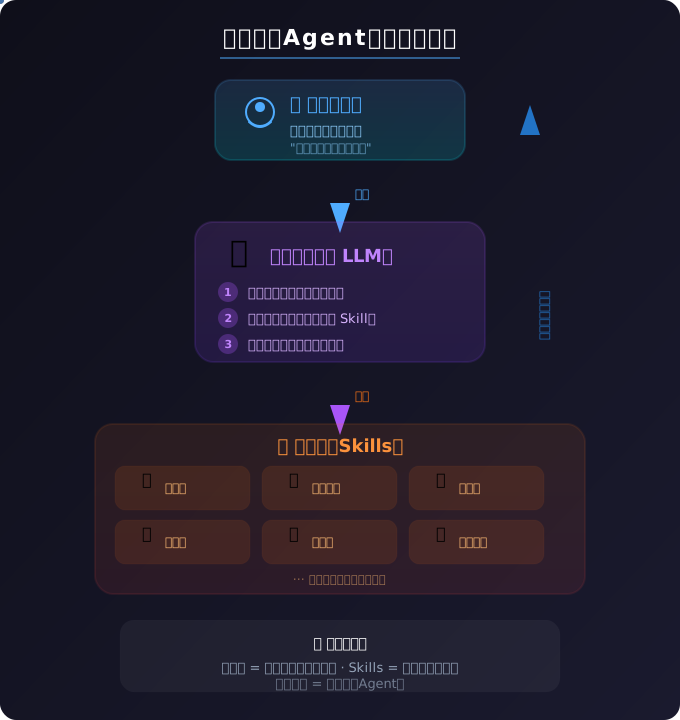
Three steps:
- Understand what you want(using the large model)
- Decide which skill to use(using the large model)
- Execute the skill and give you the result(using Skills)
Agents you can already see in your life
In fact, many products are already using agents:
- Siri / Xiao Ai / Tmall Genie— You say "set an alarm," and it actually sets it for you, instead of telling you "you can set it yourself"
- GitHub Copilot— Not just chatting, it can actually help you write and modify code
- Various AI customer service— Not just answering questions, but also checking orders, processing refunds, and changing addresses for you
- Autonomous driving— Also an agent; it can perceive the environment, make decisions, and execute actions
What are Skills for agents?
智能体的大模型 = 大脑(负责理解、决策、说话)
Skills = 手和脚(负责动手干活)
An agent without Skills is like a person with only a brain and no hands or feet—it understands everything but can do nothing.
The agent itself is very smart, but it needs someone to tell it—in this specific environment, to complete this specific task, which tools to use, what steps to follow, and what pitfalls to avoid.
This manual is called a Skill.
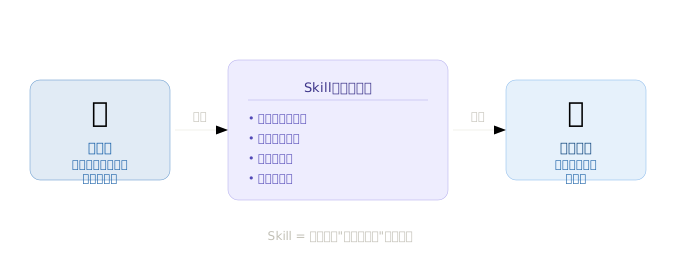
Understand Skills with a more down-to-earth analogy:
把智能体想象成一位聪明的新员工,他能力很强,但第一天来公司什么流程都不懂。
Skill 就是公司的 SOP 手册(标准操作流程)。
有了这本手册,他就知道:遇到客户投诉该怎么处理、出差报销流程是什么、代码提交要走哪些审核……不需要每次都问你,能自己完成任务。
Technically, Skills is a Markdown file (SKILL.md) that contains the complete execution guide for the task. It is written by humans and then automatically read and followed by the agent when performing tasks.
What problems can Skills solve?
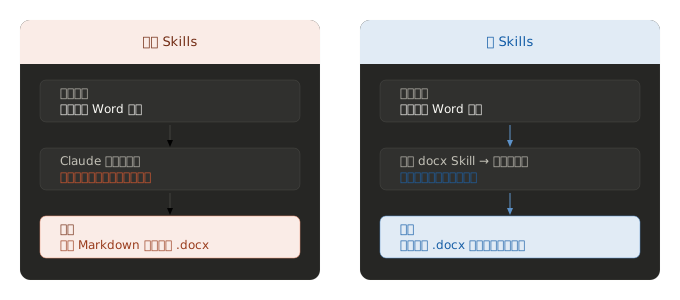
Scenario 1: Without Skills
Suppose you ask Claude to help yougenerate a Word document:
你:帮我生成一个项目计划书的 Word 文档

Claude:好的,以下是项目计划书内容:
(输出一堆 Markdown 文本……)
Result: Claude outputs plain text,not a real .docx filebecause it doesn't know what libraries are in your environment, where files should be placed, or what the formatting requirements are.
Scenario 2: With Skills
When the system is equipped withdocxa Skill, Claude, upon receiving the same request, will:
- Automatically recognize "this is a Word document task" → trigger
docxSkill - Read the Skill file to learn the correct library (
python-docx) and output path (/mnt/user-data/outputs/) - Follow the Skill's steps to generate a real
.docxfile - Give the file to you for download
The result is completely different— one is a chat reply, the other is a Word file you can open immediately.
Summary of the core value of Skills
After learning this chapter, you need to remember the following three points:
1. Skills turn agents from conversational chat into doers: Without Skills, an agent is just a knowledgeable chatbot. With Skills, it becomes a doer that can truly complete tasks.
2. Skills are reusable experience packs: Once someone writes the experience of generating Word documents into a Skill, everyone, on every invocation, will get stable and consistent results. It won't fail just because a different person asks.
3. Skills are the bridge between humans and AI collaboration
Humans write domain knowledge, process experience, and environmental constraints into a Skill; AI reads and then executes. Skills are this bridge—humans focus on defining how to do it, and AI is responsible for actually doing it.
| Concept | One-sentence summary |
|---|---|
| AI agent | An AI system that can perceive, reason, and act; it doesn't just chat, it can also execute tasks |
| Skills | A manual (Markdown file) that tells the agent "how to complete a certain type of task" |
| Value of Skills | Makes task execution accurate, stable, and reusable |
Difference between Skills and MCP
Skills is used forknowledge reuse, MCP is used forcapability expansion。
Skills
Knowledge reuse
- Knowledge sharing: experience, best practices, workflows
- Based on simple Markdown files, anyone can create
- Progressive loading, high token efficiency
- No server or backend setup required
- Works for Web / Desktop / CLI
MCP
Capability expansion
- Feature expansion: connecting APIs, databases, external tools
- Requires coding skills and server-side configuration
- Loads all tool definitions at startup
- Strong integration with external systems
- Higher token consumption and complexity
Use cases for skills
Agent Skills applies to various scenarios, including but not limited to:
- Domain expertise: Encapsulate knowledge from specialized fields such as legal review, data analysis, and coding standards into skills
- Workflows: Turn multi-step task processes into repeatable skills
- Company standards: Encapsulate company-specific coding standards, submission processes, document templates, etc. into skills
- Tool integration: Encapsulate usage methods and API calls for specific tools
Tools that support Agent Skills
Agent Skills is an open standard supported by multiple AI tools, including:
- Claude Code
- OpenCode
- GitHub Copilot
- OpenAI Codex
- and many other AI agent tools
This means you only need to write a skill once, and you can use it in different tools.
Other extensions