OpenCV Introduction
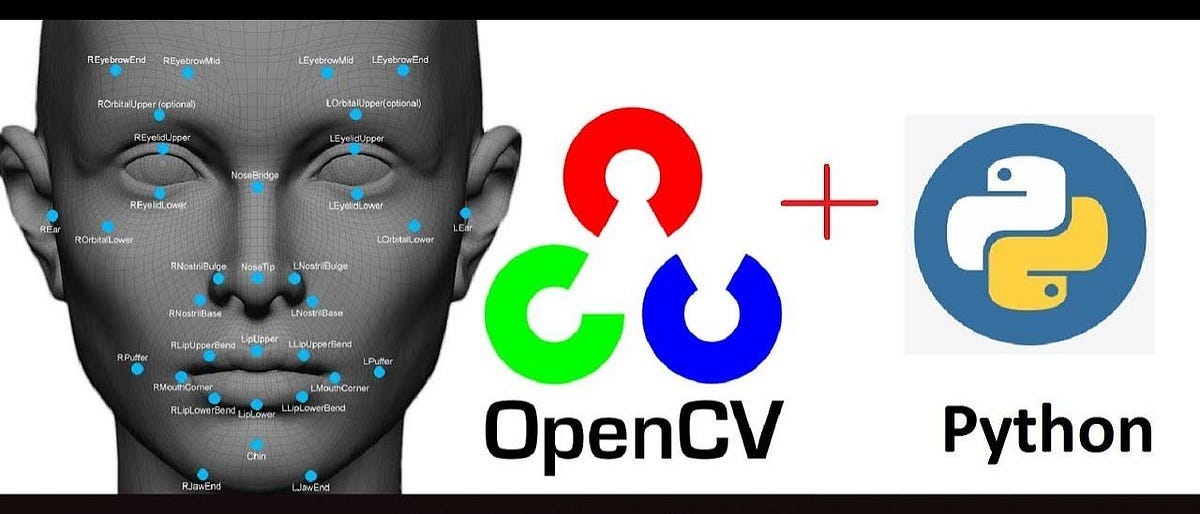
OpenCV is a powerful and widely used computer vision library that provides developers with a rich set of tools and algorithms, helping them quickly build various vision applications.
With the continuous development of computer vision technology, OpenCV will continue to play an important role.
OpenCV provides a large number of computer vision algorithms and image processing tools, widely used in image and video processing, analysis, and machine learning.
OpenCV Key Features
Open Source and Free
OpenCV is an open source project, and anyone can freely use, modify, and distribute its code. This means you can customize OpenCV as needed.Cross-Platform Support
OpenCV supports multiple operating system platforms, including Windows, Linux, macOS, Android, and iOS. You can use OpenCV on various devices, including desktops, servers, and mobile devices.Support for Multiple Programming Languages
OpenCV provides interfaces for multiple programming languages, supporting C++, Python, Java, JavaScript, MATLAB, and more. Therefore, whether you are a C++ developer or a Python enthusiast, you can easily use OpenCV.Powerful Function Library
OpenCV provides hundreds of optimized algorithms, covering every aspect of computer vision and image processing. The following are some common applications:- Image Processing:Image filtering, edge detection, color space conversion, morphological operations, feature extraction, etc.
- Video Analysis:Video capture, motion analysis, object detection and tracking, etc.
- Machine Learning and Artificial Intelligence:OpenCV integrates deep learning frameworks and can perform face recognition, object detection, image classification, etc.
- Computer Vision:Image matching, object recognition, stereo vision, depth map computation, etc.
Efficient Performance
Many algorithms built into OpenCV are highly optimized and support hardware acceleration (such as Intel's TBB, OpenCL, CUDA, etc.), giving it high performance when handling complex computations, especially in processing video streams and real-time image analysis.
OpenCV Application Areas
OpenCV has a very wide range of application fields, covering various aspects of computer vision, for example:
Image Processing:Image filtering, image enhancement, image segmentation, image feature extraction, etc.
Video Analysis:Object tracking, motion detection, behavior recognition, etc.
Object Recognition:Face recognition, license plate recognition, object recognition, etc.
Machine Learning:Support vector machines, K-means clustering, neural networks, etc.
Deep Learning:Image classification, object detection, image segmentation, etc.
Augmented Reality:Virtual object overlay, gesture recognition, etc.
Robotics:Visual navigation, object grasping, etc.
Application Scenarios
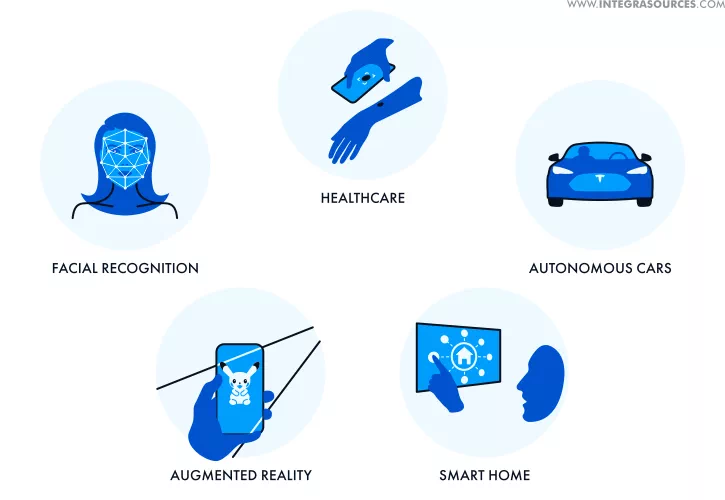
- Face Recognition and Detection:It uses features of faces in images for identity verification, applied in fields such as security systems, social media, and photo management.
- Object Detection and Tracking:In scenarios such as surveillance, autonomous driving, and industrial inspection, analysis is performed by detecting and tracking target objects.
- Augmented Reality (AR):Overlay virtual information onto real-world images, widely used in gaming, medical, industrial, and other fields.
- Medical Image Analysis:Use OpenCV to analyze medical images (such as CT scans, MRI images) to help diagnose diseases.
- Robot Vision:Robots use vision to recognize the environment and perform tasks such as object manipulation and navigation.
- Autonomous Driving:In autonomous driving, OpenCV is used for tasks such as lane detection, traffic sign recognition, and obstacle detection.
Future Development of OpenCV
With the rapid development of artificial intelligence and computer vision technology, OpenCV is also constantly updated and improved. In the future, OpenCV will continue to develop in the following areas:
Deep Learning:Further strengthen support for deep learning and provide more pre-trained models and algorithms.
Mobile:Optimize OpenCV's performance on mobile devices to make it more suitable for mobile application development.
Cloud Computing:Provide cloud-computing-based computer vision services to facilitate large-scale image and video processing for users.