Codex Introduction
OpenAI Codex is aAI coding agent (AI Coding Agent),the goal is not to help you complete code, but to directlyParticipate in and complete the entire development task— Write code, fix bugs, run tests, submit pull requests.
After July 10, 2026, Codex merged with ChatGPT, and Codex became an application of ChatGPT. In other words, there will be no more Codex in the future. After upgrading to the latest version, it will simply be ChatGPT.
Traditional chatbots only have one input box, but the Codex App is different—it is essentially:An AI Agent workbench that runs on a local computer.
It not only answers questions, but can also:
- Read local files
- Modify projects
- Browse the web
- Run commands
- Invoke external tools
- Automatically execute tasks
- Operate browsers and even desktop applications
One-sentence definition:
Codex App is a local work platform with AI Agent capabilities.
The core of traditional ChatGPT is:
- You ask
- AI answers
And the core of the Codex App is:
- You set goals
- AI helps you get things done
These two are not on the same level.
Codex APP features a classic three-column layout: the left side is the task list, the middle is the conversation window, and the right side is the multi-functional area.

Why is Codex said to be the third-generation AI programming tool?
| Phase | Positioning | Representative products |
|---|---|---|
| Phase 1 | Code Completion | GitHub Copilot |
| Phase 2 | Write code through conversation | ChatGPT |
| Phase 3 | Autonomously execute development tasks | OpenAI Codex |
The essence of the first two generations of tools is assistance; the essence of Codex is execution—AI has transformed from a tool into a collaborator.
Core capabilities
Write code— Describe the requirements, and Codex generates code that conforms to the project structure and style, rather than isolated code snippets.
Understand Codebase— Read the entire repository, explain the architecture, business logic, and module relationships, which is especially practical for large legacy projects.
Code Review— Automatically identify potential bugs, missing edge cases, performance bottlenecks, and security risks.
Debug and Fix— Read error logs → locate the problematic code → provide fix patches, with full-process automation.
Task automation— Refactoring, test generation, database migration, and CI/CD configuration can all be delegated with one click.
How it works
Each task runs in an independentCloud sandbox, the process is as follows:
输入任务 → 创建云环境 → 加载仓库 → 分析代码
        → 修改代码 → 运行测试 → 生成 PR → 等待审查
Two key advantages:
- Parallel execution: Multiple tasks run simultaneously without blocking each other
- Security isolation: Sandbox environment, without affecting the local system

All operations are traceable—terminal logs, test output, and code diffs are clear at a glance.
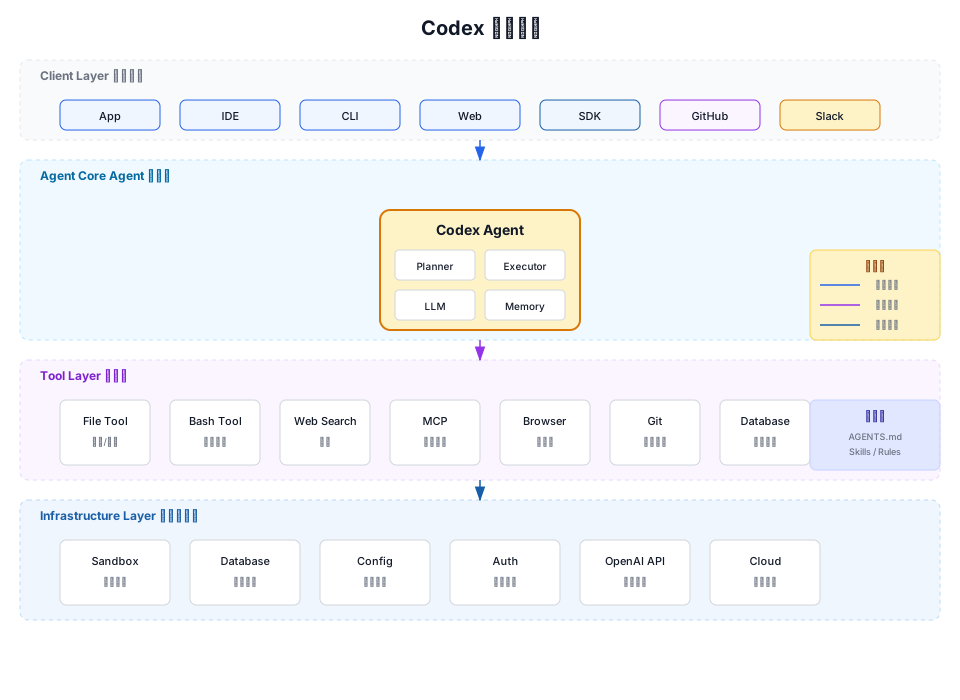
The system architecture is as follows:
Usage
| Form | Applicable scenarios |
|---|---|
| Codex Web(Integrated into ChatGPT) | Submit tasks, view progress, review code |
| Codex CLI | Direct terminal operation, suitable for developers' daily workflow |
| Codex Desktop App | Manage multiple parallel Agent tasks |
What Codex changed
Changes in the developer roleWith the introduction of Codex, developers' focus of work is undergoing a structural shift — from "writing every line of code by hand" to breaking down tasks, reviewing results, and steering the architectural direction.
Three shifts in the core responsibilities of developers:Task Decomposition(Decompose vague requirements into executable specific instructions),Architecture decisions(Codex is not adept at global system design; this remains the domain of humans),Result review(Ensure that the code generated by Codex conforms to business logic and quality standards).

Applicable scenarios
Codex is not a universal tool; understanding what it does best is the only way to maximize its value.
Independent developers / small teams— When requirements are clear but manpower is insufficient, delegate repetitive development tasks (CRUD interfaces, test cases, scaffolding) to Codex and focus on core business logic.
Large-scale enterprise refactoring— For refactoring or framework migration involving tens of thousands of lines of code (e.g., upgrading from Python 2 to Python 3, migrating from REST to GraphQL), Codex can process them in batch while ensuring behavioral consistency.
Legacy system understanding— When taking over an undocumented legacy codebase, let Codex prioritize code reading and comment generation, greatly reducing the onboarding cost.
Rapid prototype validation— When a product idea needs rapid implementation and validation, use Codex to generate a running prototype in minutes, rather than spending days building the foundational structure.
Test coverage completion— When existing code lacks tests, Codex can analyze function signatures and business logic, batch-add unit tests, and improve coverage.
Unsuitable scenarios— Core algorithm design requiring deep domain knowledge, decisions heavily dependent on non-public internal documentation, and high-risk production operations requiring frequent human confirmation are still recommended to be led by humans.
other extensions