AGI (Artificial General Intelligence)
AGI (Artificial General Intelligence) can be simply understood as:
It is not an AI that only does one specific thing, but an artificial intelligence with general cognitive abilities close to those of humans.
Current ChatGPT, Claude, Gemini, DeepSeek, etc. have already shown strong generality, but there is still no globally unified, operational standard for determining "whether they are AGI".

What is the difference between AGI and current AI?
First, look at the most intuitive comparison table:
| Type | Capability characteristics | Examples |
|---|---|---|
| Narrow AI (ANI) | Specially solves a certain type of problem | Recommendation algorithms, AlphaGo, speech recognition |
| Current large models | Already possess strong cross-domain capabilities | ChatGPT、Claude、Gemini、DeepSeek |
| AGI | Able to learn, reason, transfer, plan like humans, and independently solve a large number of unfamiliar problems | Currently no recognized implementation exists |
| ASI | Superintelligence that comprehensively surpasses humans | Currently a hypothesis |
The AI of the past was more likea specialist doctor: : You can have it play chess, recognize faces, or recommend products. It is strong in each of these domains, but usually only excels at specific tasks.
AGI, on the other hand, is more likea very intelligent person: You can have it learn a new language, read an unfamiliar specialized book, write programs, analyze financial statements, design products, do mathematical reasoning, operate computers, formulate business plans, learn a completely unfamiliar tool, adjust strategies based on failure results, and transfer previously acquired knowledge to new problems.
It doesn't need to retrain a dedicated model for every task.
The core of AGI is actually not "intelligence"
Many people understand AGI as "a chatbot much smarter than ChatGPT." This understanding is not quite accurate.
What truly matters for AGI isgenerality。
If an AI scores 100 on math exams and 100 on programming, but stops working when encountering unseen problems, it is not necessarily AGI.
Conversely, a system that can go through "encounter a new problem → understand the problem → acquire knowledge → formulate a plan → execute → correct errors based on results → finally complete the task" is much closer to the core of AGI.
Therefore, the key capabilities of AGI can usually be summarized as a chain:
Perception → Understanding → Reasoning → Learning → Planning → Execution → Feedback → Transfer
Among these, especially important arelearning and transfer abilities。
One of humanity's greatest advantages istransfer learning: After learning to drive a car, learning to drive a truck doesn't start from zero. You already have the foundations of traffic rules, directional control, speed control, spatial awareness, and risk judgment, so learning new things gets faster and faster.
True AGI should also possess similar abilities.
Where exactly is "generality" general: the six dimensions of intelligence
The previous section discussed the importance of generality, but intelligence itself is hard to measure with a single number.
The radar chart below breaks intelligence into six dimensions, comparing the approximate status of cutting-edge AI models in 2026, the target level of AGI, and humans:
Figure · Schematic comparison of six-dimensional capabilities. The values are illustrative scores for ease of understanding (0–10), not precise measurements published by any institution.
Note that the gap between the red dashed line (AGI target) and the orange area (frontier AI) is mainly concentrated in the three dimensions on the right half: cross-domain transfer, autonomous long-term planning, and continuous learning.
These are precisely the obstacles that the later section "Why It's Hard" will elaborate on.
The road to AGI: more than sixty years of groundwork
The vision of "artificial general intelligence" is almost as old as the discipline of "artificial intelligence" itself.
The following table sorts out several recognized key milestones:
| Time | Event | Significance |
|---|---|---|
| 1956 | Dartmouth Conference | The term "artificial intelligence" was formally coined, with scholars optimistically predicting that general intelligence would be built within a few decades. |
| 1997 | Deep Blue defeats Kasparov | A "specialist" AI that only plays chess, with clearly defined capability boundaries. |
| 2012 | Deep learning takes the stage | AlexNet vastly surpassed traditional methods in image recognition, sparking the current wave of AI. |
| 2016 | AlphaGo defeats Lee Sedol | Reinforcement learning found strategies beyond human intuition in games of extremely high complexity. |
| 2017 | The Transformer architecture emerges | The attention mechanism became the underlying architecture for nearly all large language models. |
| 2020–2022 | Scaling up large language models | GPT-3 demonstrated that "scale brings emergent capabilities," and ChatGPT brought general-purpose conversational AI to the public. |
| 2023–2025 | Multimodal and reasoning models | Models can simultaneously understand text, images, and speech, and AI agents have begun autonomously completing multi-step tasks. |
| 2026 to present | The current state of "jagged intelligence" | Can solve complex research problems, yet often makes mistakes on simple real-world tasks. |
"Jagged intelligence" is the most typical characteristic of the current era: capabilities are extremely unevenly distributed—far surpassing humans in some areas while lacking even common sense in others.
Why do current large models already look a lot like AGI?
This is the most interesting part right now.
Early AI was basically "one model for one task," but after large models emerged, the situation changed dramatically: a single model can simultaneously write code, write articles, translate, do math, summarize, reason, understand images, and call tools.
For example, today's models can already complete an entire pipeline like this:
This is already completely different from "specialized AI" in the traditional sense.
So many people now believe that we may have already entered the early stages of AGI.
But the problem is: "looks like AGI" does not equal "is already AGI."
How much longer until AGI?
This is probably the most divisive question in the entire field.
Public statements from industry leaders tend to be optimistic and concentrated within the next few years, while surveys of researcher communities generally give much later and more conservative timelines.
The figure below compiles the estimated time ranges given by public statements and surveys from various parties:
Figure · A compilation of AGI estimated timelines from public statements/surveys by various parties (as of mid-2026). The bar ranges are highly uncertain and subjective, for reference only, and do not represent factual predictions.
These numbers are not "answers," but estimates under different methodologies—optimists extrapolate along technical trajectories, conservatives rely on historical patterns, and some are influenced by industry positions.
What is the truly difficult part of AGI?
Today's AI is already very capable, but it is still a few key capabilities short of being "general."
First: Reliability
One of the biggest shortcomings of large models today is not "not knowing how," butsometimes being very confidently wrong.。
It gives an answer that looks highly plausible but is in fact incorrect.
If AGI is to take on important tasks in the real world, this error rate must drop substantially.
Second: Long-term planning
Getting AI to write a Python function is already easy, but having it build a SaaS company from scratch that can operate for five years is a completely different level of difficulty.
Because this involves an entire chain:
This has essentially shifted from "answering questions" to "autonomously completing tasks."
Third: Real-world interaction (embodied intelligence)
Today's AI mainly lives in the digital world: it can read web pages, write code, call APIs, operate computers, and process files.
But the real world is far more complex. For example, "go to the kitchen and make Kung Pao Chicken" requires completing this entire chain:
This involves a host of problems in robotics, vision, touch, spatial understanding, motion control, and more.
AGI doesn't necessarily have to be a robot, but truly entering the physical world would be an even greater challenge.
Beyond the three above, there are several equally critical challenges:
| Challenge | Description |
|---|---|
| Cross-domain generalization | Flexibly applying knowledge learned in one task to entirely new scenarios, rather than training from scratch. |
| Continuous learning | Continuously accumulating new knowledge during use, avoiding "catastrophic forgetting" where learning new things causes forgetting old ones. |
| Commonsense reasoning | Understanding the everyday logic and physical intuitions that humans take for granted without needing to state them explicitly. |
| Alignment and Safety | Ensuring that increasingly capable systems always align with human intent and values |
| Compute and Energy | Training and running frontier models requires enormous computational and electrical resources |
If AGI really arrives: opportunities and risks
It is precisely because the potential impact is so enormous that AGI is both exciting and concerning.
Looking at both sides together:
| Potential opportunities | Risks that must be taken seriously |
|---|---|
| Accelerate scientific research, shortening the discovery cycle for new drugs and materials | Employment structures are reshaped on a massive and rapid scale, bringing transition pains |
| Lower the barrier to accessing high-quality services such as education and medical consultation | System goals deviate from human intent (the alignment problem) |
| Take over repetitive, dangerous, or tedious work, freeing up human labor | Capabilities are misused for cyberattacks, disinformation, or weaponization |
| Become a "universal assistant" for individuals and businesses, handling multi-step tasks | Decision-making power becomes overly concentrated in the hands of a few institutions that control advanced systems |
The most important change with AGI may not be "AI getting smarter"
but rather:Intelligence begins to become a production factor that can be scaled and replicated。
The economic significance of a company hiring one programmer in the past versus using one AI Agent in the future is completely different:
| Past approach | Possible future approach |
|---|---|
| 1 programmer | 1 AI Agent |
| 1 salary | Runs 24 hours |
| 8 hours / day | Handles dozens of tasks simultaneously |
| Limited capacity | Replicable and parallelizable |
So what truly deserves attention now is not the old question of "will AI replace programmers," but a sharper new question:
How many AI can one person actually manage in the future?
AGI may truly change the way "companies" are organized
The structure of a traditional company is a boss with a row of departments underneath:

The future may become: one person is responsible for a small number of AI, and the AI then manages a group of execution Agents.
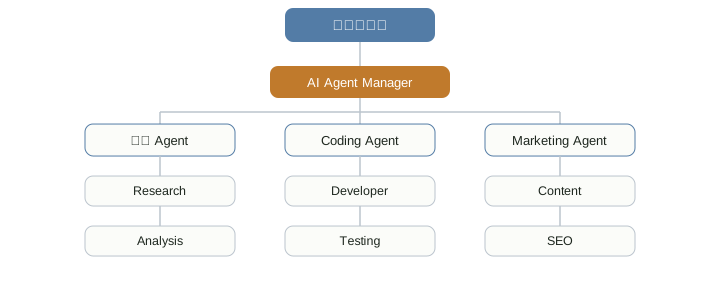
In this structure, humans handle goals, judgment, resources, and final decisions, while AI handles a large amount of execution.
So what will truly be scarce in the future may no longer be "knowing how to write code," but rather whether one can define the right problems, judge the results produced by AI, and organize multiple AI to complete complex tasks.
This is also the reason why new roles such as AI Agent, AI Application Engineer, FDE, Context Engineer, and AI Builder have emerged in recent years.
AGI ≠ AI Agent
These two concepts are easy to confuse.
AGI is a concept at the capability level, whileAgent is a system form。
It can be understood this way: once a large model has reasoning ability, adding capabilities such as tools, memory, environment perception, planning, and execution forms an AI Agent.
AGI, on the other hand, is closer to "sufficiently strong general intelligence."
Agent doesn't necessarily require AGI—many Agents can already be built today.
Likewise, AGI doesn't necessarily have to manifest as an Agent—it can simply be an intelligent system with highly general cognitive capabilities.
So, is there actually AGI now?
There is currently no universally accepted answer.
The key question is: what standard should AGI actually meet?
If the standard is "being able to complete most knowledge work," some of today's top models are already very close; if the standard is "learning autonomously in a completely unfamiliar environment and completing various long-term tasks like a normal adult," the gap is clearly much larger.
So AGI is more like acontinuous spectrum, rather than a switch that suddenly turns on:
The real world will likely never see a day when "at 10:00 today, AGI is officially born."
It's more likely that AI's general capabilities will improve bit by bit, until at some point, humans realize it can already independently complete a large amount of complex work that only humans could do before—that is the real arrival of AGI.
Common questions about AGI
The following are several questions that beginners most easily confuse.
Are large models like ChatGPT considered AGI?
The current mainstream view is that they don't yet.
They perform impressively on language tasks, but still have obvious shortcomings in long-term planning, continual learning, true common-sense reasoning, and other areas—their capabilities are not evenly distributed.
Does AGI mean robots have self-awareness?
No, it doesn't.
AGI is about "general cognitive ability," while "consciousness" is a vaguer, more philosophical concept. The two are not the same thing, nor do they necessarily appear together.
Why do different experts give such different timelines?
One reason is that there is no unified definition or testing standard for "what counts as AGI."
Another is that everyone uses different methods: some extrapolate based on technical roadmaps, some rely on historical patterns, and others are influenced by industry positions.
Do ordinary people need to prepare for AGI now?
Compared to worrying about an uncertain point in time, a more practical approach is to continuously pay attention to the boundaries of AI capabilities, learn to collaborate with existing tools, and maintain a basic understanding of relevant policies and social discussions.
Understanding AGI in one sentence
Putting different forms of intelligence together makes the distinctions clearer:
| form | One-sentence metaphor |
|---|---|
| Traditional AI | a tool |
| Current large models | A very smart assistant. |
| AI Agent | A digital employee that can work on its own. |
| AGI | A general intelligent agent that can face unfamiliar problems, autonomously learn, reason, plan, execute, and correct errors. |
And one step further, if this intelligence is in the vast majority of cognitive domains...Comprehensively surpass humans., then what is being discussed is no longer just AGI, butASI (Artificial Superintelligence)。
Other extensionsWhat truly deserves attention is not the date of "when AGI will appear," but rather: as AI's general capabilities keep approaching human levels, which jobs, companies, and individual skills will be repriced first.