In the first stage, after learning C language, I thought to myself, since I wasn't a computer science major, when I went out to find a job, I'd need a certificate to show the recruiting company. Getting a certificate in college could also let me show off among classmates or junior students.
- A: Hey buddy, I have a computer certificate, do you?
- B: Wow wow wow, so impressive, how did you do it?
- A: Blah blah blah... (starts sharing success tips)

At that time, the more popular computer exam for non-computer majors in college was the National Computer Rank Examination (NCRE). This darn thing had four levels:
- Level 1 Exam: Office software and other basics (very elementary).
- Level 2 Exam: Programming-related, including C language, etc.
- Level 3 Exam: This is engineer preparatory level, covering network technology, database technology, etc.
- Level 4 Exam: Includes network engineer, database engineer, etc.
Aside: At that time, our major had an NCRE Level 2 course called Visual FoxPro (a database course) in the second semester of sophomore year. I don't know if it still exists now. I passed the exam in the first semester of sophomore year. The exam content was simple – just operating a database on the computer (I didn't even know how I passed back then). Also, Visual FoxPro had 6 class hours per week, so I directly applied for credit exemption and spent that time learning C language. Now I think if you're still a student, you should complete credits as early as possible, and spend more time on courses you really want to learn.
When I saw these level exams, Level 1 was boring, and I already had the Level 2 certificate. I had to get a higher one. Later I chose NCRE Network Technology (why did I choose this? I don't know either. I guess network looked more comfortable, and it was purely for the certificate).
At that time, the NCRE Network Technology exam was divided into a written test and a computer-based test:
For the written test, I just bought a book. I used the 2008 edition (as shown below), then memorized concepts and did past exercises. This was relatively simple.

The computer-based test was C language programming (luckily I had learned it before), and the program was selected from a pool of 100 questions. The question bank was public, so it was essentially an open-book exam. But honestly, I memorized the programs in the question bank by rote and had no idea what they meant.
How did I memorize them? A good memory is better than a bad pen. I copied the code from the question bank letter by letter into my notebook. Each question was copied at least 10 times. By that calculation, I copied at least 1000 times. Thinking back, I was really pushing myself hard then.
Many of the programs in the question bank were very short; only a few had a lot of code. I barely memorized the short ones. At that time, I hoped to encounter the short type to pass the exam. I thought, "I won't be so unlucky as to get one of the long code questions" (because those were truly impossible to memorize).

But sometimes what you least want to happen happens anyway. On the first computer-based test, damn it, I actually got the question with the longest code. The final result was that I passed the written test but failed the computer-based test.
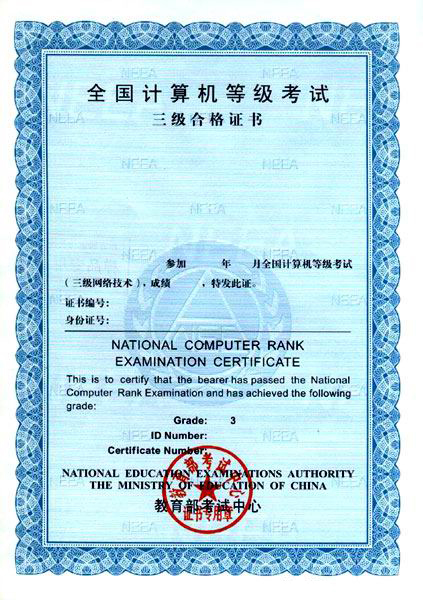
Fortunately, the written test score could be carried over to the next exam, so I waited another half year and copied the code another 1000 times (it made me want to throw up). On the second attempt, I was lucky enough to get a simple question and passed with full marks. I finally got the certificate I had dreamed of (I don't know where I left it now):
After that, I kept up the momentum and passed the NCRE Level 4 Network Engineer in one go. To be honest, the Level 4 Network Engineer exam only had a written test, no computer-based test, so memorizing the book was enough, and I passed it on the first try.
At this point, I had collected NCRE Level 2, 3, and 4 certificates. I could summon the divine dragon and act all high and mighty, haha.

Let me summarize:
Actually, it's hard to say whether getting certificates in college was useful. Although these certificates were of no damn use when I went out to find a job, they more or less helped me learn some networking knowledge and made me copy C language programs thousands of times, thoroughly understanding for and while loops, etc.
So, since you have plenty of time in college, if you really don't know what to do, getting a certificate is also a good idea. At the very least, it shows that you weren't slacking off during college and that you are motivated.
Cherish your college time, because four years really pass quickly. Improving your abilities is the real deal, even if it's just a little bit.
Skill suggestions:
- English: very useful for learning computers.
- Driver's license: a basic life skill.
- Eloquence: out in society, you mainly rely on your mouth.
- Reading: not necessarily in your major; history, psychology, economics, etc. Learning more never hurts.
- ……