AI Agent Tutorial
AI Agent (Artificial Intelligence Agent) is called an intelligent agent. It is essentially a program that automatically executes tasks. The core is to let the model not only answer questions but also complete actions step by step.
AI Agent (Artificial Intelligence Agent)It is an intelligent software entity that can perceive the environment, make decisions, and execute actions to achieve specific goals. It is not just a chatbot that answers questions, but an intelligent executor that can actually do things.
Agent = LLM (brain) + Planning (planning) + Tool use (execution) + Memory (memory).
Quick start: 0 code, generate an app with one sentence:https://www.miaoda.cn/。
Who is this tutorial for?
- People who want to use AI to automate daily tasks
- Beginners who are not familiar with programming but want to use AI to do real work
- People who have basic computer operation skills but have zero foundation in concepts such as Agent/Workflow
- People who want to upgrade AI from chatting to actually doing work
What is an Agent?
An Agent is an intelligent assistant that can do real work.
Agent = LLM (brain) + Planning (planning) + Tool use (execution) + Memory (memory).
Learning Agent requires a mindset shift: fromconversational Q&Aevolve togoal-driven task execution。
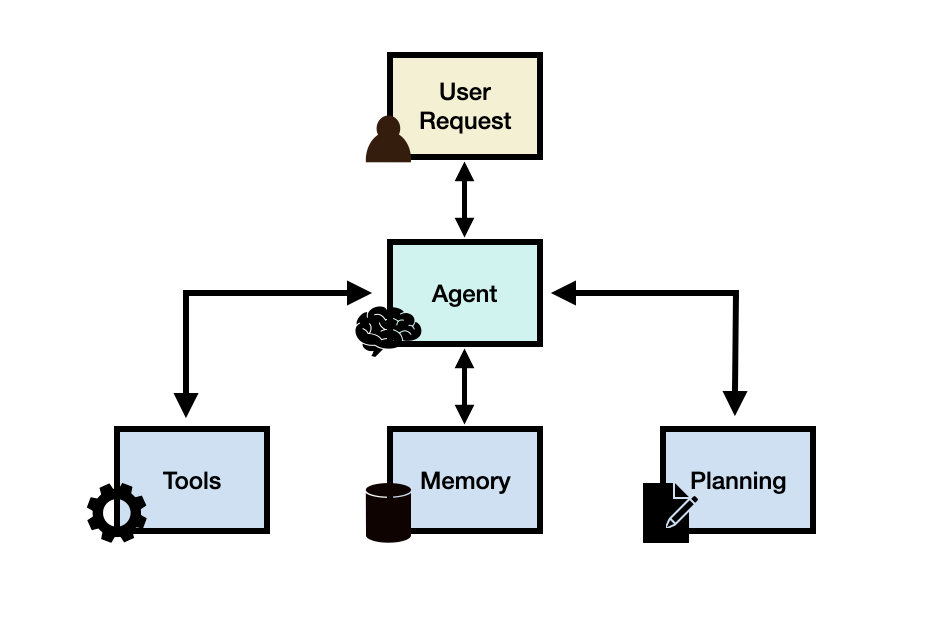
Traditional software programs follow a fixed instruction flow:Input → Process → Output, while an AI Agent is more like an autonomousemployee, it can:
- Understand task goals: understand what result you want
- Make a plan: think about how to achieve the goal
- Use tools: call various resources and APIs
- Self-adjust: optimize strategy based on feedback
- Execute continuously: until the task is completed or an unsolvable problem is encountered
Analogy:
- Traditional program = vending machine: insert coin → press button → product comes out
- AI Agent = Personal Assistant: Tell it your needs → Assistant plans → Completes tasks and reports back
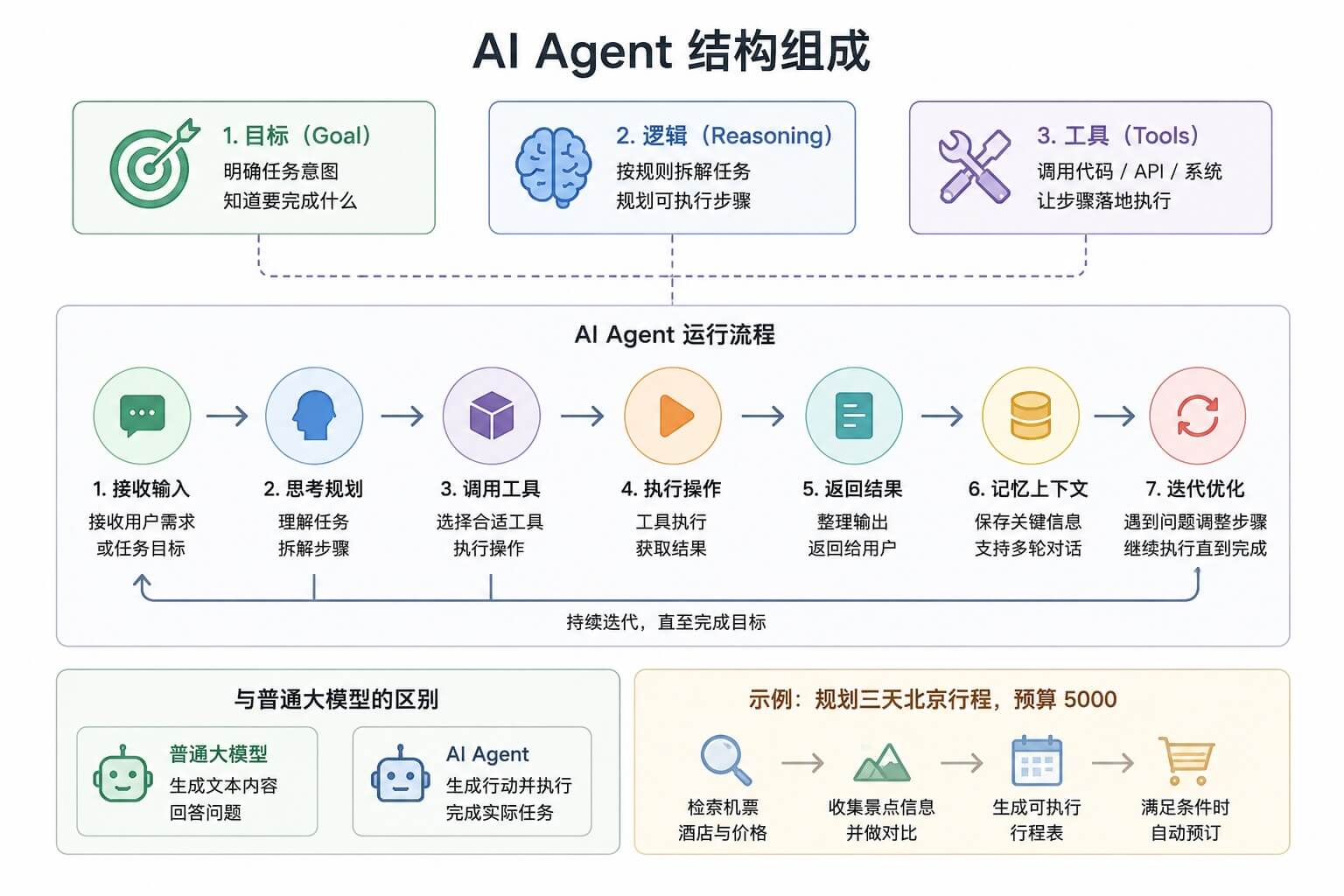
Core structure:
- Goal:Knows what to accomplish
- Reasoning:Plans execution steps
- Tools:Calls APIs, code, or systems to complete tasks
Workflow:
Input → Think → Call tool → Execute → Return result → Continue iterating
Differences from ordinary large models:
- Large model: outputs content
- Agent: outputs results and drives execution
For example, when we talk to an AI Agent and input:Plan a three-day Beijing trip with a budget of 5000the agent will complete the following tasks:
- Break down the requirements
- Search flights, hotels, and attractions
- Generate an itinerary plan
- Continue to complete bookings when conditions are met
Learning Resources
Existing platforms and popular frameworks:
| Core requirement | Recommended tool | Key advantage |
|---|---|---|
| Miaoda, generate an app with one sentence | Miaoda official website | Zero code, generate an app from a one-sentence requirement |
| MonkeyCode, AI application development platform | MonkeyCode official website | Create tasks directly on the platform, let AI code, and use terminal, file management, and preview in the cloud development environment |
| Xiaoyunque, Jianying's AI video generation | Jianying - Xiaoyunque | ByteDance's self-developed Seedance 2.0 video model + Seedream 5.0 image model, paired with Doubao large model for copywriting understanding |
| QoderWork, desktop-level AI Agent | QoderWork | You state the requirement, it delivers the result. |
| Automated triggering and system integration | n8n | Wide integration coverage, self-hostable, can connect with common internal systems |
| Deep customization controlled by developers |
Dify LangChain |
The former provides a complete open-source solution; the latter is suitable for building complex reasoning chains |
| Multi-role collaboration and task decomposition | AutoGen CrewAI |
The former emphasizes dynamic collaboration; the latter drives processes with a clear role system |
| Autonomous task execution Agent | AutoGPT | An early phenomenal open-source Agent project, emphasizing goal-driven, autonomous task decomposition, and loop execution (Plan → Execute → Reflect) |
The following are other popular open-source AI Agent frameworks. Most of these projects revolve around tool calling, memory, workflow, multi-agent collaboration, and long-term task execution capabilities.
| Project | Positioning | Features |
|---|---|---|
| OpenAI Agents SDK | Lightweight Agent development framework | Supports tool calling, handoff, multi-agent orchestration, simple structure, quick to get started |
| LangGraph | State-machine-based Agent orchestration | Controls complex workflows based on graph structures, supports long-term state and loop execution |
| LlamaIndex | RAG + Agent framework | Specializes in knowledge bases, data connections, and retrieval-augmented scenarios |
| Semantic Kernel | Enterprise-grade Agent orchestration | Open-sourced by Microsoft, supports plugins, workflows, memory, and multi-model collaboration |
| PydanticAI | Type-safe Agent development | Uses Python's type system to constrain outputs, suitable for engineering applications |
| Mastra | Modern full-stack Agent framework | Supports workflow, memory, deployment, and observability capabilities |
| Agno (formerly Phidata) | Multi-Agent application framework | Emphasizes the combination capability of Agent + Knowledge + Tools |
| Camel-AI | Multi-agent collaboration framework | Simulates team collaboration and task decomposition through role-playing mechanisms |
| MetaGPT | Software company simulation framework | Splits product, architecture, development, and testing into multiple roles that work collaboratively |
| Swarms | Agent cluster orchestration | Emphasizes large-scale Agent collaboration and task scheduling |
| Haystack Agent | Search and knowledge-augmented Agent | Suitable for enterprise search, document Q&A, and toolchain combinations |
| Atomic Agents | Composable Agent architecture | Emphasizes modular design and testability |
| DSPy | Declarative Prompt / Agent framework | Engineers and optimizes Prompt and reasoning processes |