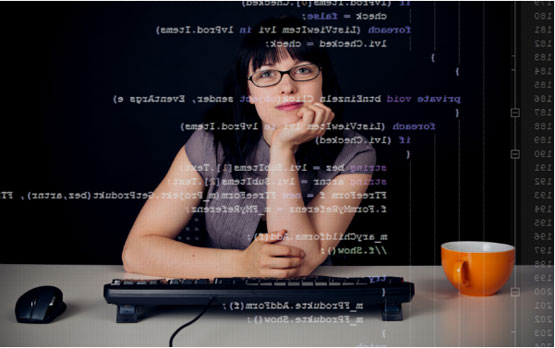
Someone on Zhihu asked: "What excuses can you use to justify writing low-quality code?" An anonymous user's answer received many upvotes: "I'm a female programmer, anyway I'm just here to liven up the atmosphere."
Wang Yijiao, who had just joined Baidu for 3 months, had heard this joke. She finished the second half of it before the reporter had even finished speaking. In the 2014 summer campus recruitment batch of new hires in Wang Yijiao's department, she was the only woman.
"This kind of teasing is fine. When I first joined the company, I was really timid. I couldn't do anything and didn't understand anything. I couldn't exactly act all high and mighty either. As a woman, you need to know how to show weakness." The master's student from Tsinghua University's Department of Automation said with a smile: "But I really can't just become the one who livers up the atmosphere. Once we become senior engineers in the future, there won't be this kind of teasing anymore. We can even say — do you think I got to where I am today by acting cute?"
Female programmer? Female coder? In this era, more and more women are joining the wave of internet technology. What is their real life actually like?
The world's first programmer was a woman
"Excellent women write more beautiful programs than men. The world's first programmer seems to have been a woman," said Xiao Han (pseudonym), an intern at Microsoft. "Yes, I'm very proud. I've never thought of female programmers as female losers."
Xiao Han chose computer science by accident. Later, she gradually discovered that although the process could be painful, it felt pretty good to get a problem running with just a few lines of code. She likes math, and she gets to use it when writing code.
During her senior year, Xiao Han interned at Baidu. No one else in her department was involved in her work, so she could only slowly figure things out on her own and get them done by herself. In the end, not only did her supervising mentor recognize her work, but even the head of the whole department thought it was very meaningful. A month later, they recruited two more interns to work with her, forming a three-person project team. Xiao Han became the team leader and built a fairly standardized result from nothing.
At Microsoft, Xiao Han discovered that excellent female students could receive Special Offers, while some male students could only get ordinary offers. This third-year master's student plans to continue on the technical track after graduation, so that "she can put what she has learned to use."
When it came time to finally decide her post-graduation direction, Wang Yijiao once hesitated. "I still hope to have a relatively stable life and a stable family, at least being able to go home for dinner." In the end, she still decided to join an internet company. "To be realistic, money is important." Wang Yijiao feels that perhaps there was once an era where men worked outside and women stayed home, and sons could support parents in their old age. But almost all post-80s are only children. Only by earning their own money can daughters have the confidence to support their parents — not just surviving, but living well.
"I hope the money I earn can satisfy my needs," said Liu Xi, a female programmer at a thermal energy state-owned enterprise in Taiyuan, Shanxi. She wants too many things — cosmetics, bags, travel — and she doesn't want to achieve that by relying on "my husband being rich."
"I admire how they could come up with so many reasons to reject you." Recalling her search for technical work within the system after graduation, Liu Xi couldn't help laughing, pinching her nose to imitate the soft voice of the recruiters, who were usually also women. Her resume was impressive and her internship experience was rich. Thinking it over, the only reason she was rejected had to be that she was a woman.
Liu Xi's boyfriend is also a programmer at a state-owned enterprise. All the female programmers who joined at the same time as him had transferred out of technical positions within one year. State-owned enterprises rarely require overtime, and when they do, there's advance notice and overtime pay. But Liu Xi yearns for the atmosphere of internet companies and hopes she can also produce higher-quality digital products.
"I have a strong career ambition," she said. "I was confused when choosing my major, but after working, if I find it's not suitable, I can change it. But if you don't work hard, you can't blame others for discriminating against you."
My world has become very small
"Among my major courses, only two were really related to programming." Ruan Hang, who studied mathematics in college, told the reporter. After graduating from Nanjing University with a master's degree in 2012, she became a programmer at Huawei's Nanjing R&D department. The female colleagues around her had diverse academic backgrounds.
According to Ruan Hang's description, in highly applied work like coding, accumulating experience is especially critical. Newcomers always go through an adjustment period where they struggle to produce results and are buried in repetitive work. "There are many things you don't know how to do because you've never seen them, and they're not in textbooks either."
Every programmer is assigned a mentor after joining. During her first month, Wang Yijiao had to keep pulling her female senior engineer mentor aside to ask questions, because she wasn't even familiar with basic operations. She felt "her only purpose of existing every day was wasting her mentor's time."
Her job, in simple terms, was tagging. A long place name gets cut into several segments, then she identified the core word and classified it. Manual tagging one by one was too slow, but writing a program to run once could tag tens of thousands of place names — and there were accuracy requirements.
This was somewhat different from what she had imagined her work would be. When she was recruited, she was told the job would be "building models and algorithms" — a very high-end data mining role. Now most of the work involved constantly optimizing strategies, which meant tweaking this and that in the program, running it again, and seeing whether the accuracy could improve.
"The current work doesn't have scientist-like innovative intelligence; it's mostly grunt work." Sometimes she would get anxious: her professional skills were improving, but her academic abilities were improving far too little.
At 9 p.m. in Xierqi, western Beijing, the internet company building with its tempered glass exterior glowed with incandescent light, like a huge ship sailing through the night. Working six days a week with no overtime pay, at this moment everyone in the department still hadn't left their cubicles.
"The leaders in the office are still working too. How could I be embarrassed to leave? Besides, the work really can't be finished," Wang Yijiao said. There really was too much work. If she napped at her desk for half an hour at noon, she'd have to stay half an hour later at night to finish her work.
Performance pressure hung over their heads, and the requirements for male and female programmers were the same. But this is where men's advantage comes in — they're physically stronger, can stay up late, and can even sleep in the office when necessary.
Wang Yijiao sometimes feels that after starting work, she "has become not such a good person anymore." With so much time spent on work, setting aside boyfriends, it's hard to even maintain normal friendships. A close best friend called, crying about emotional pain. Normally, she would have stayed on the phone with her for a long time, but at that moment there were still emails to send and programs to finish running, so she could only console her quickly and end the call. She used to call her grandfather two or three times a week; now she barely calls once a month.
"My world has become very small." She smiled. Books, movies, and shopping gave way to endless programming in front of a computer. Every day when she got home, she was so exhausted she could only lie on the sofa, not wanting to do anything.
"The work can't be finished, entirely because I'm weak." Wang Yijiao encouraged herself.
One of the reasons I like this job is that I can take off my shoes
Sister Tao is a female programmer at Tencent Technology, and also the mother of a child under two years old. She gets off work at 9 p.m., and she needs to get home a bit early, before the child falls asleep.
"Sometimes you can only do your best to push the work forward. When you work late and devote all your time to tackling a difficult problem, your mood actually relaxes, even though you're still very busy. When you've been too tense, there will be a relaxation period. Once you feel you've done your best, you won't keep pushing yourself harder." Sister Tao said all this very calmly.
After working for two years, Ruan Hang sometimes goes home a bit earlier. She feels that she shouldn't be overly "hardworking." "Actually, you do have choices. Interest is the most important thing." She sincerely advised her younger female schoolmates.
In her favorite book, "Hackers and Painters," it is written: The similarity between hackers and painters is that they are both creators — both creating beautiful things.
For Wang Yijiao, the one-hour lunch break and one-hour dinner break each day were "large-scale outdoor release activities." Eating actually doesn't take much time. Wang Yijiao and her colleagues deliberately chose distant restaurants, sometimes walking two blocks. It takes 15 minutes for adults to walk there and back. But they weren't in a hurry — they'd spend 40 minutes strolling, chatting, telling jokes, and complaining that the work they did wasn't high-end enough. They'd forget it all as soon as they finished talking, remembering only the joy.
This is also a habit of nearly the entire building. No matter how strong the sun was, the streets were full of engineers — "a huge crowd." Male programmers usually wore sandals and shorts, with T-shirts or plaid shirts on top — "very easy to spot."
"One of the reasons I like this job is that I can take off my shoes," Wang Yijiao said.
She clearly remembers her first team meeting. While they were discussing, that very capable female senior engineer team leader took off her shoes in front of the whole team. A male colleague suggested directly wearing slippers — comfortable and trouble-free. The team leader didn't take the advice and kept alternating between colorful flat shoes and high heels, freely going barefoot whenever she felt happy.
In her view, in the programmer circle, there are no interpersonal relationships like those in "Empresses in the Palace." The work is tiring, but it's simple. Programs are controllable — whether you're male or female, as long as your method is correct, you will definitely get the answer to the problem. There's no second possibility.
Original source:China Youth Daily - Wang Mengying