- Factory method pattern is a creational pattern that is widely used in JDK as well as Spring and Struts frameworks.
- Factory method pattern is based on "input" and is applied between a superclass and multiple subclasses; this pattern shifts the responsibility of creating objects to the factory class.
- First, let's learn how to apply the factory method pattern in Java and understand its advantages. In addition, the factory method pattern is also widely used in the JDK.
- The superclass can be an interface, an abstract class, or a parent class. In this example, we will explain the factory method pattern by overriding the toString() method.
Example
package com.journaldev.design.model;
public abstract class Computer {
public abstract String getRAM();
public abstract String getHDD();
public abstract String getCPU();
@Override
public String toString(){
return "RAM= "+this.getRAM()+", HDD="+this.getHDD()+", CPU="+this.getCPU();
}
}
Factory Design Pattern Subclasses
Assume the subclasses PC and Server implement Computer:
Example
package com.journaldev.design.model;
public class PC extends Computer {
private String ram;
private String hdd;
private String cpu;
public PC(String ram, String hdd, String cpu){
this.ram=ram;
this.hdd=hdd;
this.cpu=cpu;
}
@Override
public String getRAM() {
return this.ram;
}
@Override
public String getHDD() {
return this.hdd;
}
@Override
public String getCPU() {
return this.cpu;
}
}
Server also implements Computer:
Example
package com.journaldev.design.model;
public class Server extends Computer {
private String ram;
private String hdd;
private String cpu;
public Server(String ram, String hdd, String cpu){
this.ram=ram;
this.hdd=hdd;
this.cpu=cpu;
}
@Override
public String getRAM() {
return this.ram;
}
@Override
public String getHDD() {
return this.hdd;
}
@Override
public String getCPU() {
return this.cpu;
}
}
Factory Class
Now that we have multiple subclasses and a superclass, we can create the factory class:
Example
package com.journaldev.design.factory;
import com.journaldev.design.model.Computer;
import com.journaldev.design.model.PC;
import com.journaldev.design.model.Server;
public class ComputerFactory {
public static Computer getComputer(String type, String ram, String hdd, String cpu){
if("PC".equalsIgnoreCase(type)) return new PC(ram, hdd, cpu);
else if("Server".equalsIgnoreCase(type)) return new Server(ram, hdd, cpu);
return null;
}
}
It is important to point out that:
- The factory class can be a singleton, and getComputer can be static.
- getComputer is a method of the factory class, and it returns different objects based on the same parameter types.
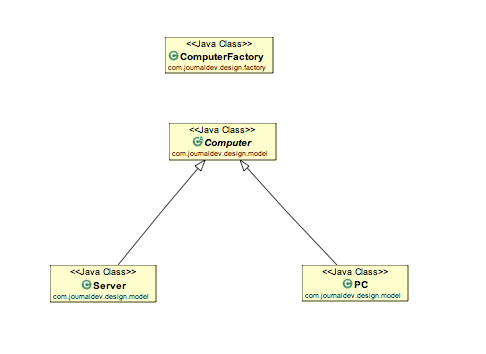
Next is a simple test client program that uses the above factory design pattern implementation.
Example
package com.journaldev.design.test;
import com.journaldev.design.abstractfactory.PCFactory;
import com.journaldev.design.abstractfactory.ServerFactory;
import com.journaldev.design.factory.ComputerFactory;
import com.journaldev.design.model.Computer;
public class TestFactory {
public static void main(String[] args) {
Computer pc = ComputerFactory.getComputer("pc","2 GB","500 GB","2.4 GHz");
Computer server = ComputerFactory.getComputer("server","16 GB","1 TB","2.9 GHz");
System.out.println("Factory PC Config::"+pc);
System.out.println("Factory Server Config::"+server);
}
}
Output:
Factory PC Config::RAM= 2 GB, HDD=500 GB, CPU=2.4 GHz
Factory Server Config::RAM= 16 GB, HDD=1 TB, CPU=2.9 GHz
Advantages of Factory Design Pattern
- Programming to an interface embodies the idea of object-oriented programming.
- The work of creating objects is shifted to the factory class.
Factory Design Pattern Examples in JDK
- java.util.Calendar, ResourceBundle and NumberFormat getInstance() use the factory method pattern.
- valueOf() in wrapper classes, such as Boolean and Integer, also uses the factory method pattern.
Translation: https://www.jianshu.com/p/5d52e9ce7358
Original: https://www.journaldev.com/1392/factory-design-pattern-in-java