DeepSeek Harness Introduction
AI models can already independently complete complex coding tasks. The real challenge is no longer making models smarter, buthow to organize their capabilities into a truly usable Agent in a stable, reliable, and observable way.。
In August 2026, DeepSeek open-sourcedDeepSeek Harness(dsh)— aEverything is a Pluginthe Agent framework, which provided the answer to that question:Agent = Model + HarnessModels are the soul of an Agent, and Harness gives the Agent the ability to understand the environment, use tools, and work continuously in real-world scenarios.

What is DeepSeek Harness?
DeepSeek Harness(dsh)Developed by DeepSeek AI,Open-source Agent Harness (agent framework)it is licensed under the MIT License, written in TypeScript, and officially open-sourced in August 2026. It is currently in developer preview (with an official note that breaking changes will come in the future).
DeepSeek Harness does not optimize the model itself, but optimizes the environment in which the model runs.Everything is a Plugin。
Models, tools, skills, sessions, sandboxes, storage, loops (agent loop), scheduling, UI, etc.All Agent capabilities are provided by plugins.They collaborate through services (Service) and events (Event) of the Cordis kernel—developers can select, replace, or extend any capability at the configuration layer without modifying any source code.
Underlying it is an open-source plugin systemCordisdriven by it, whose design philosophy corresponds to the paper "A Programming Paradigm for Spatiotemporal Composability". At runtime, there is no privileged kernel that requires patching: every capability registration is a reversible side effect, automatically undone when the plugin is unloaded. Therefore, the way to extend dsh is to mount new plugins alongside other plugins.
"Everything is a Plugin."(Everything is a Plugin)—— DeepSeek Harness official方marklanguage
Models are the soul of an Agent; Harness gives the Agent the ability to understand the environment, use tools, and work continuously in real-world scenarios.— DeepSeek Harness Official Website
Why is a Harness needed?
The industry has reached an increasingly consistent conclusion:The bottleneck is not model intelligence, but infrastructure.In a 1-million-line code experiment by the OpenAI team, all output over five months was produced by Agents, with engineers not writing a single line of code.
LangChain merely optimized the external driving environment (document structures, verification loops, tracing systems), and boosted coding Agents' score on Terminal Bench 2.0 from 52.8% to 66.5%, jumping from 30th to 5th globally—Not a single parameter of the underlying model is changed.
DeepSeek Harness is precisely the productization of this consensus: rather than pursuing a stronger model, it focuses on what the model needs to run —constraints, feedback, tools, memory, and observability.Everything is built as composable plugin infrastructure, so every team can harness AI in its own way.
Three leaps in the AI engineering paradigm
To understand why Harness matters, we first need to see clearly how we got here step by step:
| Paradigm | Core problem | Optimization target | Interaction mode |
|---|---|---|---|
| Prompt engineering | How to speak clearly | Prompt wording, format, examples | Q&A |
| Context engineering | How to feed information to AI | Documents, code snippets, historical conversations | Information injection → Generation |
| Mastering engineering | How to make Agents work reliably | Constraints, feedback loops, control systems | Human steers, Agent executes |
DeepSeek Harness is the engineering philosophy of harnessingComplete productization— an open-source implementation that fully realizes constraints, feedback, observability, and replaceability, so that steering engineering no longer remains mere methodology, but becomes out-of-the-box infrastructure.
Core architecture: everything is a plugin
The architecture of DeepSeek Harness can be explained in one diagram:The Cordis kernel is at the center, with all capabilities surrounding it as plugins, collaborating through services and events.
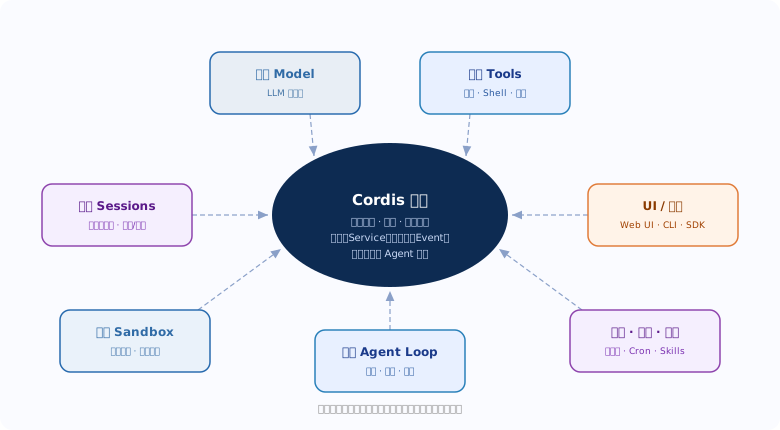
The key mechanism that realizes this architecture at runtime isProfile + Bundle: a running dsh is a plugin tree composed of layers stacked in sequence at startup — first each composition package is applied in the order listed by the profile, then the profile'scordis.patch.yml, home-level patch, and finally arbitrary--patchoverlay. Use one command to view the full configuration tree actually launched on the machine:
dsh --profile web --dump-config # Any printed entries can be replaced by your own patchFour operating modes
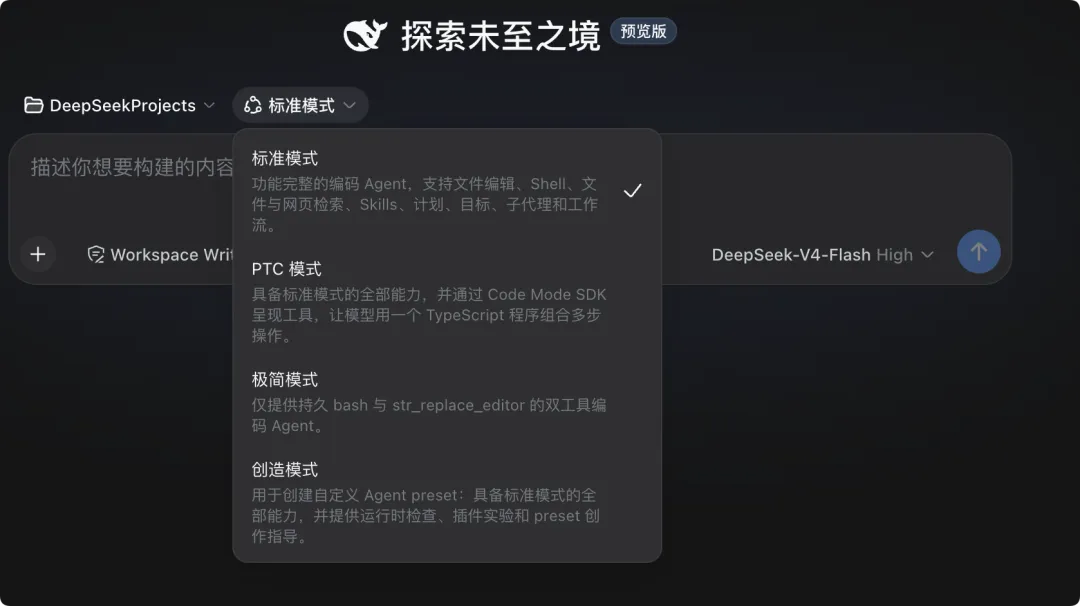
DeepSeek Harness provides four running modes out of the box, covering the full spectrum from a complete coding Agent to minimalized benchmark tests:
| Mode | Positioning | Capability composition |
|---|---|---|
| Standard mode | Feature-complete coding Agent | File editing, Shell, file and web retrieval, Skills, plans, goals, subagents, and workflows |
| PTC mode | Code composition tool calls | It has all capabilities of the standard mode, and exposes tools through the Code Mode SDK—letting the model combine multi-step operations with a single TypeScript program. |
| Minimalist mode | Minimized benchmark testing | Retains only persistent bash andstr_replace_editorTwo tools for evaluating models in minimal environments. |
| Creative mode | Custom Agent preset | Possesses all capabilities of the standard mode, and provides runtime checks, plugin experimentation, and preset creation guidance — combine to create your own new modes. |
Core features
Feature 1: Every run leaves a trace
Everything the model sees is written toAppend-only (append-only) designthe session logs: system prompts, chain of thought, tool calls and results, sub-Agent scheduling, every context injection — all persisted to disk. InTrajectory Viewcan be viewed by source; recovery, forking (fork), retrieval, and replay share the same event stream—every step of an Agent is traceable and reproducible.
Feature 2: Multi-form usage, run anywhere
Web UI(defaulthttp://127.0.0.1:3080) provides a complete graphical interface;headlessmode runs a task once, prints the final answer and exits, suitable for scripts and CI; also CLI and officialPython SDK(pip install deepseek-harness-sdk, comes with its own runtime, no system Node.js required) and TypeScript SDK, to embed Agents into any workflow.
Feature three: open and controllable, no privileged kernel
MIT open source, no privileged kernel requiring patches: all capability registrations are reversible side effects, revoked when the plugin is unloaded. Configuration is layered via profiles, composition packages, and patches,--dump-configthe entire configuration tree can be reviewed at any time —Your Agent is whatever you want it to be.
Feature four: model-agnostic, plug-and-play
Fill in the DeepSeek API key to use it. It also supports other providers and custom OpenAI-compatible endpoints; model routing does not require a server restart. The event-driven extension-point system (session/Agent/capability three-level events) lets developers mount policies and adapters, swapping models, tools, and storage at any time.
Quick start
After installing Node.js, start the Web UI with one command:
npx @deepseek-ai/dsh web
You can also install from source:
git clone https://github.com/deepseek-ai/deepseek-harness.git
cd deepseek-harness
pnpm install
pnpm run build
pnpm dsh web
Using the Web UI requires only three steps:
| Steps | Operation | Description |
|---|---|---|
| 1 | Configuration model | Open Settings → Models, fill in your DeepSeek API key and save. Model routing is immediately available without a restart. |
| 2 | Select workspace | Add and select the project directory where dsh was started (the session input box is unavailable before selection) |
| 3 | Run task | Send something like "Summarize this repository" — the agent reads/writes files, runs commands, delegates to sub-agents; operations that exceed permission policies will first ask for your approval |
Relationship between the Harness and related tools
DeepSeek Harness is not just another "library for writing a few agents", but ratherA complete layer above SDKs and frameworks, solving "how Agents can run reliably". Positioning differences from currently popular tools:
| Project | Positioning | Relationship with DeepSeek Harness |
|---|---|---|
| Claude Code | Closed-source commercial coding assistant | Feature parity, but dsh is fully open-source, self-hostable, and has replaceable capabilities. |
| Hermes Agent | Self-Evolving Personal Agent (Nous Research) | It focuses on cross-session memory and skill accumulation; dsh focuses on plugin-based composition and full observability—the two concepts are complementary. |
| OpenClaw | Local-first message-based Agent | It focuses on multi-channel access and digital sovereignty; dsh provides Web UI / headless / SDK multi-form support. |
| LangGraph / AutoGen / CrewAI | Agent building framework (programming library). | Frameworks solve "how to build"; dsh is a complete Harness — "how to run stably + how to replace capabilities" |